Facts about Iceland
Capital Reykjavik · Europe
10 topics · 20 lessons · about 20 minutes
Iceland is a volcanic island in the North Atlantic with about 390,000 residents, making it the most sparsely populated country in Europe. It sits directly on the boundary between two tectonic plates, which gives it active volcanoes, abundant geothermal energy and a landscape still visibly under construction.
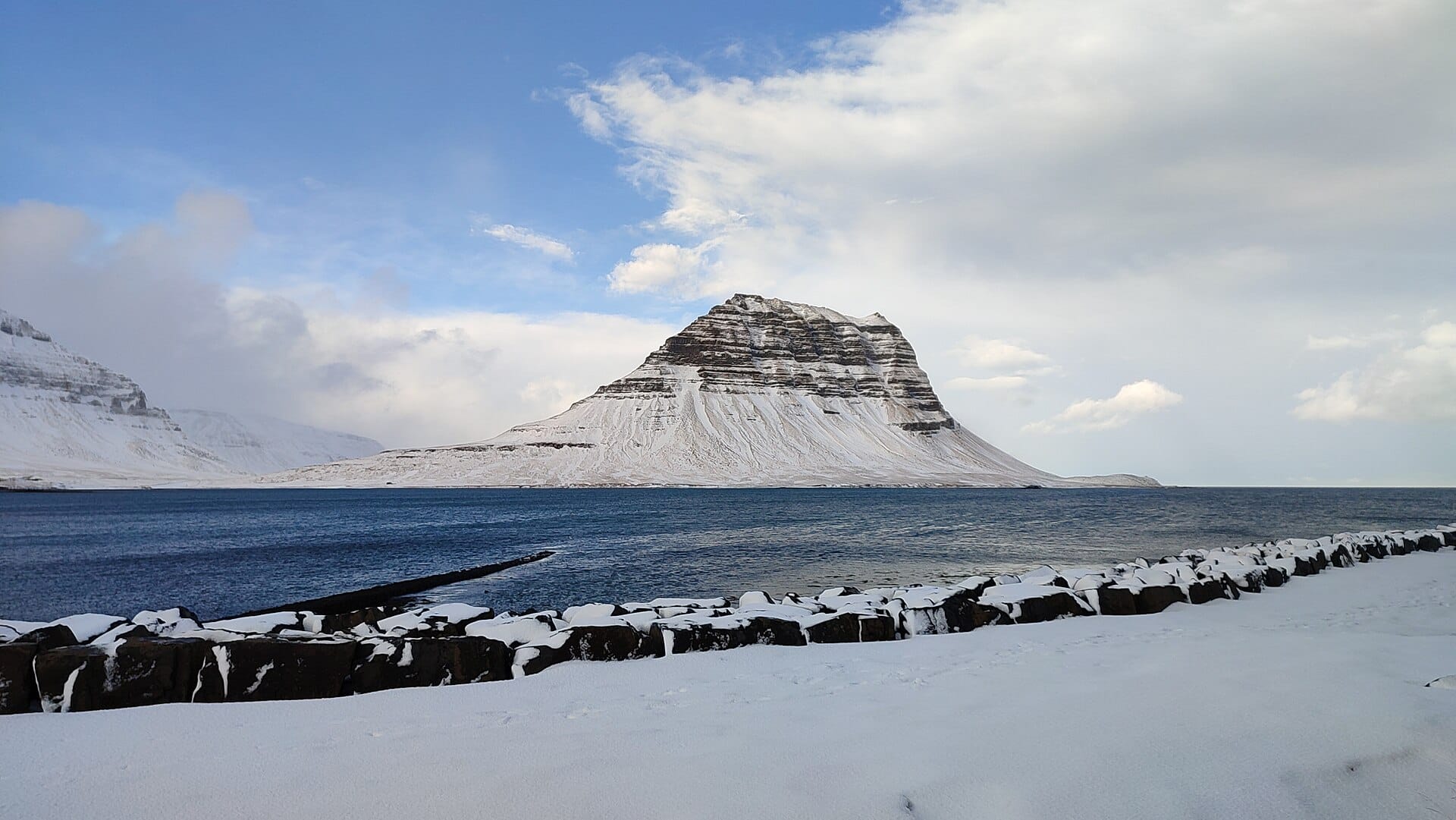
Iceland is a single volcanic island of about 103,000 square kilometers, divided into eight regions but organized in practice around one road, the Ring Road that circles the coast. The interior is an uninhabitable highland desert of lava field, glacier and black sand, so almost everyone lives on that coastal ring. The island sits directly on the Mid-Atlantic Ridge where two tectonic plates pull apart, which is why it carries roughly 130 volcanoes and enough geothermal heat to warm nearly every building in the country.
Reykjavík and the towns around it hold about 64 percent of the population, so for all that empty land the country is a highly urban one. Akureyri in the north is the only other town of real size. Visitors, who now outnumber residents several times over each year, mostly drive the Golden Circle to Þingvellir, Geysir and Gullfoss, then continue along the south coast to the black sand beaches and the glacier lagoon at Jökulsárlón, or come in winter for whatever stretch of sky is clearest.
- Population
- 390,000
- Area
- 103,000 km²
- Currency
- Icelandic króna (kr)
- Official language
- Icelandic
- Regions
- 8
- Highest point
- Hvannadalshnúkur, 2,110 m
The Iceland course
Geography of Iceland2 lessons
An island pulled apart at two centimeters a year, with about 130 volcanoes to show for it.
History of Iceland2 lessons
Settled around 874, the oldest surviving parliament in the world, and independence in 1944.
Language of Iceland2 lessons
Barely changed in a thousand years, and it coins new words rather than borrowing them.
Culture of Iceland2 lessons
More books read per person than almost anywhere, and a Christmas Eve spent reading them.
Economy of Iceland2 lessons
Electricity entirely renewable, fishing under quota, and tourism that arrived all at once.
Politics of Iceland2 lessons
No army, the first elected woman head of state, and a decade at the top of the gender gap index.
Nature & Wildlife of Iceland2 lessons
One native land mammal, most of the world’s puffins, and whales now worth more than whaling.
Food & Cuisine of Iceland2 lessons
Preserving where nothing grew, skyr since settlement, and a fermented shark visitors get dared to try.
Landmarks of Iceland2 lessons
A rift valley where two continents separate, the spring that named the geyser, and the Blue Lagoon.
People & Society of Iceland2 lessons
390,000 residents, most around Reykjavík, and genealogies complete enough for genetic research.
Geography of Iceland
Iceland straddles the Mid-Atlantic Ridge, where the North American and Eurasian plates pull apart at roughly two centimeters a year, so the island is slowly widening. That position produces around 130 volcanoes, of which some 30 systems remain active, and eruptions on the Reykjanes peninsula have been frequent since 2021.
Glaciers cover about 11 percent of the country, and Vatnajökull is the largest ice cap in Europe by volume. The interior is an uninhabitable highland desert of lava field and black sand, so nearly everyone lives on the coastal ring. Despite the name, the Gulf Stream keeps Icelandic winters milder than those of New York, and the country sits just below the Arctic Circle.

History of Iceland
Norse settlers arrived around 874, and in 930 they founded the Althing at Þingvellir, generally regarded as the oldest surviving parliament in the world. The sagas written down in the 13th century record that period and remain the foundation of Icelandic literature.
Iceland came under Norwegian and then Danish rule, enduring centuries of poverty worsened by the Laki eruption of 1783, which killed roughly a fifth of the population and disrupted weather across Europe. Home rule came in 1904, and full independence was declared on 17 June 1944 while Denmark was under German occupation. The 2008 banking collapse hit Iceland harder than any other country relative to its size.

Language of Iceland
Icelandic has changed remarkably little in a thousand years, so modern speakers can read the medieval sagas with far less difficulty than an English speaker reads Chaucer. That conservatism is partly geographic isolation and partly deliberate policy.
Rather than borrowing international words, Icelandic coins new ones from native roots, so a computer is a tölva, joining the words for number and prophetess. A naming committee rules on whether new personal names fit the grammar. Icelanders also use patronymics instead of family names, so a son of Jón is Jónsson and a daughter is Jónsdóttir, and the phone book is alphabetised by first name.

Culture of Iceland
Iceland publishes and reads more books per person than almost any other country, and the pre-Christmas flood of new titles, the jólabókaflóð, ends with books exchanged on Christmas Eve and read that night. The saga tradition gives literature unusual cultural standing.
Music carries the country abroad through Björk, Sigur Rós and Of Monsters and Men, an improbable output for a population smaller than most European cities. Surveys regularly find a large minority unwilling to rule out the existence of the huldufólk, the hidden people of folklore, and construction projects have occasionally been rerouted around rocks said to be theirs.
Economy of Iceland
Nearly all of Iceland’s electricity and heating comes from renewable sources, split between hydropower and geothermal energy drawn straight from the volcanic ground. Cheap, clean power attracted energy-intensive aluminium smelting and, more recently, data centers.
Fishing built the modern economy and still supplies a large share of goods exports, managed under a quota system introduced to prevent stock collapse. Tourism grew explosively after the 2010 Eyjafjallajökull eruption put the country on the world’s screens, and visitor numbers now run several times the resident population each year. That concentration leaves a small economy exposed when any one sector stumbles.

Politics of Iceland
Iceland is a parliamentary republic with a directly elected president whose role is largely ceremonial, though the office can refer legislation to a referendum, a power used during the banking crisis. The prime minister leads the government.
The Althing has 63 members elected proportionally, and coalitions are always required. Iceland has no standing army and relies on a 1951 defense agreement with the United States alongside NATO membership. It ranks first in the World Economic Forum gender gap index and has done for well over a decade, having elected the world’s first democratically chosen woman head of state, Vigdís Finnbogadóttir, in 1980.

Nature & Wildlife of Iceland
The Arctic fox is the only land mammal that reached Iceland without human help, arriving over sea ice at the end of the last ice age. Reindeer, mink and mice all came later with settlers or ships.
Birdlife is the real spectacle, and Iceland holds around 60 percent of the world’s Atlantic puffins, nesting in vast cliff colonies each summer. The surrounding waters support humpback, minke and blue whales, and whale watching now earns considerably more than whaling. Þingvellir sits in the rift valley where the two plates separate, and visitors can dive the Silfra fissure between them in glacial meltwater.

Food & Cuisine of Iceland
Icelandic cooking grew out of preserving food where almost nothing could be grown, so drying, smoking, salting and fermenting run through the traditional dishes. Skyr, a thick cultured dairy product closer to strained cheese than yoghurt, has been made here since settlement and is now sold worldwide.
Lamb from sheep that graze wild on highland pasture is the signature meat, and geothermal greenhouses supply tomatoes and cucumbers year-round. The dish visitors are always dared to try is hákarl, fermented Greenland shark, which is genuinely pungent. Hot dogs from a Reykjavík stand are the more honest national favorite.

Landmarks of Iceland
Þingvellir is where the Althing met from 930 and where the continental plates visibly pull apart, making it both the political birthplace of Iceland and a geological showpiece. It carries UNESCO World Heritage listing.
The Golden Circle route links it with the Geysir hot spring area, which gave the English language the word geyser, and Gullfoss, a two-tiered waterfall dropping into a canyon. Elsewhere the Blue Lagoon draws bathers to mineral-rich water beside a geothermal plant, Jökulsárlón fills with icebergs calving from a glacier tongue, and the black sand beach at Reynisfjara sits under basalt columns.

People & Society of Iceland
Iceland has roughly 390,000 residents, about 64 percent of them in the Reykjavík capital area, which makes it both the least densely populated country in Europe and a highly urbanised one. Life expectancy is among the highest in the world.
The population descends largely from Norse settlers and from people taken from Ireland and Scotland, and its genealogical records are complete enough that most Icelanders can trace their ancestry back a thousand years. That database has made the country valuable for genetic research. Immigration has risen quickly, and around 18 percent of residents now hold foreign citizenship, with Poles the largest group.

Reading is one thing, recall is another. Play the Iceland challenge to test what stuck. The lessons on all ten topics are open too, and a free account is what keeps your progress across them.