Facts about Ireland
Capital Dublin · Europe
10 topics · 20 lessons · about 20 minutes
Ireland occupies most of an island shared with Northern Ireland, which remains part of the United Kingdom. It went from one of the poorest countries in western Europe to one of the wealthiest within a generation, and its literary output and emigrant diaspora give it cultural reach far beyond a population of five million.
The republic is administered as 26 counties across four historic provinces. The island is shaped roughly like a saucer, with a low central plain of bog and farmland ringed by coastal hills and mountains, and the highest point reaches only 1,038 meters. The Atlantic and the Gulf Stream give it a mild, wet climate with little temperature range across the year, which is why grass grows nearly all year and the countryside earned the name the Emerald Isle.
Dublin on the east coast holds well over a third of the population along with the multinational offices that reshaped the economy. Cork is the southern counterweight, Galway faces the Atlantic as the cultural capital of the west, and Limerick and Waterford anchor their own regions. Most visitors work along the Wild Atlantic Way, the 2,500-kilometer coastal route from Cork to Donegal that takes in the Cliffs of Moher, the Burren and Connemara, with Dublin and the prehistoric Boyne Valley at the other end of the trip.
- Population
- 5.3 million
- Area
- 70,273 km²
- Currency
- Euro (€)
- Official languages
- Irish and English
- Counties
- 26
- Highest point
- Carrauntoohil, 1,038 m
The Ireland course
Geography of Ireland2 lessons
A saucer of bog and farmland ringed by coastal hills, green because it is never dry.
History of Ireland2 lessons
Monastic scholarship, a famine that cut the population by a quarter, and partition in 1922.
Language of Ireland2 lessons
First official language of the state, though English is what almost everyone actually speaks.
Culture of Ireland2 lessons
Four Nobel laureates from five million people, pub sessions, and hurling by parish and county.
Economy of Ireland2 lessons
A 12.5 percent tax rate that drew the tech giants, and medicine exports at global scale.
Politics of Ireland2 lessons
Single transferable vote, referendums that changed the constitution, and military neutrality.
Nature & Wildlife of Ireland2 lessons
No native snakes, forest rebuilt from one percent, and Arctic and Mediterranean plants side by side.
Food & Cuisine of Ireland2 lessons
Dairy, beef and the potato whose failure caused the famine, plus Guinness since 1759.
Landmarks of Ireland2 lessons
Cliffs rising 214 meters, a passage tomb older than the pyramids, and a monastery on a sea rock.
People & Society of Ireland2 lessons
The fastest growing country in the EU, with a diaspora many times the size of the country.
Geography of Ireland
Ireland is shaped roughly like a saucer, with a low central plain of bog and farmland ringed by coastal hills and mountains. The highest point, Carrauntoohil in County Kerry, reaches only 1,038 meters, and the Shannon is the longest river in either Britain or Ireland at about 360 kilometers.
The Atlantic and the Gulf Stream give the island a mild, wet maritime climate with little temperature range across the year, which is why grass grows nearly year-round and the countryside earned the name the Emerald Isle. Peat bogs cover a substantial area and preserved everything from ancient roadways to bog butter for thousands of years.

History of Ireland
Celtic society and later Christian monasteries made early medieval Ireland a center of learning, producing manuscripts such as the Book of Kells while much of Europe was less settled. Viking raiders founded Dublin and other ports, and Anglo-Norman intervention from 1169 began centuries of English involvement.
The Great Famine from 1845 to 1852 killed around a million people and drove a million more to emigrate, cutting the population by roughly a quarter and reshaping Irish politics permanently. The Easter Rising of 1916 and the war that followed produced the Irish Free State in 1922, with six northern counties remaining in the United Kingdom. The Troubles ran from the late 1960s until the Good Friday Agreement of 1998.

Language of Ireland
Irish is a Celtic language and the first official language of the state, with English as the second, though English is what almost everyone speaks day to day. Around 1.9 million people report some ability in Irish, while daily speakers outside the education system number in the tens of thousands.
Native-speaking regions along the western seaboard are called the Gaeltacht and receive dedicated state support. The language has verb-subject-object word order, which is rare worldwide, and mutates the initial consonants of words to mark grammar. Hiberno-English carries clear Irish influence in its grammar, including constructions such as being after doing something to mean having just done it.

Culture of Ireland
Ireland has produced four Nobel laureates in literature, with Yeats, Shaw, Beckett and Heaney between them, and Joyce’s Ulysses is set across a single Dublin day now marked annually as Bloomsday. That density of writers from so small a population is the country’s most striking cultural fact.
Traditional music built around the fiddle, tin whistle, uilleann pipes and bodhrán is still played informally in pub sessions rather than staged concerts. Gaelic games, particularly hurling and Gaelic football, are amateur sports organized by parish and county, and hurling is among the oldest field games in the world. Saint Patrick’s Day is celebrated more widely abroad than any other national day.

Economy of Ireland
Ireland transformed itself from the 1990s through the Celtic Tiger boom, drawing foreign investment with a 12.5 percent corporate tax rate, an English-speaking workforce and access to the EU single market. Apple, Google, Meta, Pfizer and Intel all run substantial operations there.
Pharmaceuticals and medical devices dominate goods exports, and Ireland is among the largest exporters of medicines in the world. Headline GDP figures are distorted upward by multinational accounting, so Irish statisticians publish modified gross national income to measure the domestic economy more accurately. The 2008 banking collapse required an EU and IMF bailout, and housing shortage is now the sharpest domestic issue.

Politics of Ireland
Ireland is a parliamentary republic under the 1937 constitution. The president is directly elected for a seven-year term and holds mostly ceremonial powers, while the taoiseach leads the government and answers to the Dáil, the lower house of the Oireachtas.
Elections use the single transferable vote in multi-seat constituencies, a system that produces proportional outcomes and rewards local reputation. Referendums are required to amend the constitution, and Irish voters have used them to legalise divorce in 1995, approve same-sex marriage in 2015 and repeal the abortion ban in 2018. Ireland has been militarily neutral since the Second World War and remains outside NATO.

Nature & Wildlife of Ireland
Ireland has relatively few native land mammals because the land bridge to Britain flooded early after the last ice age, and it famously has no native snakes, a fact folklore credited to Saint Patrick. Forest cover fell to around one percent by the early 1900s and has since been rebuilt to about 11 percent, mostly through commercial conifer planting.
The Atlantic coast supports large seabird colonies, including puffins and gannets on the Skellig islands, and basking sharks, whales and dolphins pass through in summer. The Burren in County Clare is a limestone pavement where Arctic, Mediterranean and Alpine plants grow side by side, a combination found almost nowhere else.
Food & Cuisine of Ireland
Irish cooking rests on dairy, beef, lamb, seafood and the potato, which arrived in the 16th century and became so central that its failure caused the famine. Irish butter and cheese are significant exports, helped by cattle that graze outdoors most of the year.
Traditional dishes include Irish stew, colcannon of potato and cabbage, boxty pancakes and soda bread leavened with buttermilk rather than yeast. Guinness has been brewed in Dublin since 1759 and is the best-known Irish product worldwide, while whiskey distilling has grown from a handful of producers in the 1980s to more than forty today.

Landmarks of Ireland
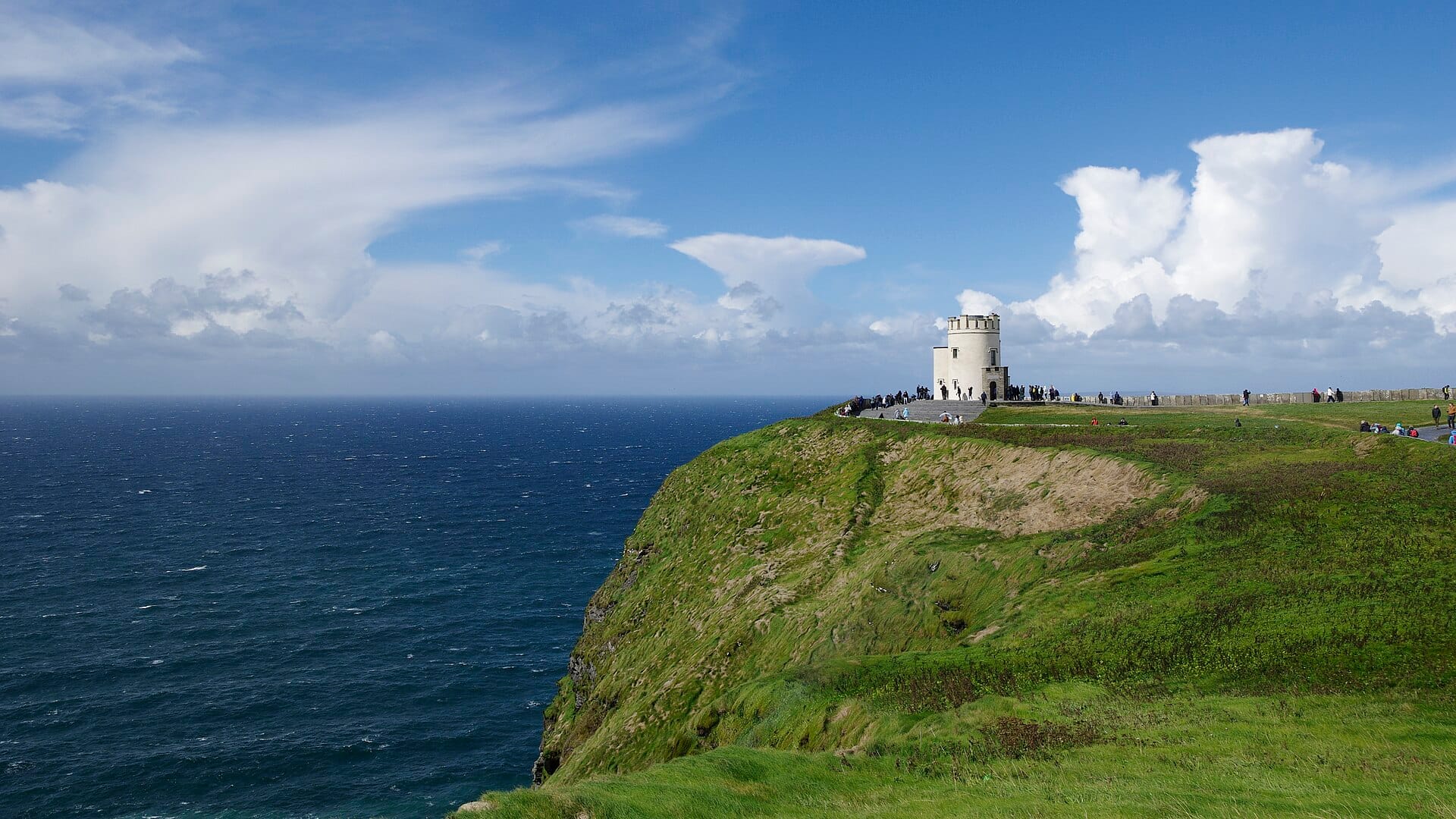
The Cliffs of Moher run about 14 kilometers along the Clare coast and rise to 214 meters at their highest, drawing well over a million visitors a year. Further north, the Wild Atlantic Way threads 2,500 kilometers of coastal road from Cork to Donegal.
Newgrange in the Boyne Valley is a passage tomb built around 3200 BC, older than Stonehenge and the pyramids, and aligned so that the winter solstice sunrise lights its inner chamber. Trinity College Dublin holds the illuminated Book of Kells, the Rock of Cashel crowns a limestone outcrop in Tipperary, and Skellig Michael carries a monastic settlement clinging to rock eleven kilometers offshore.

People & Society of Ireland
Ireland has about 5.3 million residents, and the population only recently passed its pre-famine peak of roughly 6.5 million on the island as a whole. It is now the fastest growing country in the EU, driven by immigration and a fertility rate that remains higher than most European neighbors.
The Irish diaspora is enormous, with around 32 million Americans claiming Irish ancestry alongside large communities in Britain, Australia and Canada. Roughly 20 percent of current residents were born abroad, with Polish, British, Indian and Ukrainian the largest groups. Catholic affiliation has fallen from over 90 percent in 1991 to about 69 percent, one of the fastest religious shifts in Europe.

Reading is one thing, recall is another. Play the Ireland challenge to test what stuck. The lessons on all ten topics are open too, and a free account is what keeps your progress across them.