Facts about Hungary
Capital Budapest · Europe
10 topics · 20 lessons · about 20 minutes
Hungary sits in the Carpathian Basin at the center of Europe, a flat, landlocked country whose language is unrelated to those of any of its seven neighbors. Once the eastern half of Austria-Hungary, it lost two thirds of its territory after the First World War, a fact that still shapes its politics, and today it is a member of both NATO and the European Union.
Most of the country is plain. The Great Hungarian Plain east of the Danube covers more than half the territory and is the largest area of steppe grassland left in Europe, while the Transdanubian hills roll west of the river toward Austria. The Danube cuts north to south through the middle, the Tisza runs parallel further east, and Lake Balaton in the west is the largest lake in central Europe and the country’s substitute for a coast.
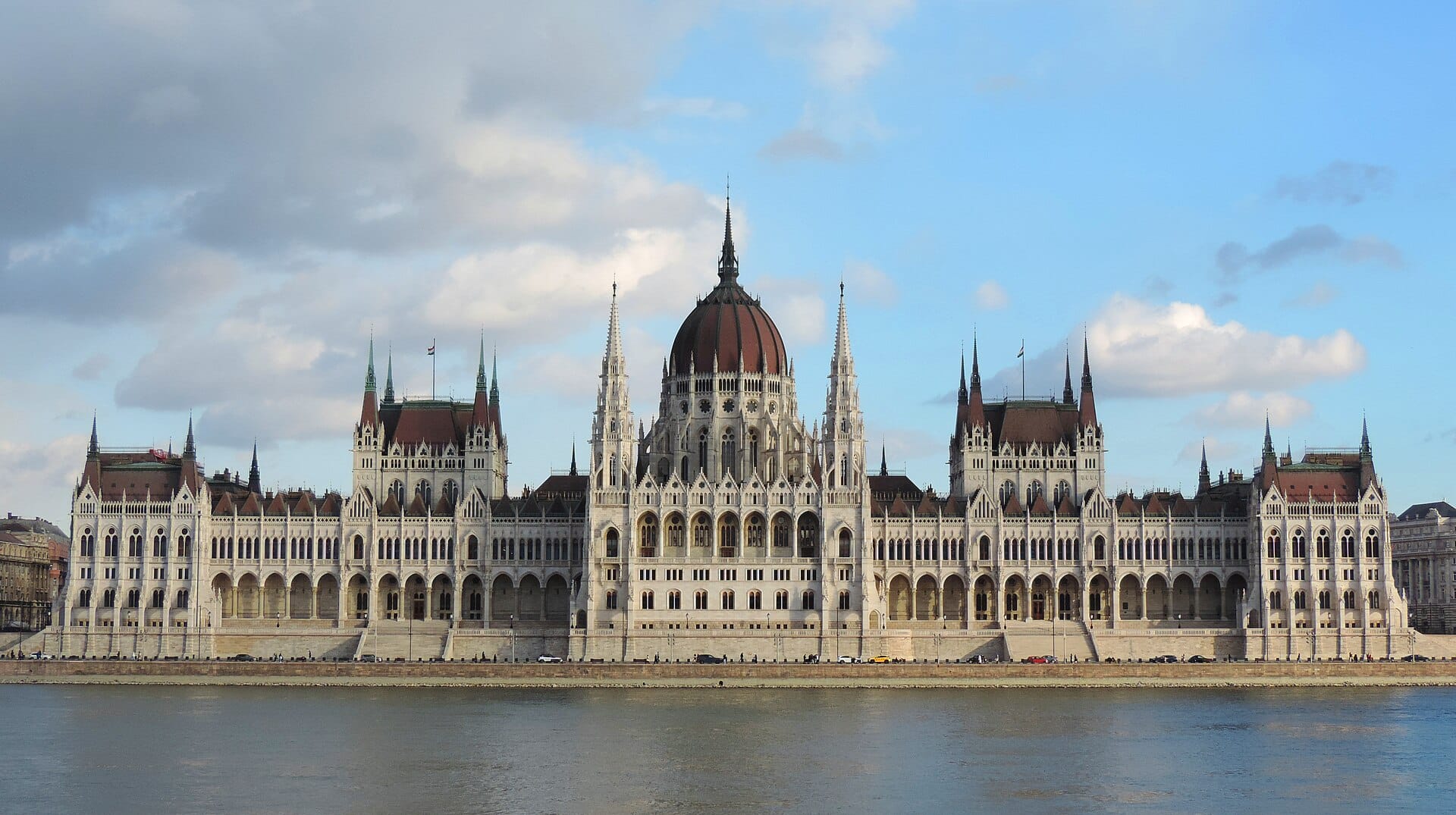
Budapest, formed in 1873 by joining hilly Buda on the west bank to flat Pest on the east, holds nearly a fifth of the population and dominates national life. Debrecen is the main city of the eastern plain, Szeged sits on the Tisza near the Serbian border, and Pécs in the south preserves Ottoman-era buildings. Visitors come for Budapest’s thermal baths and parliament, the Balaton shore in summer, and the Tokaj wine region in the northeast.
- Population
- 9.6 million
- Area
- 93,030 km²
- Capital
- Budapest
- Currency
- Forint (HUF)
- Official language
- Hungarian
- Highest point
- Kékes, 1,014 m
The Hungary course
Geography of Hungary2 lessons
Europe’s largest surviving steppe, a lake that stands in for the sea, and no mountain over 1,100 meters.
History of Hungary2 lessons
Magyar horsemen in 895, a dual monarchy, and a treaty that cut the country to a third of its size.
Language of Hungary2 lessons
Eighteen cases, no grammatical gender, and no close relatives anywhere nearby.
Culture of Hungary2 lessons
Thermal baths as social life, Liszt and Bartók, and a remarkable run of Nobel laureates.
Economy of Hungary2 lessons
Car plants, pharmaceuticals and a currency that keeps the euro at arm’s length.
Politics of Hungary2 lessons
A unicameral parliament, a two-thirds majority, and a long argument with Brussels.
Nature & Wildlife of Hungary2 lessons
Grey cattle and racka sheep on the puszta, and cranes stopping over by the tens of thousands.
Food & Cuisine of Hungary2 lessons
Paprika in almost everything, and a goulash that is a soup rather than a stew.
Landmarks of Hungary2 lessons
The third largest parliament in the world, and the first underground railway in continental Europe.
People & Society of Hungary2 lessons
A shrinking population at home, and several million Hungarian speakers across the borders.
Geography of Hungary
Hungary is landlocked in the Carpathian Basin, bordered by Slovakia, Ukraine, Romania, Serbia, Croatia, Slovenia and Austria. It is one of the flattest countries in Europe: the highest point, Kékes in the Mátra hills, reaches only 1,014 meters, and the Great Plain east of the Danube is a vast, almost level expanse.
The Danube crosses the country from north to south, turning sharply at the Danube Bend above Budapest, and the Tisza drains the eastern plain. Lake Balaton covers 592 square kilometers and is shallow enough to warm quickly in summer. The country sits on one of the richest geothermal reserves in the world, feeding more than a thousand hot springs and the bath culture built on them.

History of Hungary
Magyar tribes led by Árpád settled the Carpathian Basin around 895, and Stephen I was crowned a Christian king in 1000, an event Hungarians date the state from. The Mongols devastated the kingdom in 1241, and Ottoman victory at Mohács in 1526 split it three ways for a century and a half before Habsburg rule replaced Ottoman.
The 1848 revolution failed, but the 1867 compromise created the dual monarchy of Austria-Hungary. The Treaty of Trianon in 1920 reduced Hungary to about a third of its former territory and left large Hungarian minorities in neighboring states, a grievance that persists in national politics. The 1956 uprising against Soviet control was crushed by force, and communist rule ended in 1989 as Hungary opened its border with Austria.

Language of Hungary
Hungarian is a Uralic language, distantly related to Finnish and Estonian and to the Khanty and Mansi languages of Siberia, and completely unrelated to the Slavic, Germanic and Romance languages that surround it. It is spoken by around 13 million people, roughly 9.6 million of them in Hungary and the rest in neighboring countries and the diaspora.
The grammar is agglutinative: suffixes stack onto word stems to express what other languages do with prepositions, giving somewhere between 18 and 25 cases depending on how they are counted. Vowel harmony decides which form a suffix takes, there is no grammatical gender and no verb for possession, and stress falls invariably on the first syllable.

Culture of Hungary
Thermal bathing is central to daily life, with Budapest alone running dozens of bath complexes including the Ottoman-era Rudas and the vast neo-baroque Széchenyi, where men play chess in the outdoor pool through the winter. Café culture in the capital produced a literary scene that survives in the surviving grand coffee houses.
Franz Liszt, Béla Bartók and Zoltán Kodály shaped both concert music and the systematic collection of folk song, and Kodály’s method is still used to teach music worldwide. Hungary has produced an outsized number of Nobel laureates and mathematicians relative to its size, and the folk dance revival of the táncház movement keeps village repertoires in active use.

Economy of Hungary
Hungary runs an open, export-led economy dominated by vehicle manufacturing, with Audi at Győr, Mercedes at Kecskemét, Suzuki at Esztergom and a BMW plant at Debrecen, plus a large electronics and battery sector supplying the European car industry. Pharmaceuticals, led by Gedeon Richter, are a long-standing strength.
The country retains the forint and has no timetable for adopting the euro. Growth relies heavily on foreign direct investment and European Union transfers, and disputes with Brussels over rule-of-law conditions have repeatedly held up those funds. Agriculture remains significant on the plain, particularly maize, wheat, sunflower and paprika, and Tokaji is the best known of the wine exports.

Politics of Hungary
Hungary is a parliamentary republic with a single 199-seat National Assembly elected through a mixed system of constituency and list seats, and a president chosen by parliament as head of state. Governing parties holding two thirds of the seats can amend the constitution alone, which is what happened after 2010 when Fidesz used that majority to write a new constitution in 2011.
The country joined NATO in 1999 and the European Union in 2004. Successive disputes over judicial independence, media ownership, academic freedom and asylum policy have led to Article 7 proceedings and the suspension of some EU funding, and Hungary has taken a distinctive line within the bloc on relations with Russia and China.
Nature & Wildlife of Hungary
Hortobágy on the Great Plain is the oldest and largest national park in Hungary and a World Heritage Site, protecting the puszta grassland along with the pastoral traditions that go with it: Hungarian grey cattle, racka sheep with spiral horns, and mounted herdsmen. Its fishponds and marshes make it one of the best bird sites in Europe.
Tens of thousands of common cranes stop at Hortobágy on migration each autumn, and great bustards, among the heaviest flying birds in the world, survive on the plains. Aggtelek in the north holds the Baradla cave system, shared with Slovakia and listed by UNESCO, and the Kis-Balaton wetland beside Lake Balaton has been restored as a filter and bird reserve.

Food & Cuisine of Hungary
Paprika, ground from peppers brought via the Ottomans and grown around Szeged and Kalocsa, defines the cooking. Gulyás is properly a soup of beef, onion, potato and paprika cooked over a fire, while the thicker stew foreigners call goulash is closer to pörkölt, usually served with small egg dumplings called nokedli.
Halászlé, a fiery river fish soup, belongs to the Danube and Tisza towns, lángos is deep-fried dough with sour cream and cheese sold at markets and beaches, and dobos torte and chimney cake cover the sweet end. Tokaji Aszú, a botrytised sweet wine from the northeast, was prized at European courts long before the region was formally delimited in 1737.

Landmarks of Hungary
The Hungarian Parliament Building, completed in 1902 on the Pest bank of the Danube, is among the largest legislative buildings in the world, built in Gothic Revival style with a dome exactly 96 meters high, a number chosen for the Magyar arrival in 896. Across the river, Buda Castle and the Fisherman’s Bastion look back over the city, and the whole riverfront is a World Heritage Site.
The Chain Bridge of 1849 was the first permanent crossing between Buda and Pest, and the Millennium Underground beneath Andrássy Avenue, opened in 1896, was the first electrified underground railway on the European continent. Outside the capital, Eger’s castle and baroque center, Pécs’s Ottoman mosque turned church, and the abbey at Pannonhalma are the main draws.

People & Society of Hungary
Hungary has about 9.6 million residents, and the population has been falling since the early 1980s through low birth rates and emigration to western Europe. Governments have responded with large family subsidies, including income tax exemptions for mothers of several children, making natalist policy a central and openly stated aim of the state.
Roughly two million ethnic Hungarians live in neighboring countries, mainly Romania, Slovakia, Serbia and Ukraine, a legacy of Trianon; since 2010 they have been able to acquire Hungarian citizenship and vote. Roma are the largest minority within the country, and their social and educational exclusion remains the sharpest domestic inequality.

Reading is one thing, recall is another. Play the Hungary challenge to test what stuck. The lessons on all ten topics are open too, and a free account is what keeps your progress across them.