Facts about Georgia
Explore Georgia from Tbilisi’s balconies and Mtskheta’s churches to Kakheti’s vineyards, the Black Sea coast and the towers of Upper Svaneti. Learn the regions, cities and waters, locate sixteen sights and discover the history, food and everyday life behind them, then begin Georgian.
- Capital
- Tbilisi
- Population
- About 3.94 million, Jan 2026
- Currency
- Georgian lari (GEL)
- Main language
- Georgian
- Administrative units
- 9 regions, 2 autonomous republics + Tbilisi
- UNESCO World Heritage
- 4 properties
Georgia · 0 of 20 rounds passed
Two timed rounds per topic, 20 seconds a question
Georgia sits in the South Caucasus, where the Black Sea lowlands rise towards forested ranges and high mountain valleys. Tbilisi stands on the Mtkvari in the east; Kutaisi anchors Imereti in the west, and Batumi faces the sea in Adjara. Kakheti’s Alazani valley is known for vineyards, while the southern Javakheti plateau holds high lakes and Armenian-speaking communities.
This guide uses internationally recognised Georgian territory. Abkhazia and South Ossetia remain outside Georgian government control, and the learning maps do not depict current lines of control. The sights selection concentrates on other parts of the country. Mountain routes and heritage sites need their own access checks.
Geography of Georgia
Black Sea lowlands, two Caucasus ranges and rivers flowing towards different seas.
- Where is Georgia?
- In the South Caucasus, between the Black Sea and Russia, with Türkiye, Armenia and Azerbaijan to the south and east. This guide covers the country called Sakartvelo in Georgian.
- Do the Mtkvari and Rioni reach the same sea?
- No. The Rioni reaches the Black Sea. The Mtkvari, also called the Kura, continues through Azerbaijan towards the Caspian Sea.
- How many administrative units are on the map?
- Twelve: nine regions, two autonomous republics and Tbilisi. South Ossetia is not a separate thirteenth unit in this reference framework.
More about Georgia: geography
Georgia lies in the South Caucasus between the Black Sea and the mountains separating it from Russia. Türkiye and Armenia lie to the south and Azerbaijan to the east. Humid western lowlands contrast with the drier valleys and uplands of the east. The Greater Caucasus rises along the north, while the Lesser Caucasus and volcanic Javakheti plateau shape much of the south.
The Likhi Range separates the main western and eastern drainage basins. The Rioni passes through Kutaisi and reaches the Black Sea near Poti. The Mtkvari, also called the Kura, rises in Türkiye, crosses Georgia through Borjomi, Gori and Tbilisi, then continues through Azerbaijan towards the Caspian. Lake Paravani sits high on the southern Javakheti plateau.
The regional map teaches nine regions, two autonomous republics and the separate capital, Tbilisi. Abkhazia is included within internationally recognised Georgian territory. South Ossetia overlaps parts of the regional framework rather than forming a thirteenth unit in this map. Neither the polygons nor the city pins show present security control or accessible routes.
History of Georgia
Ancient Colchis and Iberia, medieval kingdoms and two modern declarations of independence.
- Was ancient Iberia in Spain?
- The name also described an eastern Georgian kingdom in the Caucasus. It is geographically separate from the Iberian Peninsula of Spain and Portugal.
- When did Georgia become independent?
- The first modern republic declared independence on 26 May 1918. Georgia restored independence from the Soviet Union on 9 April 1991.
- Who was Tamar?
- A medieval Georgian monarch whose reign, from 1184 to 1213, is associated with the kingdom’s Golden Age. Vardzia developed under Giorgi III and Tamar.
More about Georgia: history
Ancient Colchis lay in the west, while the kingdom known as Iberia occupied parts of eastern Georgia. This Caucasian Iberia is distinct from the Iberian Peninsula. Christianity became established in the eastern kingdom in the fourth century. Mtskheta’s monuments preserve important layers of the country’s early Christian and medieval history.
A unified medieval Georgian kingdom emerged around the beginning of the eleventh century. David IV and Tamar are associated with a period of political strength and cultural achievement in the twelfth and early thirteenth centuries. Gelati Monastery and Shota Rustaveli’s epic poem belong to this wider world. Later invasions and rival kingdoms preceded expanding Russian imperial rule.
Georgia declared an independent republic on 26 May 1918, but the Red Army invaded in 1921 and Soviet rule followed. Independence was restored on 9 April 1991. The post-Soviet decades brought wars, displacement, the 2003 Rose Revolution and the 2008 war with Russia. These events help explain why recognised borders and present control remain different questions.
Georgian and the languages of Georgia
Georgian belongs to the Kartvelian family and has a distinctive living writing tradition.
- What family does Georgian belong to?
- Kartvelian, alongside Mingrelian, Svan and Laz. Georgian is unrelated to Russian’s Slavic branch or Armenian’s Indo-European branch.
- How many letters does modern Georgian use?
- Modern Mkhedruli has 33 letters. Two older scripts, Asomtavruli and Nuskhuri, also retain religious and cultural uses.
- How do you say hello in Georgian?
- გამარჯობა, usually transliterated gamarjoba. მადლობა, madloba, means thank you. The Georgian lessons pair native spelling with pronunciation guidance.
More about Georgia: language
Georgian, called kartuli, belongs to the Kartvelian language family. It is not a Slavic, Turkic or Indo-European language. Other Kartvelian languages include Mingrelian, Svan and Laz; they should not simply be treated as regional accents of Georgian. Armenian, Azerbaijani, Abkhaz, Ossetian and other languages also belong to the country’s communities.
Modern Georgian normally uses Mkhedruli, with 33 letters. Asomtavruli and Nuskhuri remain important in religious and cultural settings. UNESCO recognises the living culture of these three writing systems. The earliest surviving Georgian inscriptions date to late antiquity, but a precise date for the alphabet’s invention is not securely established.
Georgian is the state language; the constitution also gives Abkhazian official status in the Autonomous Republic of Abkhazia. Start with გამარჯობა, gamarjoba, for hello, and მადლობა, madloba, for thank you. The linked lessons introduce standard Georgian with the script, pronunciation guidance and everyday situations. English or Russian knowledge varies between people and places.
Culture of Georgia
Polyphonic singing, regional dances and the art of bringing people around a table.
- What is Georgian polyphonic singing?
- Singing that combines independent vocal lines. Regional styles differ, and UNESCO recognises the tradition as intangible cultural heritage.
- What is a supra?
- A Georgian feast with shared dishes and a sequence of toasts. The tamada guides the toasting; customs vary by occasion and household.
- Who wrote The Knight in the Panther’s Skin?
- Shota Rustaveli, around the turn of the thirteenth century. The epic is a major work of Georgian literature.
More about Georgia: culture
Georgian polyphonic singing combines independent vocal lines. Regional styles differ: UNESCO describes Svan complex polyphony, Kakhetian dialogue over a bass and western traditions with contrasting parts. Songs accompany celebrations and other gatherings, while choirs and families pass repertoires between generations. A single number of voice parts does not explain every regional form.
A supra is a shared feast structured by food, conversation and toasts. A tamada guides the toasting, with the role depending on the occasion and the company. Hospitality is an important cultural ideal, but no visitor needs to assume that every household follows the same customs or that participation requires drinking alcohol.
Dance, poetry, church architecture, enamelwork and cinema offer other ways into Georgian culture. Shota Rustaveli’s The Knight in the Panther’s Skin remains a central literary work. Regional identities matter too: Svaneti’s towers, Gurian singing and Kakhetian wine traditions belong to particular communities as well as the wider national story.
Economy of Georgia
Services, wine, farming, hydropower and trade routes between the Black Sea and the Caspian.
- What currency does Georgia use?
- The Georgian lari, abbreviated GEL. One lari is divided into 100 tetri.
- Why are the Black Sea ports important?
- Poti and Batumi connect Georgia’s inland transport routes with shipping. They are part of wider road, rail and trade networks across the South Caucasus.
- Does a trade agreement make Georgia an EU member?
- No. Georgia’s EU trade agreement operates separately from membership. Its accession process came to a de facto halt in 2024.
More about Georgia: economy
Tbilisi is the main centre for business, administration and many services. Tourism connects mountain towns, wine-growing areas, heritage sites and the Black Sea coast. Farming supports rural livelihoods, with grapes especially associated with Kakheti and hazelnuts with western areas. Georgia’s economy also includes manufacturing, construction and mineral production.
The country’s position makes transport and logistics important. Poti and Batumi connect inland routes with Black Sea shipping, while roads, railways and pipelines link the South Caucasus with neighbouring markets. The Baku–Tbilisi–Ceyhan pipeline carries oil across Georgia towards Türkiye. Hydropower draws on mountain rivers, making energy planning closely connected to water and habitats.
The national currency is the Georgian lari, abbreviated GEL and divided into 100 tetri. Georgia has a Deep and Comprehensive Free Trade Area with the European Union under its Association Agreement. Trade arrangements and EU membership are separate matters. Older Doing Business rankings are historical measures from a discontinued World Bank series, rather than current league tables.
Politics of Georgia
Parliamentary institutions, contested political life and the gap between borders and control.
- Where does Georgia’s Parliament sit?
- In Tbilisi. Kutaisi housed Parliament for several years, but it is not the current seat.
- Is Georgia a parliamentary republic?
- Yes. The prime minister leads the government, which is accountable to Parliament. The president is the head of state.
- Is Georgia in the European Union?
- No. It received candidate status in December 2023. The Council of the EU reports that its accession process came to a de facto halt in 2024.
More about Georgia: politics
Georgia’s constitutional system is a parliamentary republic. The government is led by a prime minister and is accountable to Parliament; the president is head of state. Parliament sits in Tbilisi. A parliamentary building in Kutaisi served as the legislative seat for several years, which explains why older quiz material sometimes names the wrong city.
The constitution provides for a 150-member Parliament elected by proportional representation. Formal institutional design is distinct from how political rights work in practice. The European Union has criticised democratic backsliding, restrictions on civil society and violence against protesters. Georgia received EU candidate status in December 2023, but the Council of the EU says the accession process came to a de facto halt in 2024.
Abkhazia and South Ossetia are internationally recognised as part of Georgia and remain outside Georgian government control, with Russian military presence. This guide uses recognised Georgian territory for geographic learning. It does not mark administrative boundary lines of occupation. Check current official advice before considering travel near those areas.
Nature of Georgia
Colchic rainforests, peatlands, alpine valleys and volcanic plateau lakes.
- Does Georgia have rainforests?
- Yes. The Colchic forests in the humid west are temperate rainforests, with parts protected in a UNESCO World Heritage property alongside wetlands.
- Is all of Georgia’s landscape mountainous?
- No. It also has coastal lowlands, river valleys, agricultural plains and volcanic uplands. Elevation and rainfall create very different habitats.
- Where is Lake Paravani?
- On the Javakheti plateau in southern Georgia, in Samtskhe-Javakheti. Its outflow belongs to the Mtkvari drainage system.
More about Georgia: nature & wildlife
The Colchic Rainforests and Wetlands World Heritage property protects a series of western forest and wetland areas near the Black Sea. Its warm, humid climate helped ancient plant lineages survive cycles of climatic change. The inscription includes lowland peatlands and mountain forests rather than one continuous park.
Farther inland, mountain forests give way to alpine and subalpine habitats. Borjomi-Kharagauli protects wooded ridges in central Georgia, while the Greater Caucasus holds steep valleys, glaciers and high pastures. The Javakheti plateau has a very different landscape of open uplands and lakes, including Paravani, important to the country’s water geography.
Elevation and exposure change conditions over short distances. A photograph of a green valley cannot establish the weather on a mountain pass. Protected areas have their own route rules and conservation priorities; verify conditions with the relevant visitor centre. The generalised river and lake outlines on the learning map do not represent current flows or shorelines.
Food of Georgia
Khinkali, regional khachapuri, vegetables with walnuts and wine made in buried clay vessels.
- What is the difference between khinkali and khachapuri?
- Khinkali are pleated dumplings. Khachapuri is cheese-filled bread, with shapes and toppings that vary by region.
- What is pkhali?
- A preparation of vegetables mixed with seasoned ground walnuts and herbs. Different vegetables produce different colours and flavours.
- What is a qvevri?
- A large earthenware vessel buried in the ground and used for traditional wine-making. UNESCO inscribed the method in 2013.
More about Georgia: food & cuisine
Khachapuri is cheese-filled bread with distinct regional forms. Imeretian versions are usually round; Adjarian khachapuri is boat-shaped and commonly finished with egg and butter. Khinkali are pleated dumplings, often filled with seasoned meat and broth, though mushroom, potato and cheese versions also exist. Bite carefully to keep the hot broth from spilling.
Walnuts, herbs, beans and vegetables give Georgian cooking much of its range. Pkhali combines vegetables with a seasoned walnut mixture. Lobio is a family of bean dishes, while churchkhela is made by coating strings of nuts in thickened grape juice. Recipes vary between regions and households, and the same dish name can cover several preparations.
Qvevri are large earthenware vessels used in a traditional wine-making method recognised by UNESCO in 2013. They are buried in the ground for fermentation, storage and ageing. Kakheti is a major wine region, but western Georgia has its own grape varieties and methods. Archaeological evidence for early wine-making and the living qvevri tradition describe related but different kinds of evidence.
Landmarks of Georgia
Mtskheta’s churches, Gelati, Svan towers and rock-hewn settlements across the country.
- Is Bagrati Cathedral still part of the Gelati World Heritage inscription?
- No. Bagrati was removed in 2017. Gelati Monastery remains a World Heritage property.
- Are Vardzia and Uplistsikhe the same kind of site?
- Both are cut into rock, but their histories differ. Vardzia is chiefly a medieval monastic complex; Uplistsikhe is an ancient settlement with later layers.
- Where is Gergeti Trinity Church?
- Above Stepantsminda in Mtskheta-Mtianeti, beneath Mount Kazbek in the Greater Caucasus.
More about Georgia: landmarks
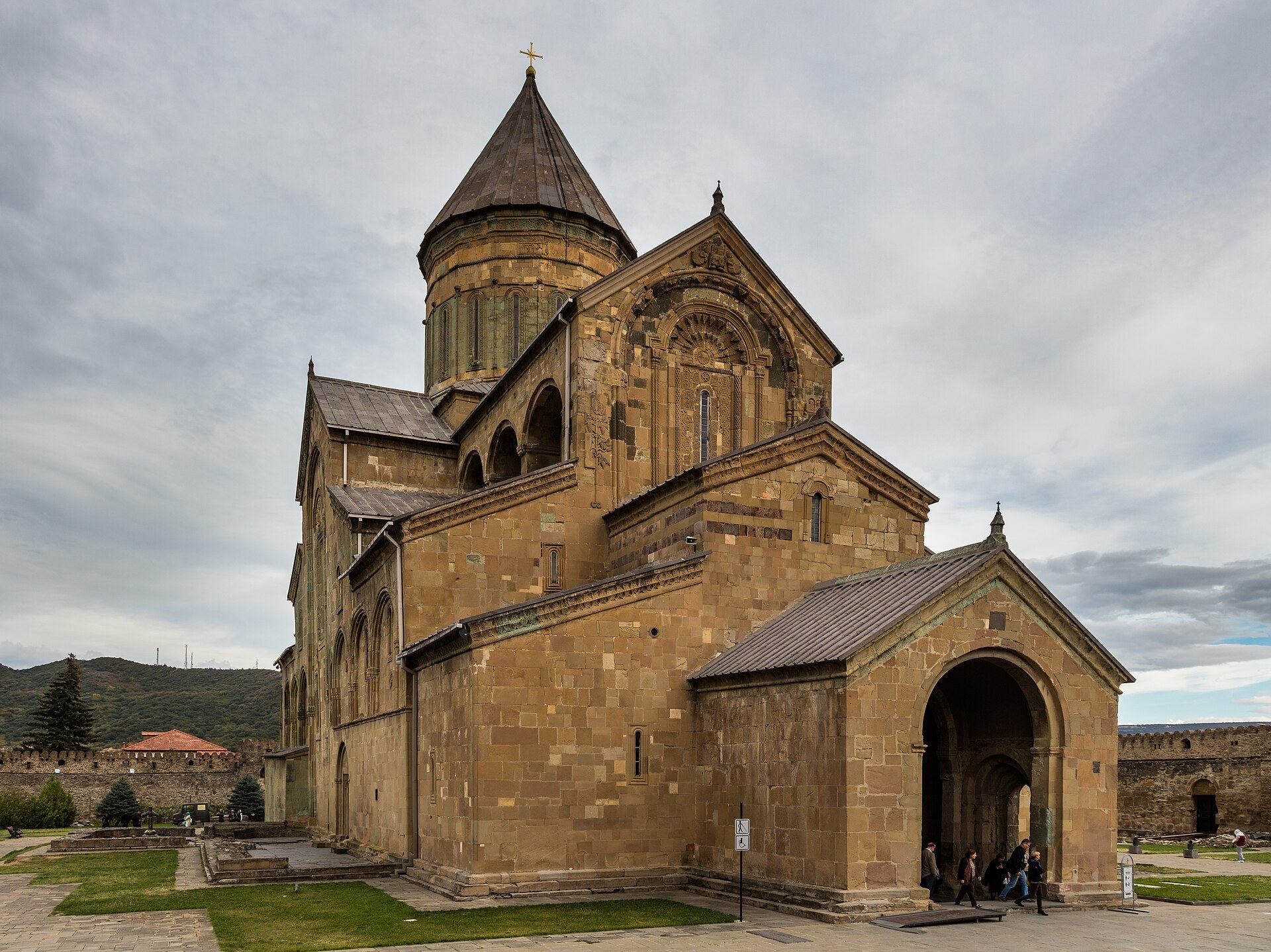
Mtskheta’s World Heritage monuments include Jvari Monastery, Svetitskhoveli Cathedral and Samtavro. Jvari stands above the confluence of the Aragvi and Mtkvari, while Svetitskhoveli anchors the town below. Near Kutaisi, Gelati Monastery combines medieval architecture, mosaics and painting. Bagrati Cathedral was removed from the shared World Heritage inscription in 2017; Gelati remains listed.
Upper Svaneti’s inscription centres on a mountain landscape of villages and defensive tower houses. Chazhashi, within the Ushguli community, is a representative place to locate it on the map. In the south, Vardzia is a medieval cave monastery, while Uplistsikhe near Gori is a much older rock-hewn settlement. Their similar rock-cut appearance should not hide their different histories.
Gergeti Trinity Church stands above Stepantsminda below Mount Kazbek. Tbilisi’s Narikala ridge and Abanotubani baths connect the capital’s terrain with its urban history. The sights selection includes these monuments alongside gardens, wetlands and wine-country streets. Large parks and serial heritage properties use representative pins rather than pretending to fit into one point.
People of Georgia
Sakartvelo is home to many communities, regional languages and a wide diaspora.
- What do Georgians call their country?
- Sakartvelo, written საქართველო in Georgian.
- What is Georgia’s population?
- Geostat estimates about 3.94 million on 1 January 2026. That statistical series excludes Abkhazia and the Tskhinvali region/South Ossetia.
- Does everyone in Georgia speak only Georgian?
- No. Georgian is the state language, but Armenian, Azerbaijani, Abkhaz, Ossetian and other languages are part of community life. Mingrelian and Svan are distinct Kartvelian languages.
More about Georgia: people & society
Georgians call their country Sakartvelo. Georgian identity includes strong regional affiliations, from Kakheti and Imereti to Samegrelo and Svaneti. Armenian and Azerbaijani communities have important histories, especially in parts of Samtskhe-Javakheti and Kvemo Kartli. Abkhaz, Ossetian, Kist, Jewish and other communities also belong to the country’s story.
Geostat’s revised estimate puts the population at about 3.94 million on 1 January 2026. Its population series excludes Abkhazia and the Tskhinvali region/South Ossetia, so the figure does not have the same territorial coverage as the guide’s recognised-boundary map. Census revisions mean that an older rounded total should not be compared with a newer one as though methodology were unchanged.
Tbilisi brings together people from across the country, while migration links Georgian families with communities abroad. Wars and displacement have reshaped many lives. Language, citizenship, ethnicity and religion describe different aspects of identity; none can reliably be inferred from someone’s town or surname. Georgian lessons are a starting point for conversation, not a substitute for learning how a person describes themselves.