Facts about Finland
Capital Helsinki · Europe
10 topics · 20 lessons · about 20 minutes
Finland is a heavily forested northern country of about 5.6 million people that spent centuries under Swedish and then Russian rule before declaring independence in 1917. It has since built a reputation on education, design and its welfare model, and it has topped the World Happiness Report every year since 2018.
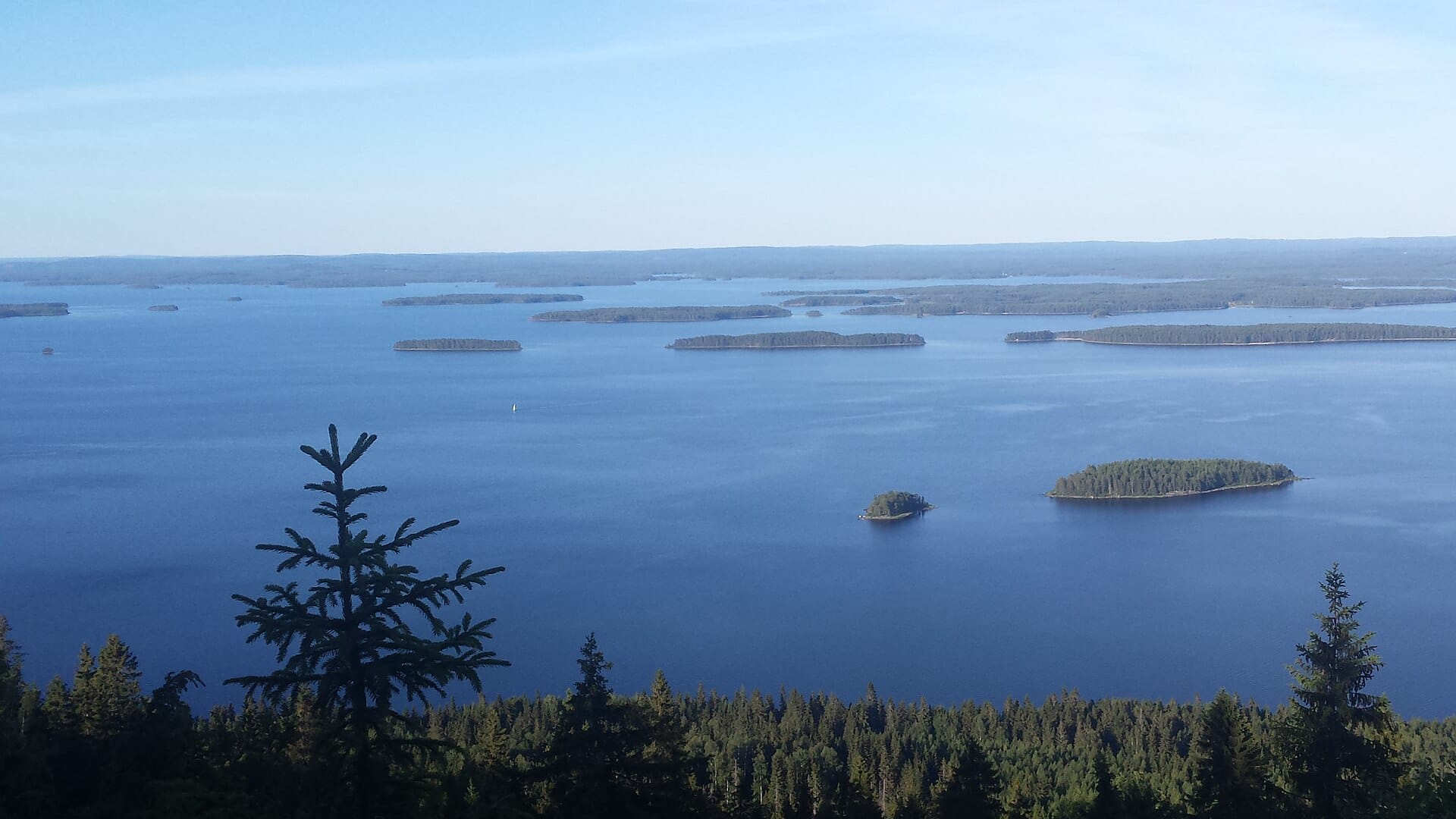
Nineteen regions cover a country that is roughly three quarters forest, the highest share in Europe, and dotted with about 188,000 lakes. The south holds nearly all the cities and farmland, the great lake district fills the middle and southeast around Saimaa, and Lapland runs north above the Arctic Circle into open fell country where the sun stays up for weeks in summer and never rises for weeks in winter. The land is still rebounding from the weight of the last ice sheet, rising a few millimeters a year, so the coastline slowly grows.
Helsinki sits on the south coast facing the Gulf of Finland and holds the government, the design industry and about a fifth of the population in its metropolitan area. Espoo next door is the technology cluster, Tampere between two lakes is the old industrial center, Turku on the southwest coast was the capital until 1812, and Rovaniemi is the gateway to Lapland. Visitors mostly come for one of two Finlands: the summer of lakes, islands and long light, or the winter of snow, aurora and reindeer in the north.
- Population
- 5.6 million
- Area
- 338,455 km²
- Currency
- Euro (€)
- Official languages
- Finnish and Swedish
- Regions
- 19
- Highest point
- Halti, 1,324 m
The Finland course
Geography of Finland2 lessons
About 188,000 lakes under the highest forest cover in Europe, on land still rising after the ice.
History of Finland2 lessons
Six centuries Swedish, a century Russian, independent since 1917, and in NATO since 2023.
Language of Finland2 lessons
Not Indo-European at all, with fifteen cases and its nearest large relative in Estonian.
Culture of Finland2 lessons
Roughly three million saunas for 5.6 million people, and a word for endurance they built a national character on.
Economy of Finland2 lessons
Forests and machinery, plus a phone company whose engineers became a games industry.
Politics of Finland2 lessons
A president who still runs foreign policy, coalitions always required, and the EU’s longest border with Russia.
Nature & Wildlife of Finland2 lessons
The brown bear as national animal, and a freshwater seal found in one lake system and nowhere else.
Food & Cuisine of Finland2 lessons
Rye bread, Karelian pies, and more coffee per person than any country on Earth.
Landmarks of Finland2 lessons
A sea fortress across six islands, a church quarried into bedrock, and the aurora further north.
People & Society of Finland2 lessons
Five and a half million spread very thinly, and eight straight years first in the happiness report.
Geography of Finland
Finland is the most heavily forested country in Europe, with roughly three quarters of its land under trees, and it holds about 188,000 lakes along with a comparable number of islands. Saimaa in the southeast is the largest lake and among the largest in Europe, and the archipelago off the southwest coast around Turku and the Åland Islands is one of the biggest island groups anywhere by count.
The terrain is low and glaciated, and Halti in the far northwest reaches only 1,324 meters on the Norwegian border. About a quarter of the country lies above the Arctic Circle, where Lapland gets continuous daylight for weeks around midsummer and a corresponding polar night in December. Post-glacial rebound is still lifting the land several millimeters a year, particularly around the Gulf of Bothnia.

History of Finland
Finland was part of the Swedish realm for around six centuries, which left Swedish law, Lutheranism and a Swedish-speaking coastal population. Russia took it in 1809 and governed it as an autonomous Grand Duchy, a status that gave Finnish national identity room to develop through the language, the Kalevala epic and the music of Sibelius.
Independence was declared on 6 December 1917 during the Russian revolution and was followed immediately by a short and bitter civil war. The Winter War of 1939 to 1940 against the Soviet Union cost Finland territory in Karelia but preserved its independence, and the country then spent the Cold War carefully neutral between the blocs. It joined the European Union in 1995 and NATO in April 2023, ending that neutrality after the Russian invasion of Ukraine.

Language of Finland
Finnish is a Uralic language, unrelated to the Indo-European languages surrounding it, with its nearest large relative in Estonian and a far more distant one in Hungarian. It has fifteen noun cases, no grammatical gender and no future tense, and it builds meaning by stacking endings onto a stem rather than by using prepositions.
Swedish is the second official language, spoken as a first language by around five percent of the population along the south and west coasts and in Åland, where it is the sole official language. Three Sámi languages hold official status in the north. Finnish spelling is almost perfectly regular, so words are pronounced exactly as written, which makes reading it far easier than speaking it.

Culture of Finland
The sauna is a national institution rather than a leisure activity, with around three million of them for 5.6 million people, in homes, offices and parliament, and the practice carries UNESCO intangible heritage status. Sisu, usually translated as stoic determination in the face of adversity, is the quality Finns most often name as characteristically their own.
Design carries the country abroad through Alvar Aalto in architecture and furniture, Marimekko in textiles and Iittala in glass, all sharing a preference for plain forms and natural materials. The Kalevala, compiled from oral poetry in the 1800s, gave the national movement its foundation text and influenced Tolkien among others.

Economy of Finland
Forestry and the paper, pulp and timber industries built the modern Finnish economy and remain significant exporters, alongside machinery, ships and electronics. Nokia dominated global mobile phones before losing that market in the early 2010s, and the engineering and software talent it left behind fed a games industry that produced Rovio and Supercell.
The country runs a comprehensive welfare state funded by high taxes, with free education through university and heavily subsidised childcare. Structural pressures come from an aging population, a small domestic market and heavy exposure to the forest sector, and Finland has been among the more fiscally cautious eurozone members.

Politics of Finland
Finland is a parliamentary republic in which the president, directly elected for a six-year term, retains a real role in foreign policy alongside the prime minister, an unusual division among European republics. Domestic government rests with the cabinet, which must hold the confidence of parliament.
The Eduskunta has 200 members elected proportionally, and no party comes close to a majority, so broad coalitions spanning left and right are normal. Åland holds extensive autonomy, its own parliament and demilitarised status under an arrangement dating from a League of Nations decision in 1921. Finland shares a 1,340-kilometer border with Russia, the longest of any EU member state.

Nature & Wildlife of Finland
The brown bear is the national animal, and Finland also holds wolves, lynx and wolverines across its northern forests, along with around 200,000 semi-domesticated reindeer herded largely by Sámi communities in Lapland. Elk are common enough to be a serious road hazard.
The Saimaa ringed seal, cut off from the sea when the land rose after the ice age, lives only in that lake system and numbers a few hundred animals after decades of protection. Everyman’s right, jokamiehenoikeus, lets anyone walk, camp and pick berries and mushrooms on most land regardless of who owns it, and forty national parks protect the most valued areas.

Food & Cuisine of Finland
Finnish cooking is built on rye, fish, potatoes, dairy and forest produce, and dark sour rye bread is eaten more or less daily. Karjalanpiirakka, thin rye pastry cases filled with rice porridge and topped with egg butter, are the best-known regional item, and salmon soup with dill and cream is the standard comfort dish.
Finns drink more coffee per person than any other nation, and the working day is structured around breaks for it. Wild berries, especially bilberry, lingonberry and the prized cloudberry from northern bogs, are gathered in enormous quantities under public access rights, and reindeer served with lingonberry and mashed potato is the Lapland staple.

Landmarks of Finland
Suomenlinna, a sea fortress begun in 1748 across six islands outside Helsinki, is a UNESCO site and still home to several hundred residents, reached by a short public ferry. Helsinki itself is compact and neoclassical around Senate Square, with the white cathedral above it, and holds the Temppeliaukio church quarried directly into bedrock under a copper dome.
Beyond the capital, the wooden old town of Rauma carries World Heritage listing, Koli hill above Lake Pielinen is the landscape Finnish national romantic painters returned to again and again, and Lapland draws visitors for the aurora, the Santa Claus Village at Rovaniemi and the fell country around Ylläs and Levi.

People & Society of Finland
Finland has about 5.6 million residents in a country the size of Germany, so density is among the lowest in Europe and the north is nearly empty. Roughly 85 percent live in urban areas, overwhelmingly in the southern third of the country.
Finland has ranked first in the World Happiness Report every year since 2018, a result usually attributed to trust in institutions, low inequality and public services rather than to any national cheerfulness. Fertility has fallen to record lows near 1.3 births per woman, and the foreign-born share of the population, historically very small, has risen quickly to around ten percent.

Reading is one thing, recall is another. Play the Finland challenge to test what stuck. The lessons on all ten topics are open too, and a free account is what keeps your progress across them.