Facts about Estonia
Explore Estonia from Tallinn’s medieval streets and the islands of Saaremaa and Hiiumaa to Tartu, eastern border towns and the bogs of the southern interior. Learn fifteen counties, place sixteen cities and towns, explore lakes and coastal waters, discover sixteen sights, read ten illustrated topics and begin Estonian.
- Population, 2021 census
- 1,331,824
- Capital
- Tallinn
- Official language
- Estonian
- Currency
- Euro (€)
- Counties
- 15
- EU and NATO member since
- 2004
Estonia · 0 of 20 rounds passed
Two timed rounds per topic, 20 seconds a question
Estonia’s northern coast faces Finland, its western islands open onto the Baltic Sea, and its southern uplands lead towards Latvia. Tallinn, Tartu, Narva and Pärnu anchor different regions; Saaremaa and Hiiumaa add island landscapes and maritime history.
Follow a sixteen-settlement map, explore sixteen heritage and landscape sights, and connect places with the country’s history, institutions, language and daily life. The map teaches settlement locations rather than administrative boundaries.
Islands, lowlands and an eastern lake border
Estonia lies on the eastern side of the Baltic Sea. The Gulf of Finland separates its northern coast from Finland, and the Gulf of Riga opens to the southwest. Latvia is its southern land neighbour and Russia lies to the east. Lake Peipus, called Peipsi in Estonian, forms part of that eastern border. Tallinn stands on the northern coast; Tartu lies inland on the Emajõgi.
- Which countries share land borders with Estonia?
- Latvia to the south and Russia to the east. Finland is across the Gulf of Finland.
- What are Estonia’s two largest islands?
- Saaremaa and Hiiumaa, off the western mainland.
- Which lake forms part of the eastern border?
- Lake Peipus, known as Peipsi in Estonian, shared with Russia.
More about Estonia: geography
Estonia lies on the eastern side of the Baltic Sea. The Gulf of Finland separates its northern coast from Finland, and the Gulf of Riga opens to the southwest. Latvia is its southern land neighbour and Russia lies to the east. Lake Peipus, called Peipsi in Estonian, forms part of that eastern border. Tallinn stands on the northern coast; Tartu lies inland on the Emajõgi.
Saaremaa and Hiiumaa are the two largest islands, set off the western mainland. Glaciation left a generally low landscape of lakes, wetlands and rolling ground. Southern uplands include Suur Munamägi, Estonia’s highest point at about 318 metres. The country has fifteen counties; the city map groups settlements for learning and does not teach county or municipal boundaries.
Independence declared, occupied and restored
Medieval crusades brought much of present-day Estonia under Danish and German-speaking rulers. Tallinn became a Hanseatic trading city, while later Swedish rule helped shape institutions and education. The University of Tartu was founded in 1632 under Swedish rule. The Great Northern War brought the region under Russian imperial control in the early eighteenth century.
- Why does Estonia mark both 1918 and 1991?
- Independence was declared on 24 February 1918 and restored on 20 August 1991 after Soviet rule.
- What was the Baltic Way?
- A human chain across Estonia, Latvia and Lithuania on 23 August 1989, calling attention to the consequences of the Molotov–Ribbentrop Pact.
- When was the University of Tartu founded?
- In 1632, during Swedish rule.
More about Estonia: history
Medieval crusades brought much of present-day Estonia under Danish and German-speaking rulers. Tallinn became a Hanseatic trading city, while later Swedish rule helped shape institutions and education. The University of Tartu was founded in 1632 under Swedish rule. The Great Northern War brought the region under Russian imperial control in the early eighteenth century.
Estonia declared independence on 24 February 1918 and secured it through the War of Independence and the 1920 Treaty of Tartu. Soviet occupation and annexation in 1940 were followed by Nazi German occupation and renewed Soviet rule in 1944. Deportations and repression affected many families. The Singing Revolution and the 1989 Baltic Way helped mobilise peaceful resistance. Independence was restored on 20 August 1991, a different anniversary from the original declaration.
A Finnic language on the Baltic coast
Estonian is the official language. It belongs to the Finnic branch of the Uralic family and is closely related to Finnish. Estonia is a Baltic country geographically, but Estonian is not a Baltic language like Latvian or Lithuanian. Its Latin-based writing system uses õ, ä, ö and ü, and differences in sound length can change a word’s meaning.
- Is Estonian related to Latvian?
- They belong to different language families. Estonian is Uralic and Finnic; Latvian is an Indo-European Baltic language.
- How do you say hello and thank you?
- Tere means hello; aitäh means thank you.
- What language do Worldly’s linked lessons teach?
- Standard Estonian, rather than a dedicated Võro, Seto or Russian course.
More about Estonia: language
Estonian is the official language. It belongs to the Finnic branch of the Uralic family and is closely related to Finnish. Estonia is a Baltic country geographically, but Estonian is not a Baltic language like Latvian or Lithuanian. Its Latin-based writing system uses õ, ä, ö and ü, and differences in sound length can change a word’s meaning.
Tere means hello and aitäh means thank you. Estonian has grammatical cases and no grammatical gender. Russian is widely spoken in some communities, especially in the northeast and Tallinn. Võro and Seto speech traditions in the southeast have their own identities and literary activity. The linked lessons introduce standard Estonian; they do not represent every regional or community language.
Song celebrations and seasonal traditions
The Estonian Song Celebration, or laulupidu, brings large choirs together, with a tradition dating to Tartu in 1869. Song and dance celebrations are shared cultural practices across Estonia, Latvia and Lithuania and are recognised by UNESCO. Mass singing also became part of the late-1980s independence movement, linking performance with public memory.
- Where did the first Estonian Song Celebration take place?
- In Tartu in 1869.
- What is Jaanipäev?
- The midsummer celebration associated with bonfires, gatherings and the long June evenings.
- What is Seto leelo?
- A traditional polyphonic singing practice of the Seto community, recognised by UNESCO.
More about Estonia: culture
The Estonian Song Celebration, or laulupidu, brings large choirs together, with a tradition dating to Tartu in 1869. Song and dance celebrations are shared cultural practices across Estonia, Latvia and Lithuania and are recognised by UNESCO. Mass singing also became part of the late-1980s independence movement, linking performance with public memory.
Jaanipäev, celebrated around midsummer, brings bonfires and gatherings during the long northern evenings. Smoke-sauna traditions in Võromaa have their own UNESCO recognition, while Seto leelo is a distinctive polyphonic singing tradition. Literature, design, film and contemporary music add to this regional variety. Arvo Pärt’s music is internationally known, but one composer or festival cannot stand for the whole culture.
Digital services and a working Baltic economy
Estonia’s economy includes services, information technology, manufacturing, logistics and forestry-related industries. Tallinn’s port links it with Baltic shipping routes, while Tartu is a centre of education and research. Electronics, wood products and food processing sit alongside software businesses. The northeastern oil-shale industry has shaped employment and energy supply as well as environmental challenges.
- When did Estonia adopt the euro?
- On 1 January 2011, replacing the Estonian kroon.
- Does e-residency grant a right to live in Estonia?
- No. It provides access to specified digital services and is separate from citizenship, immigration permission and tax residence.
- What industries matter besides software?
- Manufacturing, logistics, wood processing, food production and other services, among others.
More about Estonia: economy
Estonia’s economy includes services, information technology, manufacturing, logistics and forestry-related industries. Tallinn’s port links it with Baltic shipping routes, while Tartu is a centre of education and research. Electronics, wood products and food processing sit alongside software businesses. The northeastern oil-shale industry has shaped employment and energy supply as well as environmental challenges.
Estonia joined the European Union in 2004 and adopted the euro on 1 January 2011, replacing the kroon. Digital identity supports many public services and online business processes. E-residency lets eligible foreign applicants access specified digital services and establish or manage businesses; it does not grant citizenship, tax residence, a visa or a right to live in Estonia.
The Riigikogu and a parliamentary republic
Estonia is a parliamentary republic. The 101-member Riigikogu is the national parliament and meets at Toompea in Tallinn. The prime minister leads the government; the president is head of state. The president is selected through a constitutional election process involving parliament and, when required, an electoral body, rather than a direct popular presidential vote.
- What is the Riigikogu?
- Estonia’s 101-member national parliament, based at Toompea in Tallinn.
- Who leads the government?
- The prime minister. The president serves as head of state.
- When did Estonia join the EU and NATO?
- Both in 2004: NATO on 29 March and the EU on 1 May.
More about Estonia: politics
Estonia is a parliamentary republic. The 101-member Riigikogu is the national parliament and meets at Toompea in Tallinn. The prime minister leads the government; the president is head of state. The president is selected through a constitutional election process involving parliament and, when required, an electoral body, rather than a direct popular presidential vote.
The constitution adopted in 1992 frames the restored republic’s institutions and rights. Estonia joined NATO on 29 March 2004 and the European Union on 1 May 2004. These memberships are distinct from adopting the euro in 2011. Local government is organised through municipalities; counties and municipalities are different territorial levels. This guide offers country reading rather than a citizenship examination preparation course.
Bogs, forests and migration coasts
Forests and peatlands cover much of Estonia’s landscape. Raised bogs store water and carbon and support specialised plants such as sphagnum mosses and sundews. Lahemaa National Park brings together northern coastal scenery, forests, wetlands and historic settlements. Soomaa is known for seasonal flooding, often described locally as a fifth season.
- What is Soomaa’s fifth season?
- Seasonal flooding that can inundate floodplains and alter how people travel through the landscape.
- Why is Matsalu important for birds?
- Its shallow bay, reed beds and coastal meadows provide feeding and resting habitat along migration routes.
- What kind of landscape is a raised bog?
- A peat-forming wetland whose surface rises through accumulated plant material and is largely supplied by precipitation.
More about Estonia: nature & wildlife
Forests and peatlands cover much of Estonia’s landscape. Raised bogs store water and carbon and support specialised plants such as sphagnum mosses and sundews. Lahemaa National Park brings together northern coastal scenery, forests, wetlands and historic settlements. Soomaa is known for seasonal flooding, often described locally as a fifth season.
Matsalu’s coastal meadows, reed beds and shallow bay are important for migrating birds. Vilsandi protects western coastal and island habitats, while Alutaguse preserves northeastern forests and wetlands. Brown bears, wolves and Eurasian lynx live in Estonia, but their presence is no guarantee of a sighting. Marked boardwalks and designated trails help protect wetland habitats.
Rye bread, Baltic fish and forest harvests
Dark rye bread is a familiar part of the Estonian table. Potatoes, barley, dairy foods, pork and fish feature in traditional meals, alongside berries and mushrooms gathered in season. Kiluvõileib is an open sandwich with spiced sprats, often served on rye bread with egg. Coastal and island kitchens have strong connections to Baltic fish.
- What is kiluvõileib?
- An open sandwich with spiced sprats, often on rye bread and topped with egg.
- What is kama?
- A roasted, ground mixture of grains and peas, often eaten with cultured dairy.
- Which foods are associated with Christmas?
- Verivorst, or blood sausage, and sauerkraut are familiar examples.
More about Estonia: food & cuisine
Dark rye bread is a familiar part of the Estonian table. Potatoes, barley, dairy foods, pork and fish feature in traditional meals, alongside berries and mushrooms gathered in season. Kiluvõileib is an open sandwich with spiced sprats, often served on rye bread with egg. Coastal and island kitchens have strong connections to Baltic fish.
Kama is a mixture of roasted and ground grains and peas, commonly combined with cultured dairy. Verivorst, a blood sausage, and sauerkraut are associated with Christmas meals. Contemporary cooking includes vegetarian dishes and reinterpretations of local ingredients. Regional traditions and household choices vary; no single festive plate describes everyone’s daily diet.
Hanseatic streets, island castles and a university city
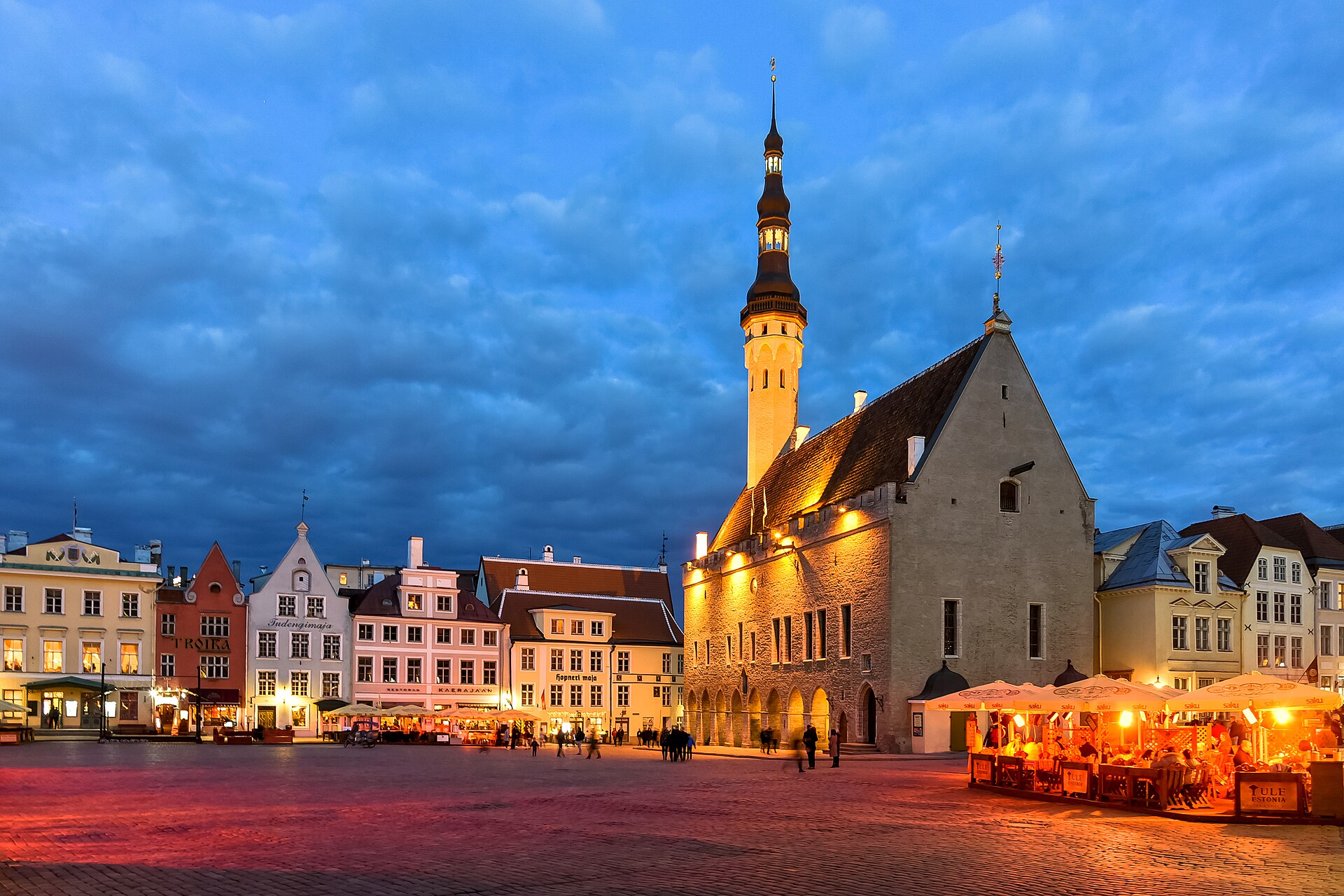
Tallinn’s UNESCO-listed historic centre includes both Toompea and the lower town. Its walls, merchant houses and Town Hall Square recall a Baltic trading city, while the surrounding capital has modern districts and a working port. Tartu’s university buildings, Town Hall Square and Estonian National Museum present a different urban history centred on education and culture.
- What does Tallinn’s World Heritage listing include?
- Its historic centre, including the upper town of Toompea and the lower town, rather than the entire modern city.
- What formed the Kaali craters?
- Meteorite impacts on the island of Saaremaa.
- What is the Struve Geodetic Arc?
- A chain of nineteenth-century survey points used to measure a meridian arc and improve knowledge of Earth’s shape; one listed point is in Tartu.
More about Estonia: landmarks
Tallinn’s UNESCO-listed historic centre includes both Toompea and the lower town. Its walls, merchant houses and Town Hall Square recall a Baltic trading city, while the surrounding capital has modern districts and a working port. Tartu’s university buildings, Town Hall Square and Estonian National Museum present a different urban history centred on education and culture.
Kuressaare Castle on Saaremaa preserves a substantial medieval episcopal stronghold. Nearby Kaali contains a group of meteorite impact craters. Hiiumaa’s Kõpu Lighthouse belongs to the history of Baltic navigation; Narva’s castle faces Ivangorod across the Russian border. The Struve Geodetic Arc’s Tartu observatory point links Estonia with a transnational scientific World Heritage property.
Urban centres, island life and regional identities
Estonia had 1,331,824 usual residents in the 2021 census. This is a dated census count, not a current population estimate. Tallinn is the largest city and Tartu a major university centre. Ethnic Estonians form the majority, while Russians and other communities contribute to the country’s social life. Language, ethnic identity and citizenship are different characteristics.
- How many people did the 2021 census count?
- 1,331,824 usual residents. The figure refers to the census, not a current estimate.
- Where are Russian-speaking communities particularly prominent?
- In Tallinn and northeastern Estonia, including Narva.
- Are language, ethnicity and citizenship interchangeable?
- No. A person’s home language, ethnic identity and legal citizenship describe different things.
More about Estonia: people & society
Estonia had 1,331,824 usual residents in the 2021 census. This is a dated census count, not a current population estimate. Tallinn is the largest city and Tartu a major university centre. Ethnic Estonians form the majority, while Russians and other communities contribute to the country’s social life. Language, ethnic identity and citizenship are different characteristics.
Russian-speaking communities are especially prominent in Tallinn and northeastern towns such as Narva. Võro and Seto identities have strong roots in the southeast, while island communities have their own local histories. Education, work and migration connect these places with the wider Baltic region and beyond. Urban employment patterns and seasonal life in rural or island communities offer different experiences of the country.