The Germany course
Facts about Germany, for your next trip
Explore Germany through ten illustrated topics, from its landscapes and history to food and everyday life. Play the available facts rounds as you move through the course.
Capital Berlin · Europe · 10 topics · 20 rounds · 80 questions · 20 seconds each
Germany is the most populous country in the European Union and its economic center of gravity. Unified only in 1871 and divided again from 1949 to 1990, it has spent the modern era rebuilding institutions deliberately designed to prevent any repeat of the 20th century.
Germany is a federation of 16 states, and they hold genuine power over education, policing and broadcasting, which is why the country feels less centralised than most of its neighbors. The land rises from the flat North German Plain, through the wooded hills and river valleys of the middle, to the Bavarian Alps along the Austrian border. The Rhine carries more freight than any waterway in Europe and its valley holds the densest industry, while the Danube rises in the Black Forest and runs east. Germany shares land borders with Denmark, Poland, Czechia, Austria, Switzerland, France, Luxembourg, Belgium and the Netherlands.
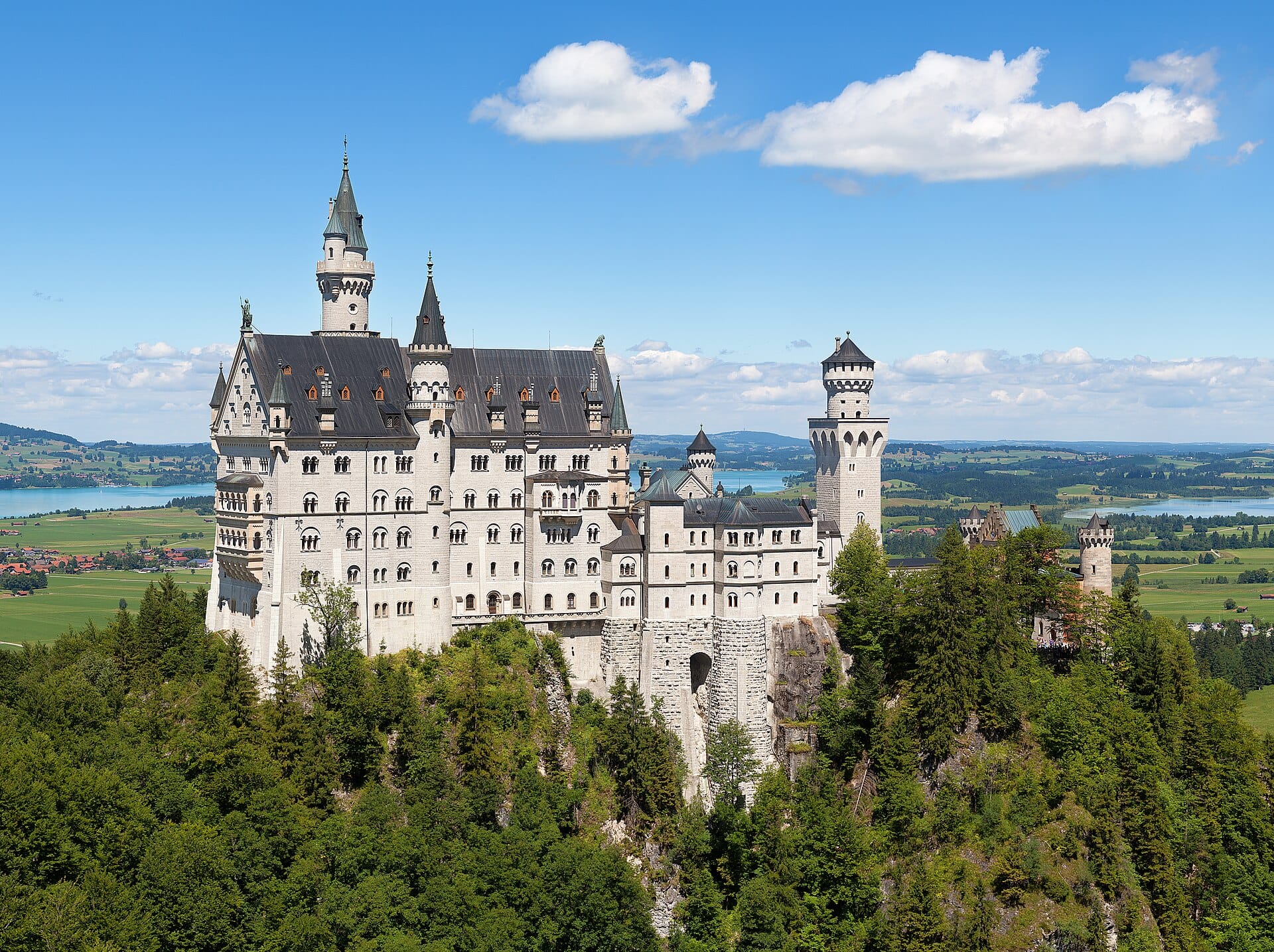
Berlin is the capital and much the largest city, though not the economic center: that is spread between Munich in the Bavarian south, Frankfurt as the banking hub, Hamburg as the great port, and the Ruhr conurbation behind Cologne and Düsseldorf. Dresden and Leipzig anchor the east. Visitors come for Berlin’s museums and nightlife, Munich’s Oktoberfest, the castles and steep vineyards of the Rhine and Mosel, and the Bavarian Alps, where Neuschwanstein stands above wooded foothills.
- Population
- 83.5 million (2025)
- Area
- About 357,600 km²
- Currency
- Euro (€)
- Official language
- German
- States
- 16
- Highest point
- Zugspitze, 2,962 m
Germany · Geography
Geography of Germany
Travel from the North Sea and Baltic coasts through river valleys and wooded uplands to the Bavarian Alps. Sixteen federal states divide this varied landscape.
Commonly asked
- Which countries border Germany?
- Denmark, Poland, Czechia, Austria, Switzerland, France, Luxembourg, Belgium and the Netherlands share land borders with Germany.
- What is Germany’s highest mountain?
- The Zugspitze reaches 2,962 meters on the border with Austria. Germany’s north is much lower, with coastal plains beside the North Sea and Baltic Sea.
Germany · History
History of Germany
Follow the path from the Holy Roman Empire and the Reformation to unification, dictatorship, division and reunification. The Nazi period and the Holocaust remain central to how Germany teaches and remembers its past.
Commonly asked
- When was Germany unified?
- The German Empire was proclaimed in 1871. After the Second World War, two German states were founded in 1949; reunification took place on 3 October 1990.
- When did the Berlin Wall fall?
- The border opened on 9 November 1989. The Wall had divided East and West Berlin since 1961 and also enclosed West Berlin along its boundary with East Germany.
Germany · Language
The German language
German connects the country through a shared written standard, while regional dialects preserve local identities. Explore its compound nouns and grammar, then practise useful phrases in the German lessons.
Commonly asked
- What language is spoken in Germany?
- German is the main official language. Regional and minority languages include Low German, Sorbian, Danish and Frisian, alongside the many languages spoken in migrant communities.
- Why are some German words so long?
- German commonly combines nouns into a single compound, such as Bahnhof, meaning railway station. Articles and endings also change with grammatical gender and case.
Germany · Culture
German culture and traditions
Opera houses, football clubs, local festivals and museums all belong to Germany’s cultural life. Regional traditions matter as much as the famous names in music, literature and philosophy.
Commonly asked
- Is Oktoberfest celebrated everywhere in Germany?
- The original Oktoberfest is Munich’s festival, rooted in a royal wedding celebration in 1810. Other regions have their own traditions, including Carnival in Cologne and the Rhineland.
- Which composers are associated with Germany?
- Johann Sebastian Bach, Ludwig van Beethoven and Johannes Brahms were born in places that are now in Germany. Concert halls and opera houses remain an important part of city life.
Germany · Economy
Germany’s economy
Cars, machinery, chemicals and electrical equipment connect German industry to world markets. Smaller specialist firms and vocational apprenticeships help explain how that industrial economy works.
Commonly asked
- What is the Mittelstand?
- The term often describes small and medium-sized businesses, especially independently owned firms. Many German manufacturers specialise in industrial products used by customers around the world.
- What is Germany’s dual apprenticeship system?
- Apprentices combine paid workplace training with vocational school. Employers and schools share responsibility for teaching practical skills and the knowledge behind them.
Germany · Politics
How Germany is governed
Germany’s parliamentary system shares authority between the federal government and sixteen states. The Bundestag, Bundesrat and Constitutional Court each play a different role.
Commonly asked
- What is the difference between the Bundestag and Bundesrat?
- The Bundestag is the elected federal parliament. The Bundesrat represents the state governments and participates in federal legislation, particularly laws affecting the states.
- Who leads Germany’s government?
- The federal chancellor leads the government and is elected by the Bundestag. The federal president is the head of state, with a separate, largely representative role.
Germany · Nature & Wildlife
Nature and wildlife in Germany
Forests cover about a third of Germany, but its protected landscapes also include tidal flats, lakes and Alpine habitats. Explore the places where wildlife and people share a densely settled country.
Commonly asked
- How many national parks does Germany have?
- Germany has sixteen national parks. They include the Bavarian Forest, Harz, Black Forest and Berchtesgaden, as well as coastal parks protecting parts of the Wadden Sea.
- Why is the Wadden Sea important?
- Its tidal flats provide feeding and resting habitat for millions of migratory birds. The UNESCO World Heritage site extends along the coasts of the Netherlands, Germany and Denmark.
Germany · Food & Cuisine
German food and drink
Bread, regional sausages and seasonal vegetables sit alongside dishes shaped by migration. From a bakery breakfast to Riesling country along the Mosel, food offers another way to explore the regions.
Commonly asked
- What foods are associated with Germany?
- Rye breads, pretzels, sausages and potato dishes are widespread, with strong regional variations. Swabian Maultaschen, northern fish dishes and Berlin’s currywurst tell different local stories.
- Where is German wine grown?
- Many wine regions lie along the Rhine and its tributaries. The Mosel is especially associated with Riesling grown on steep river-valley slopes.
Germany · Landmarks
Landmarks of Germany
See the Brandenburg Gate in Berlin, Cologne’s Gothic cathedral and Neuschwanstein above the Bavarian foothills. Each landmark reveals a different period of German history.
Commonly asked
- What does the Brandenburg Gate symbolise?
- Built in the late eighteenth century, the gate stood in the restricted border area during Berlin’s division. After 1989 it became a prominent symbol of reunification.
- Why was Neuschwanstein built?
- King Ludwig II of Bavaria commissioned it in the nineteenth century as a romantic retreat inspired by medieval legends and Wagner’s operas. It was a royal residence project rather than a medieval defensive fortress.
Germany · People & Society
People and everyday life in Germany
Germany is the European Union’s most populous country. Large cities, smaller towns and rural districts have different rhythms, shaped by regional identity, an aging population and migration.
Commonly asked
- How many people live in Germany?
- About 83.5 million people lived in Germany at the end of 2025, according to the Federal Statistical Office. Population estimates should always be read with their reference year.
- What is Germany’s largest city?
- Berlin is the largest city by population and the national capital. Hamburg, Munich and Cologne are also major cities; the Rhine-Ruhr area contains several closely connected urban centers.