Facts about Zambia
Explore Zambia from Lusaka and the Copperbelt to the Barotse floodplain, Luangwa valley and Victoria Falls. Sixteen city and town locations, twelve sights and ten illustrated topics connect its rivers and plateaus with history, languages and everyday life.
- Capital
- Lusaka
- Area
- 752,612 km²
- Neighbours
- 8 countries
- Official language
- English
- Currency
- Zambian kwacha (ZMW)
- Independence
- 24 October 1964
Zambia · 0 of 20 rounds passed
Two timed rounds per topic, 20 seconds a question
Lusaka and Kabwe anchor the central corridor. Kapiri Mposhi links it with TAZARA, while Ndola, Kitwe, Mufulira and Chingola introduce the Copperbelt. Solwezi faces the northwestern mining region. Mongu stands by the Barotse floodplain, Choma serves the southern plateau and Livingstone is near Victoria Falls.
Chipata orients the eastern country, with Mansa, Kasama, Chinsali and Mbala in the north. South Luangwa, Kafue and Lower Zambezi protect different habitats; Kasanka, Bangweulu and Kalambo Falls introduce further landscapes. City pins mark approximate settlement centres, while parks and wetlands use representative sight locations.
Geography of Zambia
A plateau country joining the Zambezi and Congo drainage basins.
- Which eight countries border Zambia?
- Angola, DRC, Tanzania, Malawi, Mozambique, Zimbabwe, Botswana and Namibia.
- Where does the Zambezi reach the sea?
- It reaches the Indian Ocean through Mozambique.
- Does all Zambian water drain to the Zambezi?
- No. Northern rivers and lakes also feed the Congo basin.
More about Zambia: geography
Zambia is a landlocked country in southern Africa, sharing borders with Angola, the Democratic Republic of the Congo, Tanzania, Malawi, Mozambique, Zimbabwe, Botswana and Namibia. Lusaka lies on the south-central plateau. The Copperbelt cities stand farther north, close to the DRC, while the Luangwa valley cuts through the east. Most of the country is elevated plateau rather than lowland tropical forest. Its small river boundary with Botswana lies at Kazungula; the four nearby countries do not meet at a single point.
The Zambezi rises in northwestern Zambia, flows through Angola and returns to Zambia before reaching Victoria Falls and the southern frontier. The Kafue and Luangwa join it on its journey to Mozambique and the Indian Ocean. Northern waters also belong to the Congo basin: the Chambeshi flows towards the Bangweulu wetlands and the Luapula, which leads to Lake Mweru. Zambia shares the southern end of Lake Tanganyika. Barotse floodplain livelihoods follow the seasonal rise and fall of the upper Zambezi.
History of Zambia
From early communities and regional kingdoms to independence on 24 October 1964.
- When did Zambia become independent?
- On 24 October 1964, from Britain.
- Who was the first president?
- Kenneth Kaunda, who served from 1964 to 1991.
- What changed in 1991?
- Multiparty elections returned and Frederick Chiluba defeated Kenneth Kaunda.
More about Zambia: history
Archaeological evidence places human activity in the region far before its modern name or borders. At Kalambo Falls, researchers reported interlocking worked logs dating to about 476,000 years ago. Later farming, metalworking, migration and trade shaped diverse communities. Lozi, Bemba, Lunda and other political traditions developed in different regions, with connections across today’s frontiers. David Livingstone reached the already locally known Victoria Falls in 1855 and gave them an English name; he did not discover an unknown landscape.
British South Africa Company administration preceded direct British control of Northern Rhodesia in 1924. The territory joined the Federation of Rhodesia and Nyasaland from 1953 to 1963. Zambia became independent on 24 October 1964, with Kenneth Kaunda as its first president. A one-party constitution took effect in 1973. Multiparty politics was restored in 1990, followed by the 1991 election in which Frederick Chiluba defeated Kaunda. Zambia also hosted southern African liberation movements, a role that brought solidarity, economic pressures and attacks from white-minority regimes.
English and Zambia’s languages
English, Bemba, Nyanja and a multilingual everyday world.
- What is Zambia’s official language?
- English, alongside a wide range of Zambian languages used in everyday life.
- Which lingua franca is common in Lusaka?
- Nyanja, including urban Town Nyanja varieties.
- Is 73 an exact count of Zambia’s languages?
- No. It is commonly a count of ethnic groups; language and dialect counts depend on classification.
More about Zambia: language
English is Zambia’s official language and is used in legislation, government and much formal education. Bemba and Nyanja are widely used lingua francas, especially in the Copperbelt and Lusaka respectively. Tonga, Lozi, Kaonde, Lunda and Luvale are also important regional languages. These seven Zambian languages have long been used in broadcasting and educational materials. They do not exhaust the country’s linguistic diversity, and the often repeated figure of 73 ethnic groups is not a precise count of languages.
Most indigenous Zambian languages belong to the Bantu branch of the Niger-Congo family. Language use crosses provincial and national boundaries: people may speak one language at home, another at a market and English at work. Urban Town Nyanja includes vocabulary and patterns drawn from several languages. Muli bwanji? is a Nyanja greeting asking how someone is; zikomo expresses thanks. These are examples from one language, not a universal Zambian phrasebook. Worldly does not yet offer a dedicated Bemba or Nyanja course.
Culture of Zambia
Floodplain ceremonies, masked performance and the electric sound of Zamrock.
- What does Kuomboka mark?
- The Litunga’s seasonal move from the flooded Barotse plain to higher ground.
- What is Zamrock?
- A musical movement associated with 1970s Zambia, mixing rock, funk and local influences.
- Is Makishi a UNESCO World Heritage site?
- No. Makishi masquerade is intangible cultural heritage, distinct from the World Heritage property list.
More about Zambia: culture
Kuomboka marks the Lozi Litunga’s move from the flooded Barotse plain to higher ground, travelling in the Nalikwanda royal barge. Its timing follows flood conditions rather than a fixed date each year. Nc’wala is associated with Ngoni first-fruits celebrations in the east, while Mutomboko is associated with the Lunda of Mwata Kazembe in Luapula. Ceremonies express particular community histories; none stands for every Zambian household or belief.
Makishi masquerade, associated with initiation traditions of communities in northwestern Zambia, is recognised by UNESCO as intangible cultural heritage. So is Gule Wamkulu, shared with Chewa communities in Malawi and Mozambique. Knowledge, performance and responsibilities belong to living communities rather than only museum displays. Printed chitenge cloth serves many uses, from clothing to carrying children. Urban creativity includes Zamrock, the 1970s fusion of rock, funk and local influences associated with bands such as WITCH and musicians such as Rikki Ililonga, alongside later gospel, hip-hop and popular music.
Economy of Zambia
Copper, farms and the challenge of reliable power and transport.
- What is Zambia’s currency?
- The Zambian kwacha (ZMW), divided into 100 ngwee.
- Why is copper economically important?
- It is a major export, linking mining revenue and foreign exchange to international copper markets.
- Why can drought affect electricity supply?
- Much of Zambia’s electricity comes from hydropower, which depends on available water.
More about Zambia: economy
Copper links Zambia to global manufacturing and energy technologies. Kitwe, Ndola, Chingola and Mufulira developed around the Copperbelt’s mines, factories and transport network. Major newer mining operations also lie in North-Western Province, around Solwezi. Emerald mining is important too. Mineral exports bring foreign exchange and public revenue, but dependence on commodity prices makes the economy vulnerable to international shocks. Mine work also raises questions about safety, pollution and the distribution of benefits.
Farming, markets, construction, services and small businesses support livelihoods beyond mining. Maize is a major staple crop; cassava is especially important in some northern areas, alongside other crops, livestock and fishing. Zambia uses the kwacha, divided into 100 ngwee. TAZARA links Kapiri Mposhi with Dar es Salaam in Tanzania, while other road and rail corridors connect the landlocked country to regional ports. Hydropower supplies a large share of electricity, so drought can reduce generation and disrupt businesses. Debt restructuring following the 2020 sovereign default forms another part of the country’s economic history.
Politics of Zambia
A presidential republic with multiparty elections and regional connections.
- What is Zambia’s legislature called?
- The National Assembly.
- How many provinces does Zambia have?
- Ten provinces.
- Who won the 2021 presidential election?
- Hakainde Hichilema; the date distinguishes this historical result from current officeholding.
More about Zambia: politics
Zambia is a presidential republic. The president leads the executive, the National Assembly makes legislation and scrutinises government, and courts exercise judicial authority. The country is divided into ten provinces, with districts and local councils beneath them. Traditional authorities also have roles in community life and customary affairs. Political institutions and customary leadership should not be treated as the same system or as identical everywhere.
Multiparty elections resumed in 1991 after the one-party period. Subsequent transfers of power included Michael Sata’s victory in 2011 and Hakainde Hichilema’s victory in the 2021 presidential election. Those are dated historical events rather than a statement about the current officeholder. Public debate includes jobs, electricity, public services, debt and accountability. Zambia belongs to the African Union, SADC, COMESA and the Commonwealth. Lusaka hosts COMESA’s secretariat, reflecting the importance of regional trade and cooperation to a landlocked state.
Nature & Wildlife of Zambia
Miombo woodland, floodplain antelope and the Luangwa’s wildlife.
- What animals gather seasonally at Kasanka?
- Millions of straw-coloured fruit bats.
- Which national park faces Mana Pools?
- Lower Zambezi National Park, across the Zambezi in Zambia.
- Where are Kafue lechwe found naturally?
- In the Kafue Flats, distinct from the Bangweulu wetlands associated with black lechwe.
More about Zambia: nature & wildlife
Miombo woodland covers large areas of Zambia, interspersed with grasslands, rivers, dambos and seasonal wetlands. South Luangwa is associated with walking safaris and supports elephants, hippos, leopards and the distinctive Luangwa giraffe, also called Thornicroft’s giraffe. Kafue National Park spans an enormous range of habitats, including the seasonally flooded Busanga Plains. Lower Zambezi faces Zimbabwe’s Mana Pools across the river. A representative map pin introduces each landscape without describing its full extent.
Kasanka’s seasonal gathering of straw-coloured fruit bats brings millions of animals to a small area of forest. Bangweulu’s wetlands support shoebills and black lechwe; Kafue lechwe are associated with the separate Kafue Flats. Zambia’s flag carries an African fish eagle, a bird often seen near water. Habitat protection depends on community livelihoods, water management and the control of illegal hunting as well as park boundaries. Seasonal water levels shape both wildlife movements and access, so the guide’s locations are learning points rather than a travel itinerary.
Food & Cuisine of Zambia
Nshima and relishes, freshwater fish and regional staples.
- What is nshima usually made from?
- Maize meal, though other staple preparations also exist.
- What are chibwabwa?
- Pumpkin leaves used as a vegetable relish.
- What are ifinkubala?
- Edible caterpillars, eaten in some regions of Zambia.
More about Zambia: food & cuisine
Nshima is a thick staple porridge, usually made from maize meal, shaped by hand and eaten with accompanying relishes. These may include beans, leafy vegetables, groundnuts, fish or meat. Chibwabwa are pumpkin leaves, often prepared with groundnuts. Cassava-based staples are important in parts of the north and northwest, so maize nshima should not be mistaken for the only staple eaten throughout Zambia. Meals vary with region, season, household preferences and income.
Dried small fish known as kapenta are important around Lake Tanganyika and Lake Kariba; the fish were introduced to Kariba. Ifinkubala are edible caterpillars, collected and prepared in some regions. Munkoyo is a fermented cereal drink traditionally made using roots containing enzymes that help break down starch. Preparation and fermentation vary, making blanket claims about alcohol content unhelpful. Street stalls, markets, restaurants and home kitchens offer many other foods, including grilled meats and snacks; there is no single barbecue meat preferred by all Zambians.
Landmarks of Zambia
Mosi-oa-Tunya, ancient wood at Kalambo and museums across the country.
- Which countries share Victoria Falls?
- Zambia and Zimbabwe.
- Where is Kalambo Falls?
- On the Zambia–Tanzania border near Lake Tanganyika.
- What is significant about the Kalambo archaeology?
- Researchers reported worked wooden structures dating to about 476,000 years ago.
More about Zambia: landmarks
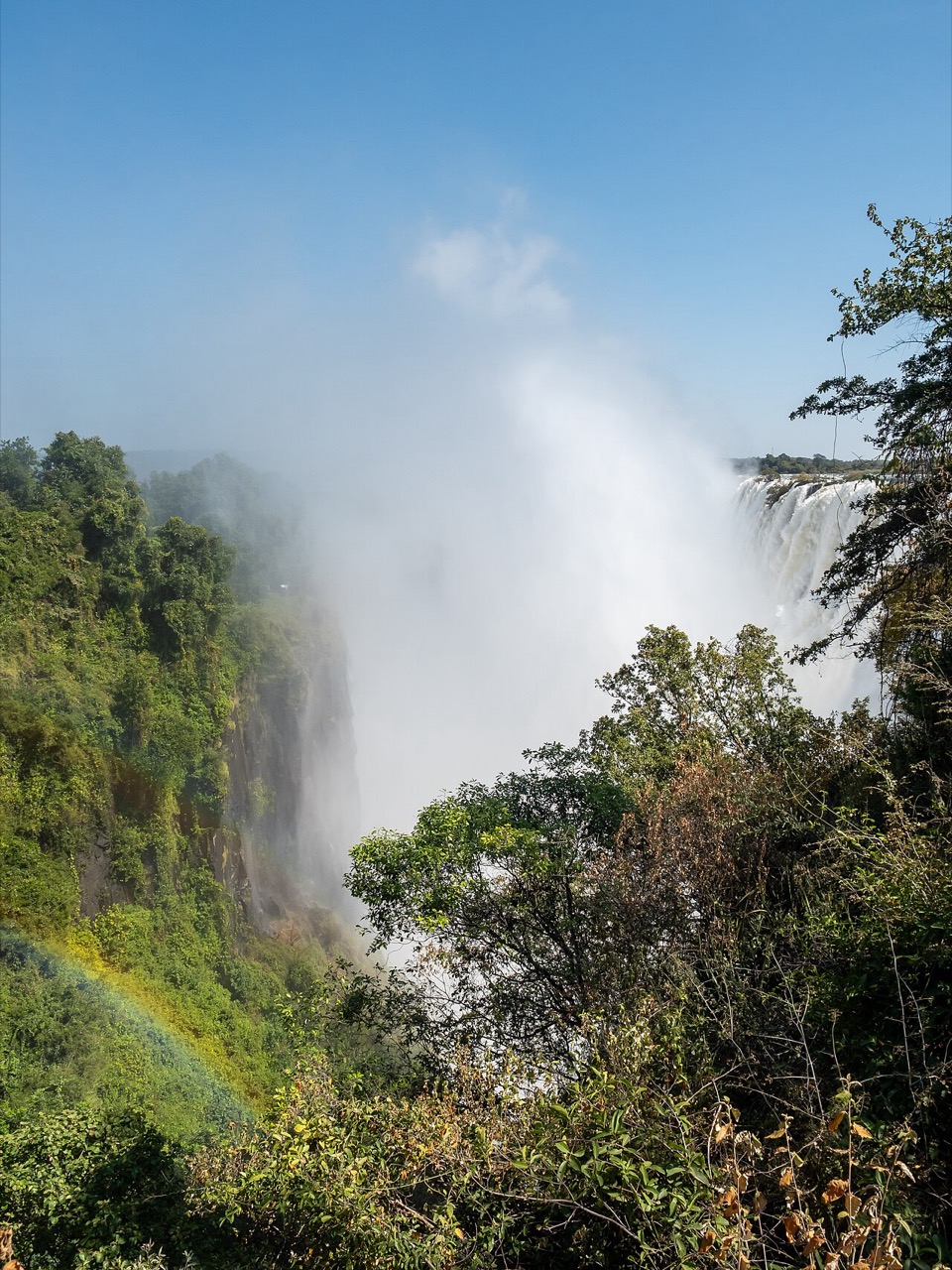
Mosi-oa-Tunya / Victoria Falls is a World Heritage property shared with Zimbabwe. The Zambezi plunges over a broad basalt edge into a narrow gorge, sending spray high above the river when flows are strong. Views change substantially through the year. Livingstone is the nearby Zambian city, with a museum that places the falls within wider archaeology, history and natural history. The name Mosi-oa-Tunya is commonly translated as “the smoke that thunders”.
Kalambo Falls lies on the Tanzanian border near the southern end of Lake Tanganyika. Nearby archaeological work revealed exceptionally early woodworking, published in 2023; the falls and archaeological deposits are related locations, not one identical point. Moto Moto Museum in Mbala introduces the cultural history of northern Zambia. Shiwa Ngandu is a twentieth-century estate with a large brick house, rather than an ancient palace. The lakes, Barotse floodplain and national parks add major landscapes, but they should not all be described as UNESCO World Heritage properties.
People & Society of Zambia
Nationalist organisers, writers, athletes and changing urban communities.
- Where was the 2012 Africa Cup of Nations final won?
- In Libreville, Gabon; the tournament was co-hosted with Equatorial Guinea.
- Was Kalusha Bwalya aboard the plane that crashed in 1993?
- No. He was playing abroad and was not on the flight.
- Which medal did Samuel Matete win at Atlanta 1996?
- Silver in the men’s 400 metres hurdles.
More about Zambia: people & society
Zambia’s communities have histories that reach across today’s borders. Lusaka and the Copperbelt bring together people from many regions through education, mining, trade and migration. Rural livelihoods include farming, fishing, livestock keeping and small businesses, with strong connections to towns. Kinship traditions vary: historical descriptions of Bemba matrilineal descent, for example, do not mean that every household lives in the same way or that all political authority belongs to women.
Kenneth Kaunda, Simon Kapwepwe and campaigners such as Julia Chikamoneka were important to the independence struggle, alongside many less widely recorded organisers. Writers include Namwali Serpell, author of The Old Drift, and Ellen Banda-Aaku. Football is a major public passion: Zambia won the men’s Africa Cup of Nations in 2012, with the final in Libreville, Gabon. The 1993 crash killed 18 players and members of the national team delegation; Kalusha Bwalya was not aboard. Samuel Matete won silver in the men’s 400 metres hurdles at the 1996 Olympics, rather than the gold sometimes incorrectly attributed to him.