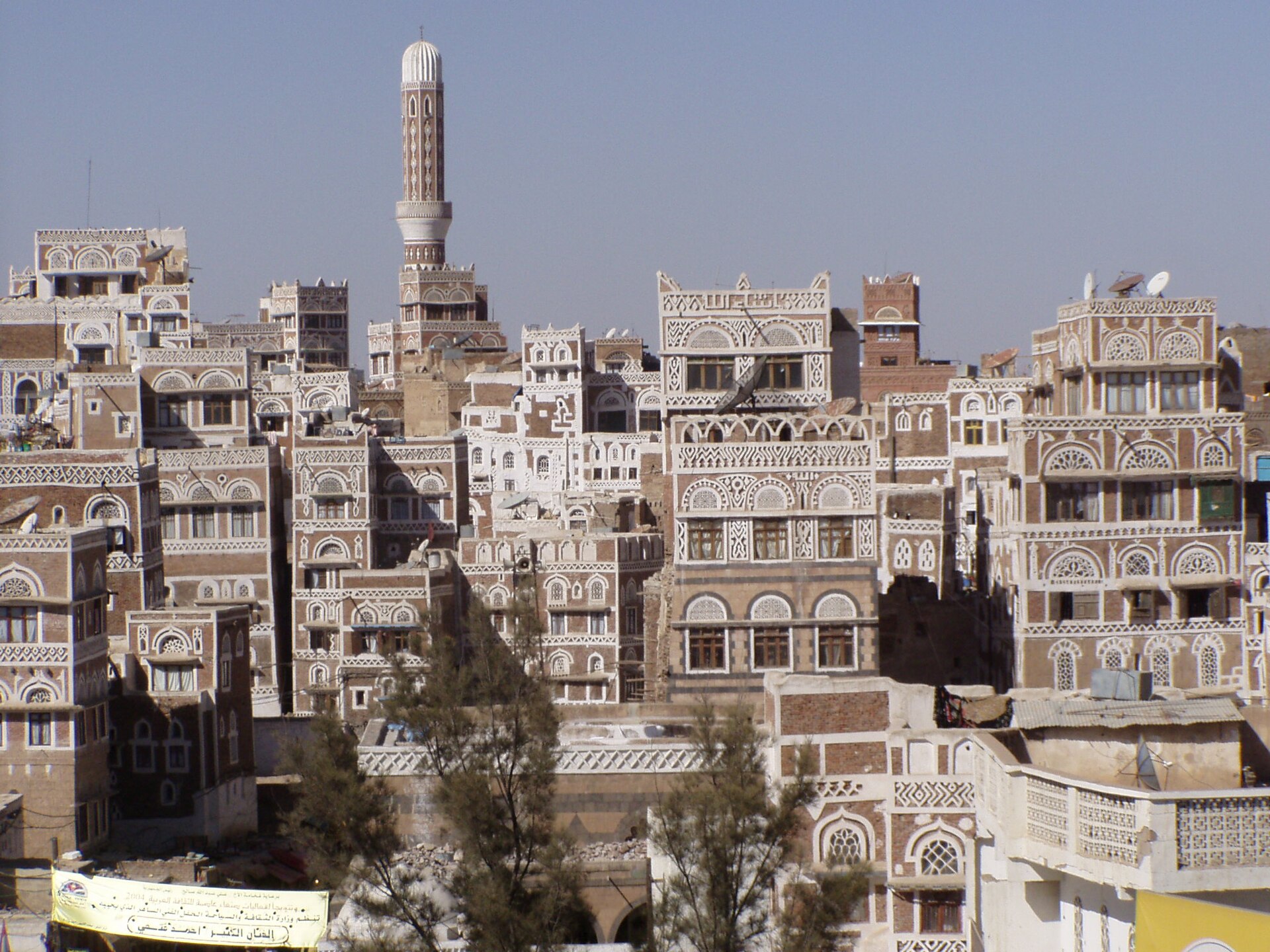
Facts about Yemen
Explore Yemen from Sana’a’s decorated tower houses and the terraces of Haraz to Wadi Hadhramaut, the Red Sea coast and Socotra. Connect ancient irrigation, coffee, poetry and regional languages with the communities and landscapes behind them.
- Capital
- Sana’a
- Temporary government capital
- Aden
- Currency
- Yemeni rial (YER)
- Official language
- Arabic
- Administrative areas
- 21 governorates + capital
- UNESCO World Heritage
- 5 properties (2026)
Yemen · 0 of 20 rounds passed
Two timed rounds per topic, 20 seconds a question
Yemen joins the southwestern Arabian Peninsula to a wider Red Sea and Indian Ocean world. Its western highlands hold Sana’a, Taiz and Ibb; the Tihamah plain follows the Red Sea. Aden faces the Gulf of Aden, while Mukalla and the towns of Wadi Hadhramaut connect the southern coast with the inland valleys. Farther east lies Al Mahrah, beside Oman. Offshore Socotra has its own language traditions and remarkable island ecology.
The country’s history reaches from Sabaean temples and irrigation works to medieval cities and the coffee trade. North and South Yemen united in 1990, but prolonged conflict has fragmented authority and caused immense hardship. This guide is for learning about the country and its heritage. Its administrative maps and sights do not show current control or safe routes; official advice warns against travel, including to Socotra.
Geography of Yemen
Highland terraces, the Tihamah plain and eastern desert meet the Red Sea, Gulf of Aden and Arabian Sea.
- Which countries share land borders with Yemen?
- Saudi Arabia and Oman. The Red Sea, Gulf of Aden and Arabian Sea border its coasts.
- Is Sana’a city the same administrative area as Sana’a Governorate?
- No. The capital municipality is separate from the surrounding governorate. Together with twenty-one governorates, it makes twenty-two first-level areas.
- Where is Socotra?
- The archipelago lies offshore in the Arabian Sea, far southeast of the mainland, and forms a separate governorate.
More about Yemen: geography
Yemen occupies the southwestern Arabian Peninsula, with Saudi Arabia to the north and Oman to the east. The Red Sea borders its west, while the Gulf of Aden and Arabian Sea run along the south and east. Bab al Mandab is the strait linking the Red Sea with the Gulf of Aden. Inland, the western highlands rise sharply above the Tihamah coastal plain; farther east, plateaus and wadis open towards desert country and the Rub al Khali.
Sana’a and Dhamar stand on a high plateau, while Taiz and Ibb connect mountain settlements with cultivated slopes. Wadi Hadhramaut contains the inland towns of Shibam, Sayun and Tarim; Mukalla lies on the coast. Socotra is an offshore archipelago, not part of the mainland coastal strip. The maps distinguish twenty-one governorates from the separate capital municipality. They show administrative reference areas, including Socotra, rather than front lines or current access conditions.
History of Yemen
Sabaean irrigation, Indian Ocean ports and two twentieth-century states shape a long, varied history.
- Why was ancient Marib important?
- It was a Sabaean centre whose temples, settlements and irrigation works show how farming and trade supported political power.
- When did North and South Yemen unite?
- On 22 May 1990. A civil war followed in 1994, so unification did not end political divisions.
- Was Aden always Yemen’s capital?
- No. It was the capital of South Yemen before unification and is now designated the internationally recognised government’s temporary capital. Sana’a is the national capital.
More about Yemen: history
Ancient South Arabian kingdoms, including Saba, Ma’in, Qataban, Hadhramaut and Himyar, developed settlements and trade networks across different parts of present-day Yemen. Marib’s temples and irrigation works help explain how farming supported Sabaean power. Associations between the Queen of Sheba and Saba belong to religious and literary traditions; archaeology does not establish every part of that story. Himyar’s rulers adopted Judaism in late antiquity, followed by periods of Aksumite and Persian involvement before Islam spread in the seventh century.
Later histories include Zaydi imamates in the north, Rasulid rule, Ottoman interventions and maritime trade through ports such as Mocha. Britain took Aden in 1839; South Yemen became independent in 1967 and later developed a socialist state with Soviet ties. A republic replaced the northern imamate in 1962. North and South Yemen united on 22 May 1990, but unification did not end political divisions: a civil war followed in 1994. Uprisings in 2011, a subsequent transition and renewed war are distinct chapters in the recent history.
Arabic and the languages of Yemen
Arabic is official; Mehri and Soqotri are separate Semitic languages with their own living traditions.
- Are Mehri and Soqotri dialects of Arabic?
- No. They are distinct Modern South Arabian languages within the Semitic family.
- What do the linked Arabic lessons teach?
- Modern Standard Arabic, rather than a particular Yemeni spoken variety.
- Is Soqotri solely an unwritten language?
- It has a strong oral tradition, but writing and documentation projects also exist. Calling it simply unwritten misses those developments.
More about Yemen: language
Arabic is Yemen’s official language. Modern Standard Arabic is used in formal writing, education and news, while spoken Yemeni Arabic includes regional varieties associated with Sana’a, Taiz and Aden, Tihamah and Hadhramaut. These varieties differ in pronunciation, vocabulary and grammar. They should not be ranked as a single unchanged form of ancient Arabic. The linked Arabic lessons introduce Modern Standard Arabic rather than a course in a particular Yemeni dialect.
Mehri is spoken in eastern Yemen and neighbouring Oman, while Soqotri, also written Socotri, is associated with Socotra. They belong to the Modern South Arabian branch of the Semitic family and are distinct languages, not Arabic dialects or direct descendants of ancient Sabaic. Oral poetry and other spoken traditions carry knowledge between generations; writing and documentation projects also exist. Arabic’s dominance and changing patterns of transmission create pressures whose effects differ between communities.
Culture of Yemen
Song, poetry, decorated tower houses and skilled crafts express regional histories and everyday creativity.
- What is the Song of Sana’a?
- A tradition combining poetry and music, recognised by UNESCO as intangible cultural heritage.
- What is a qamariya?
- A decorative window, often using coloured glass, associated with traditional Yemeni architecture.
- Are Sana’a and Shibam built from the same materials?
- Their building traditions differ. Sana’a’s houses use stone, brick and plaster; Shibam’s towers are largely mud brick.
More about Yemen: culture
The Song of Sana’a combines poetry and music in a tradition recognised by UNESCO as intangible cultural heritage. Performances belong to social settings as well as the stage, with poetry carrying themes of love, faith and daily experience. The jambiya is a curved dagger associated with some forms of men’s dress and ceremonial identity; its use varies. A mafraj is an upper reception room in many traditional highland houses, designed for conversation and views over the surrounding settlement.
Architecture changes with materials and place. Sana’a’s multi-storey houses combine stone, brick and plaster decoration; Shibam’s towers are built largely from mud brick. Stained-glass qamariya windows, carved wood, silverwork and textiles are other ways to explore craft traditions. Qat chewing is a social practice for some people, with health, household-budget and water-use implications. It is not a custom shared by everyone. Regional, urban, rural and diaspora settings each sustain their own forms of cultural life.
Economy of Yemen
Farming, fishing, coffee and remittances sustain livelihoods amid severe conflict-related disruption.
- What currency does Yemen use?
- The Yemeni rial, YER. Different monetary authorities and banknote policies mean exchange-rate conditions vary.
- How does Mocha connect with coffee?
- The Red Sea port was an important centre of the early coffee trade. Its name later spread to coffee terminology.
- Why are remittances important?
- Money sent by Yemenis abroad helps many households meet expenses when local incomes and public services are disrupted.
More about Yemen: economy
Yemen’s economy includes farming, fisheries, services and trade as well as oil and gas. Hydrocarbon exports were important to public revenue before the war, but conflict has damaged infrastructure, disrupted exports and weakened livelihoods. Imports play a major role in food supplies. The Yemeni rial, abbreviated YER, is the national currency; divided monetary institutions and different banknote policies have produced separate exchange-rate conditions. A single undated rate would conceal those differences.
Highland terraces support crops such as cereals and coffee, while coastal communities depend in part on fishing and related trade. Coffee’s early commercial history connects Yemen with Ethiopia and the port of Mocha; Yemen is not the original botanical home of all coffee. Remittances from Yemenis abroad help many households. Water scarcity, transport costs and the cultivation of qat affect agricultural choices. Humanitarian assistance is crucial, but it does not replace the wages, markets and public services needed for a durable recovery.
Politics of Yemen
Formal republican institutions coexist with fragmented authority and a prolonged UN-led peace effort.
- Do the maps show who controls each area today?
- No. They show administrative reference boundaries, not front lines or a live security assessment.
- What changed in the recognised presidency in 2022?
- Presidential authority was transferred to a Presidential Leadership Council.
- Does a Zaydi identity imply support for the Houthis?
- No. A religious affiliation is not the same thing as membership of, or support for, a political movement.
More about Yemen: politics
The Republic of Yemen was established by unification in 1990. Its internationally recognised government and the Houthi authorities are distinct centres of power, alongside other political and armed actors. The Houthis took Sana’a in 2014; a Saudi-led coalition intervened in 2015. In 2022, presidential authority was transferred to a Presidential Leadership Council. Sana’a remains the national capital, while Aden is designated the recognised government’s temporary capital. These constitutional and institutional descriptions do not imply that one authority governs the whole country.
Yemen’s conflict has local, national and regional dimensions, including southern political movements and demands over representation and autonomy. Zaydi religious identity should not be treated as a synonym for support for the Houthis. The UN Special Envoy works towards an inclusive political settlement, while humanitarian agencies address displacement and shortages. Administrative maps cannot show today’s changing security situation. Consult current UN reporting and official travel advice for developments; the guide’s heritage locations are learning references, not assurances that a visit is possible or safe.
Nature & Wildlife of Yemen
Socotra’s endemic species sit alongside mainland mountains, deserts, wetlands and coral habitats.
- Why is Socotra a World Heritage property?
- Its exceptional biodiversity includes many species found nowhere else. The inscription covers an archipelago, not a single tree grove.
- What is the dragon’s blood tree?
- Dracaena cinnabari, an umbrella-shaped tree endemic to Socotra, known for its red resin.
- Are all Yemeni wadis permanent rivers?
- No. Wadi refers to a valley or watercourse, and water flow can be seasonal or occur suddenly after rain.
More about Yemen: nature & wildlife
The Socotra Archipelago is a natural World Heritage property recognised for its exceptional biodiversity. Its dragon’s blood tree, Dracaena cinnabari, has a distinctive umbrella-shaped crown and red resin. Many island species occur nowhere else, but endemism should be attached to a particular species rather than to every plant with a familiar common name. Limestone plateaus, the Haghier Mountains, coastal dunes and caves create varied habitats within a relatively small island group.
Mainland Yemen includes dry mountains, agricultural terraces, desert habitats and coastal ecosystems along the Red Sea and Gulf of Aden. Water scarcity and groundwater depletion affect both people and ecosystems. Heavy rain can produce destructive flash floods, while tropical cyclones can affect the eastern coast and Socotra. Island conservation faces pressures from habitat change, introduced species, grazing and extreme weather. Yemen’s wadis are valleys and watercourses with variable flow; they should not all be presented as permanent rivers.
Food & Cuisine of Yemen
Saltah, mandi, flatbreads and honey show how home cooking changes from the highlands to Hadhramaut.
- What is saltah?
- A hot stew associated especially with the highlands, often topped with whipped fenugreek called hulbah.
- Where is mandi especially associated?
- Hadhramaut. It combines rice and meat traditionally cooked using an oven set into the ground.
- What is qishr?
- A drink made from coffee husks, often flavoured with ginger. Recipes vary.
More about Yemen: food & cuisine
Saltah is a hot stew associated especially with the highlands, often finished with hulbah, a whipped fenugreek preparation. Fahsa is a meat dish commonly served bubbling hot with bread. Mandi, strongly associated with Hadhramaut, combines rice and meat traditionally cooked using an oven set into the ground. These dishes are widely celebrated, but choosing one as an uncontested national dish would flatten regional preferences. Aseed is a dense flour-based preparation eaten with accompaniments that vary by place.
Flatbreads include malawah and other forms of khubz, with different textures and cooking methods. Bint al sahn is a layered bread or pastry served with honey; sahawiq is a chilli-based condiment whose ingredients vary. Sidr honey comes from bees foraging on sidr trees, although quality and origin require more than a label. Qishr is a drink made from coffee husks, often spiced with ginger, while Adani tea is associated with milk and spices. Family recipes and diaspora kitchens keep these traditions changing.
Landmarks of Yemen
Five World Heritage properties connect living cities, Sabaean archaeology and Socotra’s island ecology.
- How many World Heritage properties does Yemen have?
- Five as of 2026, including the Marib serial property inscribed in 2023.
- Is Dar al Hajar a separate World Heritage property?
- No. It is a well-known palace in Wadi Dhar, but it is not one of Yemen’s five separate inscriptions.
- Do the sights imply that travel is safe?
- No. They are heritage learning references. Current official advice warns against travel to Yemen, including Socotra.
More about Yemen: landmarks
Yemen has five inscribed UNESCO World Heritage properties as of 2026: the Old Walled City of Shibam, the Old City of Sana’a, the Historic Town of Zabid, the Socotra Archipelago, and the Landmarks of the Ancient Kingdom of Saba, Marib. Marib was inscribed in 2023 and is a serial property with several components. A pin at Awam Temple represents one component; a pin on Socotra represents a much larger island property. Neither is the outline of the entire inscription.
Shibam’s mud-brick towers, Sana’a’s decorated houses and Zabid’s streets and religious buildings reveal different urban histories. Marib’s ancient dam and temple sites connect monumental building with irrigation and settlement. Dar al Hajar in Wadi Dhar, Jibla’s Queen Arwa Mosque and Sayun’s palace add other perspectives without being separate World Heritage inscriptions. War, flooding, neglect and material shortages threaten buildings and living communities. Heritage status describes significance; it does not establish visitor access or remove the need for current safety advice.
People & Society of Yemen
Regional identities, migration and community networks connect Yemen with a much wider world.
- Who is Tawakkol Karman?
- A Yemeni journalist and activist who shared the 2011 Nobel Peace Prize for work on women’s rights and peaceful participation.
- Where did Hadhrami migration create overseas connections?
- Among other places, East Africa, South Asia and Southeast Asia, through trade, scholarship and family networks.
- Can one social identity describe all Yemenis?
- No. Regional, religious, family, tribal, professional and civic identities overlap and vary between people.
More about Yemen: people & society
Yemenis have longstanding family and trading connections across the Red Sea, the Gulf and the Indian Ocean. Hadhrami migration created communities in East Africa, South Asia and Southeast Asia, while other migration routes link Yemen with the Arabian Peninsula and beyond. Islam is the main religion, with Sunni and Zaydi traditions among its communities; religious affiliation does not determine a person’s politics. Yemen also has an important Jewish history, preserved in Yemen and in diaspora communities.
Tribal affiliations matter in some settings, alongside neighbourhood, professional, religious and civic networks; they are not a complete description of every Yemeni’s identity. Women participate in education, business, civil society and the arts while facing substantial barriers. Tawakkol Karman shared the 2011 Nobel Peace Prize for work on women’s rights and peaceful participation. War has displaced many people and disrupted schooling and health care. Population and displacement estimates need dates and definitions, so the guide avoids treating a changing humanitarian count as a permanent national characteristic.