Facts about Taiwan
Explore Taiwan from Taipei’s river basin and the western cities to the central mountains, Pacific coast and offshore islands. Learn its local divisions, cities and waters, discover ten illustrated topics and begin everyday Mandarin.
- Capital
- Taipei
- Currency
- New Taiwan dollar (TWD)
- Population
- About 23 million
- Highest point
- Yushan · 3,952 m
- Local divisions
- 6 special municipalities · 13 counties · 3 cities
- Languages
- Mandarin, Taiwanese Hokkien, Hakka and others
Taiwan · 0 of 20 rounds passed
Two timed rounds per topic, 20 seconds a question
Taipei, New Taipei and Keelung form a northern metropolitan area. Hsinchu links technology with a historic city centre; Taichung anchors the central west, while Tainan and Kaohsiung introduce different southern histories. Hualien and Taitung face the Pacific. Penghu, Kinmen and Matsu add offshore landscapes and communities beyond the main island.
Three map games cover six special municipalities, thirteen counties and three cities, selected settlement centres and named waters. The opening view includes the offshore counties, while marine areas continue to their wider geographic extents. Reading introduces Indigenous histories, democratic institutions, night-market food and several language traditions; the linked course teaches general Mandarin, with simplified-character materials rather than Taiwan-specific writing instruction.
Taiwan’s mountains, plains and offshore islands
A steep central spine, a populous western plain and island groups across the strait.
- What is Taiwan’s highest mountain?
- Yushan reaches 3,952 metres above sea level. It stands in central Taiwan, within a mountain system separate from the Central Mountain Range.
- How is Taiwan divided administratively?
- There are six special municipalities, thirteen counties and three cities. The counties include offshore Penghu, Kinmen and Lienchiang, which administers Matsu.
- Where do most people in Taiwan live?
- Most live on the western side, including the northern metropolitan area. Steeper eastern terrain supports fewer large cities and a different settlement pattern.
More about Taiwan: geography
Taiwan lies off the southeastern coast of mainland China, between the Taiwan Strait and the western Pacific. The Central Mountain Range runs along much of the island, while Yushan rises to 3,952 metres in a separate range. Mountains occupy much of the interior and east; the western plains contain most large cities and much farmland. The Tropic of Cancer crosses the island, but elevation, monsoon winds and exposure to the sea make local climates more varied than a simple tropical–subtropical divide. Earthquakes and seasonal typhoons shape buildings, river valleys and daily preparedness.
Taipei and New Taipei form a northern metropolitan area alongside the port of Keelung. Taoyuan and Hsinchu connect the northwest’s transport and technology corridors; Taichung anchors central Taiwan, while Tainan and Kaohsiung are major southern cities. Hualien and Taitung face the Pacific across the mountains. Local government comprises six special municipalities, thirteen counties and three cities. Penghu lies in the Taiwan Strait; Kinmen and the Matsu Islands lie closer to mainland China. This guide follows administered local divisions, including those offshore counties, without treating the map as a resolution of sovereignty claims.
Indigenous histories, colonial rule and democratisation
Austronesian communities, maritime trade, Japanese rule and the path out of martial law.
- When did Japan rule Taiwan?
- Japanese colonial rule lasted from 1895 to 1945. The Qing ceded Taiwan after war with Japan; ROC administration followed Japan’s defeat in 1945.
- When did martial law end in Taiwan?
- Martial law on Taiwan ended in 1987, under President Chiang Ching-kuo. Political liberalisation continued, including the first direct presidential election in 1996.
- What was the February 28 Incident?
- An uprising and its violent suppression in 1947. The event and subsequent repression left lasting effects on families, politics and historical memory.
More about Taiwan: history
Taiwan’s Indigenous peoples have histories extending thousands of years before modern states, and their languages illuminate the wider Austronesian world. Dutch traders established a southern colonial base in 1624, while Spain briefly held northern settlements. Zheng Chenggong, also known as Koxinga, expelled the Dutch in 1662. Qing forces took control in 1683; Taiwan became a Qing province in the 1880s. Han migration brought new farming, trade and settlement patterns, alongside conflict and changing relations with Indigenous communities. These histories differed between plains, mountains and offshore islands.
The Qing ceded Taiwan and Penghu to Japan in 1895 after the First Sino-Japanese War. Japanese colonial rule lasted until 1945, when the Republic of China took over administration after Japan’s defeat. The 1947 February 28 Incident and subsequent repression remain central to historical memory. Following defeat in the Chinese Civil War, the ROC government moved to Taiwan in 1949. Martial law lasted from 1949 to 1987, and the White Terror involved political imprisonment and executions. Democratic reforms culminated in the first direct presidential election in 1996; the 2000 election brought the first transfer of the presidency between political parties.
Mandarin, Taiwanese Hokkien and Indigenous languages
Traditional characters and Zhuyin sit within a much wider multilingual society.
- Does Taiwan use traditional Chinese characters?
- Traditional characters are the usual written standard. Zhuyin supports Mandarin pronunciation, while romanisation systems also help represent Mandarin, Taiwanese Hokkien and other languages.
- Is Taiwanese Hokkien the same language as Mandarin?
- They are distinct Sinitic languages with different pronunciation and vocabulary. Many people use both, alongside Hakka, Indigenous languages or other parts of their repertoire.
- What language family includes Taiwan’s Indigenous languages?
- They belong to the Austronesian family, which extends across much of the Pacific and Southeast Asia. Each language has its own community and history.
More about Taiwan: language
Mandarin is widely used in schools, government and broadcasting, and Taiwan generally uses traditional Chinese characters. Zhuyin, also called Bopomofo, is a phonetic system used to teach Mandarin pronunciation and as an input method. Taiwanese Mandarin differs in some vocabulary and pronunciation from other Mandarin varieties. The linked Worldly lessons introduce general Mandarin, including simplified-character materials, rather than a complete course in Taiwan’s writing conventions or every local variety. Xièxie means thank you; nǐ hǎo is a familiar greeting.
Taiwanese Hokkien, often called Taiwanese or Tâi-gí, and Hakka have long histories in homes, markets, performance and public life. Indigenous languages such as Amis, Atayal and Paiwan belong to the Austronesian family; they are distinct languages, not varieties of Mandarin. Taiwan Sign Language is another part of the linguistic landscape. The Development of National Languages Act recognises the equal status of languages used by Taiwan’s peoples and Taiwan Sign Language. Revitalisation efforts respond to earlier policies that privileged Mandarin and interrupted transmission. English education and bilingual initiatives do not make English a universally spoken language.
Temples, cinema, music and night-market life
Mazu pilgrimages, glove puppetry and influential film and pop-music traditions.
- Who is Mazu?
- A deity associated with the sea and protection, honoured by many Taiwanese temple communities. Pilgrimages connect religious observance with local networks and public celebration.
- What is Taiwanese glove puppetry?
- Budaixi uses hand-operated puppets with dialogue, music and elaborate costumes. It has theatre traditions as well as screen adaptations such as the Pili series.
- Is Mandopop exclusively Taiwanese?
- Mandopop means Mandarin-language popular music across several societies. Taiwan has been an influential centre for singers, record companies and audiences within that wider world.
More about Taiwan: culture
Temple festivals and neighbourhood associations make religious life visible in Taiwan’s streets. Mazu, associated with protection at sea, is honoured in major pilgrimages, including those linked with Dajia and Baishatun. Buddhist, Daoist and popular religious practices often overlap, while Christianity and other traditions also have communities. Ancestor remembrance takes different forms across families. Pingxi’s sky lanterns are associated with the Lantern Festival, but lantern releases are one local practice within a much broader festival season. Indigenous ceremonial traditions have their own meanings and community rules.
Taiwanese glove puppetry, or budaixi, combines carved figures, skilled manipulation, dialogue and music; Pili adapts it for screen audiences. Cinema includes the work of Hou Hsiao-hsien, Edward Yang, Tsai Ming-liang and Ang Lee. Lee won directing Oscars for Brokeback Mountain and Life of Pi. Mandopop describes Mandarin-language popular music across several societies, with Taiwan an influential recording centre rather than its sole home. Night markets bring food stalls, games and shopping into evening neighbourhood life. Baseball, bookshops, design and independent music add other routes into contemporary culture.
Semiconductors, ports and everyday livelihoods
Hsinchu’s technology firms connect with global production networks and domestic services.
- What does TSMC do?
- It manufactures semiconductors designed by customers, a business known as a foundry. Its work connects Taiwan with equipment suppliers, designers and electronics producers worldwide.
- What currency does Taiwan use?
- The New Taiwan dollar, with currency code TWD. Exchange rates and prices change, so comparisons with other currencies need a date and source.
- Where does Taiwan’s high-speed railway run?
- Along the western urban corridor, from Nangang in Taipei to Zuoying in Kaohsiung. Conventional railways serve other routes, including the island’s eastern side.
More about Taiwan: economy
Taiwan is a major centre of semiconductor design and manufacturing. TSMC specialises in producing chips designed by its customers, while MediaTek is known for chip design. Hon Hai, widely known as Foxconn, operates electronics manufacturing networks in several countries; ASUS and Acer are familiar computer brands. Hsinchu Science Park helped build a technology cluster in northwestern Taiwan, with further science parks around Taichung and Tainan. These companies depend on international equipment, materials, customers and skilled workers rather than a self-contained island supply chain.
Services, smaller manufacturers, agriculture and fisheries employ people alongside the headline technology industries. Kaohsiung is a major port, Taoyuan is the main international-airport gateway, and high-speed rail links the western urban corridor. The high-speed line’s southern terminus is Zuoying in Kaohsiung; it is separate from the conventional railway along the east coast. The currency is the New Taiwan dollar, code TWD. Trade patterns change by year and by whether imports, exports or total trade are measured, so an undated claim about the largest trading partner can mislead. Energy imports, ageing and housing costs also shape economic debate.
Democratic institutions and cross-strait relations
An elected president and legislature, with a complex and contested international position.
- How is Taiwan governed?
- An elected president and legislature operate under the Republic of China constitutional system. Taiwan governs itself, while the People’s Republic of China claims it.
- When was Taiwan’s first direct presidential election?
- It took place in 1996, when voters elected Lee Teng-hui. Earlier presidents were chosen indirectly, and martial law had ended on Taiwan in 1987.
- What is the Taiwan Relations Act?
- A United States law enacted in 1979 that provides a framework for unofficial relations with Taiwan. Its provisions include support for defensive capabilities.
More about Taiwan: politics
Taiwan is self-governed under the Republic of China constitutional system, with its own elected government, military and currency. Voters directly elect the president, while the Legislative Yuan is the national legislature. The constitutional framework names five yuan: Executive, Legislative, Judicial, Examination and Control. Local elections choose municipal and county leaders and representatives. The first direct presidential election took place in 1996, and competitive elections have produced peaceful transfers of power. Lai Ching-te took office as president in May 2024, following Tsai Ing-wen’s two terms.
The People’s Republic of China claims Taiwan and has never governed it. Taiwan’s international status is contested, and only a limited number of states maintain formal diplomatic relations with the ROC. Many others maintain substantial unofficial relations. The United States’ Taiwan Relations Act of 1979 provides a domestic legal framework for unofficial relations, including defensive arms; it is not a mutual-defence treaty. The phrase 1992 Consensus has disputed meanings and acceptance among political parties. Taiwan competes at the Olympics as Chinese Taipei. This guide describes administered places and geographic waters without drawing maritime claims or deciding sovereignty disputes.
Mountain forests, coral coasts and endemic wildlife
Elevation creates varied habitats, from subtropical lowlands to high alpine ridges.
- Is the Formosan black bear a separate species?
- It is an endemic subspecies of the Asian black bear. Its pale chest marking is distinctive, and conserving mountain forest habitat helps protect it.
- Which river formed Taroko Gorge?
- The Liwu River cut through marble in eastern Taiwan. Earthquake damage and reconstruction mean visitors should check current park advice before planning a route.
- What is special about Yangmingshan?
- The national park near Taipei contains volcanic landscapes, fumaroles and hot springs. Its forests and grasslands sit close to the island’s largest metropolitan area.
More about Taiwan: nature & wildlife
Taiwan’s mountains compress major ecological changes into short distances. Lowland forests give way to cooler broadleaf and conifer forests, then high-elevation grasslands and rocky terrain. Alishan is associated with mountain forests and a historic railway. Yushan and Shei-Pa national parks protect high mountain landscapes; Kenting occupies the tropical southern tip, with coastal habitats and coral communities. Yangmingshan near Taipei contains volcanic landforms, fumaroles and hot springs. Taiwan lies at a plate boundary, so earthquakes, landslides and storm-driven floods are continuing natural processes.
The Formosan black bear is an endemic subspecies of the Asian black bear, recognised by a pale chest marking; it is not a separate bear species. The Taiwan macaque is endemic, as are birds including the Mikado pheasant and Taiwan blue magpie. Habitat protection, road development and human–wildlife contact create conservation challenges. Taroko’s marble gorge was cut by the Liwu River, but the April 2024 earthquake severely damaged roads and trails. Access changes during recovery, so learning about the landscape should not be read as confirmation that a particular trail is open. Offshore waters support marine ecosystems and migratory connections beyond the island.
Night-market snacks, tea and regional kitchens
Beef noodles, braised pork rice, oyster omelettes and tea served in many forms.
- What are bubble tea’s pearls made from?
- Usually tapioca starch, derived from cassava, cooked into chewy balls. Bubble tea comes in many variations, and some versions use different toppings instead.
- What is lǔròufàn?
- A dish of braised pork served over rice. Cuts, seasoning and terminology vary across Taiwan, so local versions may look and taste quite different.
- What is gua bao?
- A folded steamed bun commonly filled with braised pork, pickled mustard greens and crushed peanuts. It is one of many familiar Taiwanese snacks.
More about Taiwan: food & cuisine
Taiwanese cooking reflects Indigenous foodways, migration from different parts of China, Japanese colonial history and continuing international exchange. Beef noodle soup is an iconic dish rather than a universally agreed official national dish. Lǔròufàn combines braised pork and rice, with regional differences in cuts and naming. Oyster omelettes bring eggs, oysters and starch together, while stinky tofu gains its pungent character through fermentation. Gua bao commonly combines a folded steamed bun, braised pork, pickled greens and crushed peanuts. Night markets offer many versions, and local cooks do not follow one fixed national recipe.
Bubble tea emerged in Taiwan in the 1980s; familiar versions add chewy tapioca pearls to sweetened tea and milk. Tapioca comes from cassava starch. Taiwan also produces distinctive oolong teas, including high-mountain styles, alongside black and other teas. Tainan’s food traditions include milkfish dishes, while coastal communities prepare seafood in many ways. Indigenous cuisines may feature millet, taro, wild greens and other locally meaningful ingredients. Vegetarian cooking has deep connections with Buddhist communities. Food names may appear in Mandarin, Taiwanese Hokkien or other languages, reflecting both the dish and the people serving it.
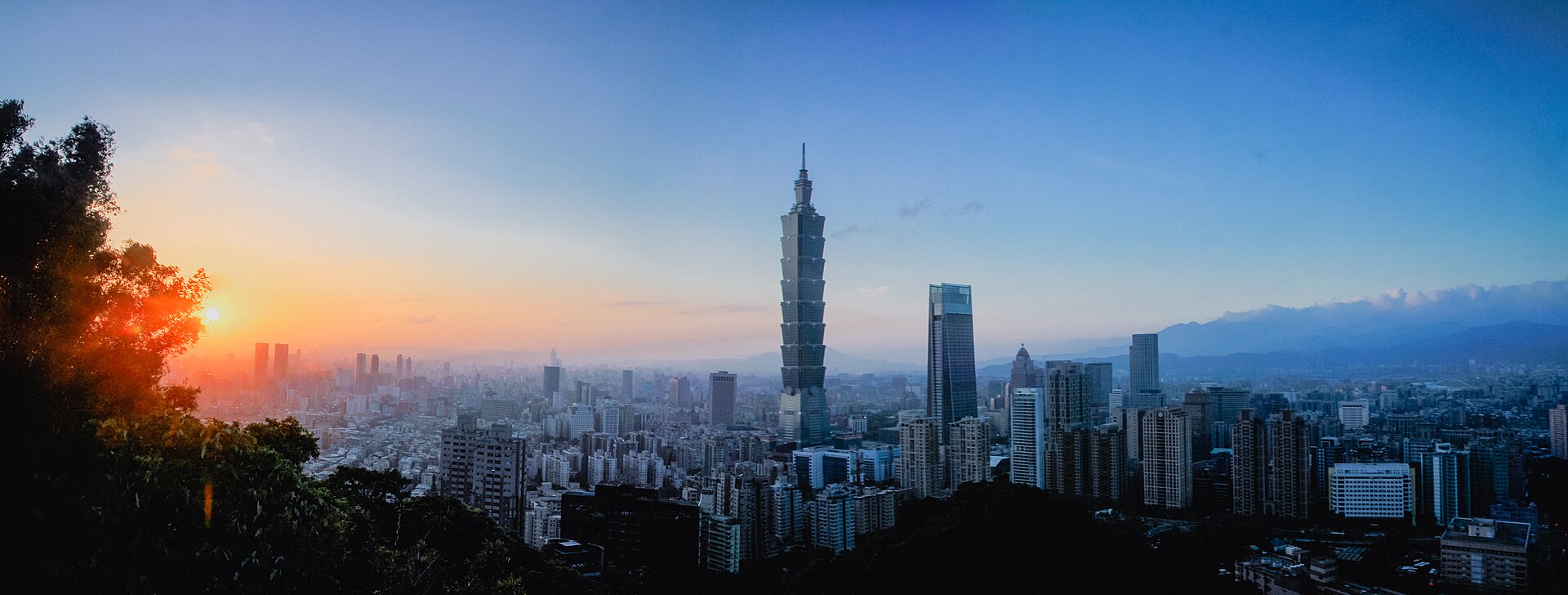
Taipei’s skyline, Tainan’s forts and mountain towns
Modern engineering and older streets reveal different layers of Taiwan’s history.
- Where is Fort Zeelandia?
- Its site is in Anping, Tainan, where Anping Old Fort preserves remains and later structures. The Dutch colonial base dates to the seventeenth century.
- Did Jiufen inspire Spirited Away?
- That popular association is not established as the film’s origin. Jiufen is a former mining town whose hillside streets and teahouses attract visitors.
- What does Taipei 101’s mass damper do?
- It helps reduce the building’s movement in strong winds and other shaking. The suspended mass works with the tower’s broader structural design and engineering.
More about Taiwan: landmarks
Taipei 101 opened in 2004 and held the world’s tallest-building title before Dubai’s Burj Khalifa opened in 2010. Its tuned mass damper helps reduce swaying; it is one part of the structure’s wider engineering system. The National Palace Museum holds a major collection of Chinese art and historical objects, much of it moved from mainland China in the twentieth century. Longshan Temple in Wanhua remains an active religious site, and the Chiang Kai-shek Memorial Hall sits within Liberty Square, a place connected with both official commemoration and democratic public assembly.
Tainan’s Anping Old Fort occupies the site of the Dutch Fort Zeelandia, with surviving traces and later rebuilding. Kaohsiung combines port landscapes with Fo Guang Shan’s Buddhist institutions and contemporary cultural venues. Jiufen is a former mining town known for hillside lanes and teahouses; a popular comparison with Spirited Away is not evidence that the town inspired the film. Sun Moon Lake lies in Nantou’s central foothills, beside Thao community heritage. Kinmen’s settlements and fortifications and Matsu’s island villages tell different offshore histories. Natural places and historic buildings are lived environments as well as sightseeing destinations.
Taiwanese communities and connections abroad
Overlapping identities, Indigenous nations and a population shaped by migration.
- Who are the Tao people?
- An Indigenous people especially associated with Lanyu, or Orchid Island. Their language belongs to the Austronesian family, and canoe-building is a distinctive cultural tradition.
- Who was Taiwan’s first woman president?
- Tsai Ing-wen, first elected in 2016, served two terms ending in 2024. Her presidency followed several decades of electoral competition and democratic reform.
- Do all Taiwanese people share one language and identity?
- Taiwan includes overlapping Indigenous, Hoklo, Hakka, mainland migration and newer immigrant histories. People’s language choices and identities vary across families, generations and settings.
More about Taiwan: people & society
Taiwan has roughly 23 million residents, with population concentrated in the western urban corridor. Most residents have Han ancestry, including families with Hoklo, Hakka and later mainland migration histories, but ancestry does not determine a person’s language or political identity. Indigenous peoples include Amis, Atayal, Paiwan, Bunun, Tao and many other communities. Government recognition categories and community identities are not identical; legal recognition continues to develop. The Tao are especially associated with Lanyu, or Orchid Island, and its distinctive canoe-building traditions. Indigenous cultures are contemporary and diverse, not simply survivals from an earlier period.
Migration links Taiwan with Southeast Asia, mainland China and communities around the world. Migrant workers and newer immigrant families contribute to care, manufacturing, food and neighbourhood life. Ageing and low birth rates affect schools, housing and care needs. Tsai Ing-wen became the first woman elected president in 2016; Lee Teng-hui was elected in the first direct presidential vote in 1996. Film director Ang Lee and technology executive Jensen Huang, born in Tainan, are two internationally known figures, but public life also depends on teachers, carers, artists, farmers and community organisers whose work rarely becomes a global headline.