Facts about Syria
Discover Syria through the courtyards of Damascus, Aleppo’s trading streets, coastal mountains and the Euphrates valley. Explore sixteen sights and learn how ancient cities, living crafts, regional cooking and many languages connect across the country and its diaspora.
- Capital
- Damascus
- Currency
- Syrian pound (SYP)
- Official language
- Arabic
- Governorates
- 14
- Coast
- Mediterranean Sea
- UNESCO World Heritage
- 6 properties
Syria · 0 of 20 rounds passed
Two timed rounds per topic, 20 seconds a question
Syria lies on the eastern Mediterranean, between Türkiye, Iraq, Jordan, Israel and Lebanon. Damascus sits beside the Ghouta oasis in the southwest. Aleppo anchors the north, Homs and Hama connect the western interior and Latakia and Tartus look towards the sea. Eastwards, the Euphrates links Raqqa and Deir ez-Zor with farmland and much drier steppe. The landscapes change sharply over distances that can look small on a map.
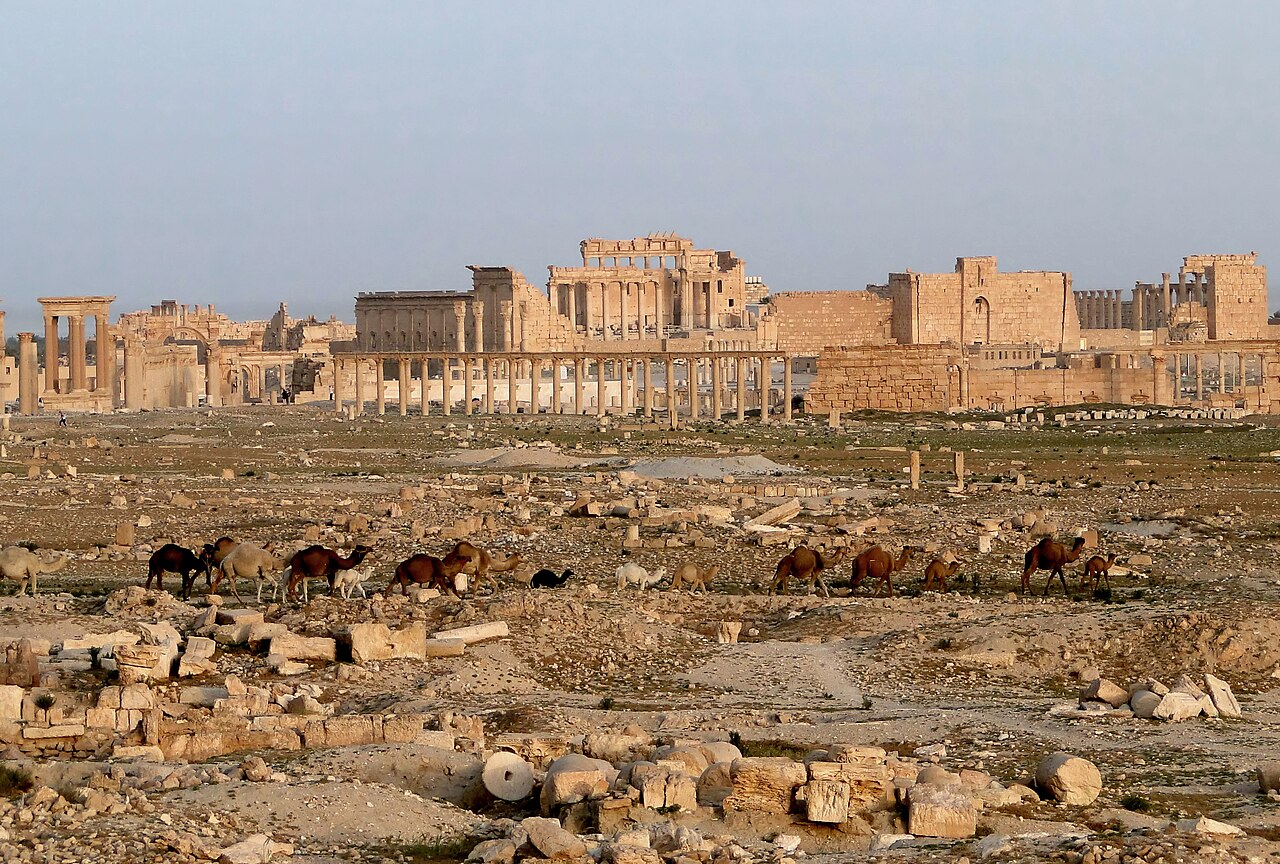
Palmyra’s caravan history, Bosra’s basalt theatre and the medieval castles are part of a wider heritage that also includes village churches, family workshops and music. War has destroyed buildings and displaced communities, while restoration and cultural work continue. This is a guide for learning about places. Official travel advice and site access must be checked separately, and older photographs can show features that have since been damaged or lost.
Geography of Syria
A Mediterranean coast, western mountain ranges and river valleys beside dry steppe.
- Does Syria have a Mediterranean coast?
- Yes. Latakia and Tartus are coastal cities in the west, separated from much of the interior by mountain ranges.
- Where does the Euphrates go after crossing Syria?
- It continues into Iraq. In Syria it passes through Lake Assad and follows the valley past Raqqa and Deir ez-Zor.
- Are Damascus and Rif Dimashq the same governorate?
- No. Damascus is a small, separate governorate. Rif Dimashq surrounds the capital and extends into a much wider area.
History of Syria
Bronze Age kingdoms, caravan cities and an Umayyad capital belong to different eras.
- Why are Ugarit’s texts important?
- They include an alphabetic cuneiform writing system. It is distinct from the much larger sign inventories of other cuneiform traditions.
- Which caliphate made Damascus its capital in 661 CE?
- The Umayyad caliphate. The city’s Great Mosque dates from the early eighth century.
- When did Syria gain full independence from France?
- In 1946. The modern state had previously been under the French mandate.
Arabic, Kurdish and Syria’s other languages
Arabic has regional spoken varieties, alongside Kurdish, Armenian and Aramaic traditions.
- Is Modern Standard Arabic identical to everyday Syrian speech?
- No. It is the formal standard. Everyday Arabic includes regional spoken varieties, with differences between Damascus, Aleppo and other areas.
- Which Kurdish variety does the linked course introduce?
- Kurmanji, using Latin spelling. Many Syrian Kurdish communities speak Kurmanji, but the course is an introduction rather than a description of every local variety.
- What language is associated with Maaloula?
- Western Neo-Aramaic. It belongs to a different branch of Aramaic from the Syriac traditions associated with other communities.
Culture of Syria
Songs, glassblowing and olive and laurel oil soap carry skills between generations.
- What is al-Qudoud al-Halabiya?
- A traditional vocal repertoire associated with Aleppo and recognised by UNESCO as intangible cultural heritage.
- Which oils are used in Aleppo ghar soap?
- Olive oil and laurel oil. The traditional craftsmanship was inscribed on UNESCO’s Representative List in 2024.
- What is the Damascene rose tradition in Al-Mrah?
- Knowledge of growing roses and making products such as rose water. It is a living craft practised by families and farmers.
Economy of Syria
Farming, trade and skilled work depend on rebuilding services and reliable water.
- What is Syria’s national currency?
- The Syrian pound, abbreviated SYP. Exchange rates and payment access can change quickly.
- Why do electricity and water matter to recovery?
- They support homes, hospitals, farming and businesses. Repairing buildings alone cannot restore daily services and livelihoods.
- Which cities are Syria’s main Mediterranean ports?
- Latakia and Tartus. Their coastal position connects them with shipping and inland trade routes.
Politics of Syria
The post-Assad transition has its own institutions and a 2025 constitutional declaration.
- What changed in December 2024?
- Bashar al-Assad’s government fell, ending decades of Assad family rule and beginning a new political transition.
- What period did the March 2025 constitutional declaration set out?
- A five-year transitional framework. Its legal provisions should be distinguished from implementation and conditions on the ground.
- What does Syria’s current flag look like?
- Three horizontal bands of green, white and black, with three red stars in the white band. The 2025 constitutional declaration specifies this design.
Nature & Wildlife of Syria
Coastal woodland and mountain habitats contrast with dry steppe and irrigated valleys.
- Is Lake Assad a natural lake?
- No. It is a reservoir created on the Euphrates. Its water level changes with river flow and management.
- Is all of Syria desert?
- No. It also has Mediterranean coastal areas, mountain woodland, farmland and river habitats alongside dry steppe and desert.
- Does the waters map show today’s shoreline?
- No. It uses a generalised reference outline. Reservoir coverage changes with water levels.
Food & Cuisine of Syria
Kibbeh, pepper and walnut dips, filled vegetables and regional sweets.
- Does kibbeh describe only one dish?
- No. It is a family of preparations, often using bulgur and meat, served in different shapes and cooking styles.
- What are the main ingredients in muhammara?
- Peppers and walnuts, with seasoning varying between recipes. It is associated with Aleppine and wider Levantine cooking.
- What gives kibbeh safarjaliyeh its fruit flavour?
- Quince. This Aleppine preparation combines kibbeh with a fruit-based sauce.
Landmarks of Syria
Six World Heritage properties span cities, castles, an oasis and ancient villages.
- How many UNESCO World Heritage properties does Syria have?
- Six. The two castles share one inscription, and the Ancient Villages of Northern Syria form a single serial property.
- Do old Palmyra photographs establish what survives today?
- No. Several major monuments were deliberately destroyed, including the temples of Bel and Baalshamin and the monumental arch.
- What is distinctive about Bosra’s Roman theatre?
- It is built from dark basalt and was later incorporated into a fortress. It belongs to the wider Ancient City of Bosra property.
People & Society of Syria
Overlapping identities, family networks and a diaspora connected across borders.
- Are ethnicity, language and religion interchangeable?
- No. They describe different, overlapping aspects of identity, and communities have varied histories and experiences.
- Where do Syrian communities live?
- Within Syria and across a large diaspora. Conflict has displaced people both internally and across borders, and some families have returned.
- Why does this guide avoid exact community percentages?
- Years of displacement and migration make older estimates a poor substitute for a current census.