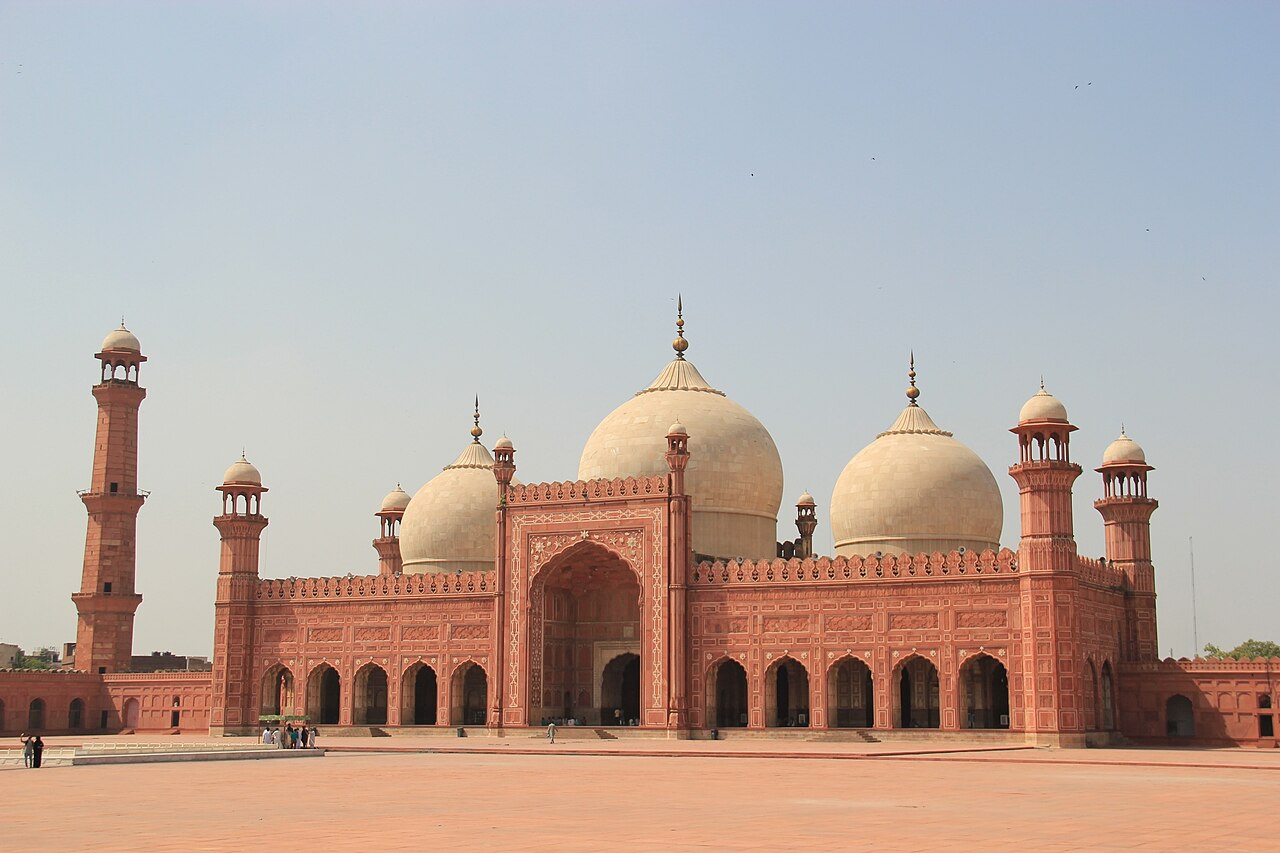
Facts about Pakistan
Pakistan follows the Indus from northern mountain valleys to the Arabian Sea. Lahore’s Mughal monuments, Karachi’s coastal streets, the Buddhist heritage of Gandhara and Sindh’s ancient cities reveal different chapters of the country.
- Capital
- Islamabad
- Currency
- Pakistani rupee (PKR)
- National language
- Urdu
- Provinces
- 4, plus distinct territories
- Independence
- 1947
- Coast
- Arabian Sea
Pakistan · 0 of 20 rounds passed
Two timed rounds per topic, 20 seconds a question
Islamabad is the capital, beside Rawalpindi and the Margalla Hills. Lahore anchors eastern Punjab, Karachi is a major commercial and port city in Sindh, Peshawar connects the northwest and Quetta serves the Balochistan plateau. Farther north, Gilgit and Skardu connect mountain valleys with the Karakoram and Himalaya.
Explore seven administrative learning areas with different statuses, twenty cities and towns, and selected rivers, a reservoir and the Arabian Sea. Sixteen heritage and landscape locations sit beside ten illustrated reading topics and practical Urdu lessons. The maps include the Pakistan-administered territories of Gilgit-Baltistan and Azad Jammu and Kashmir within the disputed Kashmir region; reference lines do not settle sovereignty claims.
Geography of Pakistan
The Indus connects northern mountains, irrigated plains and a delta on the Arabian Sea.
- Which river runs through Pakistan to the Arabian Sea?
- The Indus. Its tributaries and canals connect mountain water supplies with farming on the plains.
- Are K2 and Nanga Parbat in the same mountain range?
- No. K2 is in the Karakoram; Nanga Parbat is in the Himalaya.
- Which sea borders Pakistan?
- The Arabian Sea, part of the Indian Ocean.
More about Pakistan: geography
Pakistan lies in South Asia, beside Afghanistan, Iran, India and China. The Arabian Sea borders its south. The Indus runs from the high mountain region through the country to its delta in Sindh. Its tributaries and irrigation canals support farming across broad plains, while Balochistan contains extensive dry plateaus and the Thar Desert extends across the southeastern border with India.
The Karakoram, Himalaya and Hindu Kush meet in the wider northern mountain region. K2 belongs to the Karakoram, while Nanga Parbat belongs to the Himalaya. Snow and glacier melt help feed downstream rivers. Monsoon rain, extreme heat, drought and flooding affect different regions in different ways; a mountain valley and the Karachi coast do not share one climate.
History of Pakistan
Indus cities and Gandharan monasteries precede Mughal rule, partition and the modern republic.
- When did Pakistan become independent?
- In 1947, during the partition of British India.
- What happened to East Pakistan in 1971?
- It became independent Bangladesh after the Liberation War.
- Was Taxila part of the Bronze Age Indus civilisation?
- Taxila is best known for later settlements and Buddhist heritage in Gandhara. Mohenjo-daro and Harappa are major Indus civilisation sites.
More about Pakistan: history
Mohenjo-daro and Harappa preserve traces of the Bronze Age Indus civilisation. Much later, the Gandhara region became an important centre of Buddhist learning and art, represented at Taxila and Takht-i-Bahi. Mughal buildings in Lahore and Thatta belong to another chapter, followed by Sikh power in Punjab and British colonial rule.
Pakistan became independent in 1947 when British India was partitioned. Muhammad Ali Jinnah was its founding governor-general. Partition brought mass migration and widespread violence. The new state had western and eastern wings separated by India. After political exclusion, a military crackdown and the 1971 Liberation War, the eastern wing became Bangladesh. Pakistan’s later history includes both civilian governments and periods of military rule.
Urdu and Pakistan’s other languages
Urdu connects speakers across communities, alongside English and many regional languages.
- Is Urdu everyone’s first language in Pakistan?
- No. It serves as a shared national language alongside many first languages, including Punjabi, Pashto and Sindhi.
- Is Urdu written from left to right?
- No. Its Perso-Arabic script runs from right to left.
- Is Urdu the same language as Arabic?
- No. Urdu belongs to the Indo-Aryan language group. A related writing system and borrowed words do not make it Arabic.
More about Pakistan: language
Urdu is Pakistan’s national language and an important shared language, but it is not most Pakistanis’ first language. Punjabi, Pashto, Sindhi, Saraiki, Balochi, Hindko and Brahui are among the languages spoken at home. Shina, Balti and Burushaski add to the diversity of the northern mountain region. Language and regional identity overlap without fitting into neat provincial boxes.
Urdu is an Indo-Aryan language, closely related to Hindi in everyday grammar and much spoken vocabulary. It is written from right to left in a Perso-Arabic script, often in the flowing Nastaliq style. English also has a substantial role in administration and education. The Urdu lessons here introduce greetings, numbers, food words and practical conversation; they represent one entry into a multilingual country.
Culture of Pakistan
Poetry, devotional music, craft traditions and cricket create shared spaces across regional cultures.
- What is qawwali?
- A form of Sufi devotional music that brings together sung poetry and musical performance.
- What is Pakistani truck art?
- The decoration of vehicles with painted images, lettering, patterns and other ornaments.
- What does Lok Virsa’s museum explore?
- The living heritage of different communities, including crafts, music, clothing and everyday life.
More about Pakistan: culture
A painted truck, an embroidered shawl and a poetry recital offer different glimpses of cultural life. Urdu and regional-language literature have long traditions, while qawwali brings poetry and music into Sufi devotional performance. The shalwar kameez has many local styles. Craft, clothing and music vary between Punjab, Sindh, Balochistan, Khyber Pakhtunkhwa and the northern valleys.
Eid gatherings are important to many Muslim families; Hindu, Christian, Sikh and other communities maintain their own celebrations and places of worship. Cricket has a large following, alongside histories of achievement in hockey and squash. Islamabad’s Lok Virsa Heritage Museum presents crafts, domestic settings and performing traditions from different communities, a useful reminder that national culture contains many regional stories.
Economy of Pakistan
Farming, textile production, trade and services link the river plains with industrial cities and ports.
- What is Pakistan’s currency?
- The Pakistani rupee, with international code PKR.
- Which manufacturing sector is important to exports?
- Textiles and clothing, including production linked with cotton.
- Why does the Indus matter to farming?
- Its river and canal system provides irrigation across extensive agricultural plains.
More about Pakistan: economy
Pakistan uses the Pakistani rupee, abbreviated PKR. Textile and clothing production are important export industries, connected with cotton growing and manufacturing centres such as Faisalabad. Wheat, rice, sugarcane, fruit and livestock support farming households. Irrigation from the Indus system is central to agriculture, though water availability and flood damage vary sharply between seasons and regions.
Karachi is a major commercial and port city. Services, small businesses and money sent home by Pakistanis working abroad also support livelihoods. Energy costs, access to education and jobs, public finances and climate hazards affect economic opportunity. A national growth figure cannot describe the experience of every household, and the work of informal traders and farmers matters alongside large factories.
Government and regions of Pakistan
Four provinces, a federal capital territory and separately administered territories have different statuses.
- Does the guide show seven provinces?
- No. It distinguishes four provinces, Islamabad Capital Territory and the separately administered territories of Azad Jammu and Kashmir and Gilgit-Baltistan.
- What are the two houses of parliament?
- The National Assembly and the Senate.
- Do these maps resolve the Kashmir dispute?
- No. They are generalised learning maps, with no position on competing sovereignty claims.
More about Pakistan: politics
Pakistan’s constitutional framework is a federal parliamentary republic. The president is head of state and the prime minister heads the government. Parliament has two houses: the National Assembly and the Senate. Islamabad is the federal capital. Elected institutions operate within a political history shaped by military interventions and continuing debates over representation and civilian authority.
The four provinces are Punjab, Sindh, Khyber Pakhtunkhwa and Balochistan. Islamabad Capital Territory is separate. Azad Jammu and Kashmir and Gilgit-Baltistan are separately administered by Pakistan within the disputed Kashmir region; they are not two additional provinces. The seven areas on the learning map therefore have different constitutional statuses. Generalised reference boundaries do not settle sovereignty claims or show present military control.
Nature and wildlife of Pakistan
Mountain habitats, river channels, deserts and coastal mangroves support very different wildlife.
- Is the Indus river dolphin a sea animal?
- No. It is a freshwater dolphin associated with the Indus river system.
- Which large mammal is protected at Deosai?
- The Himalayan brown bear, along with its high plateau habitat.
- Where are Pakistan’s coastal mangroves?
- Important mangrove habitats lie in the Indus delta on the Arabian Sea coast.
More about Pakistan: nature & wildlife
Snow leopards inhabit high mountain landscapes, while markhor climb steep rocky slopes. On the Deosai plateau, a national park protects habitat for Himalayan brown bears. These species need space and suitable habitat; seeing a mountain on a map does not guarantee a wildlife sighting. Northern ecosystems also depend on seasonal snow and short growing seasons.
Far downstream, the Indus river dolphin lives in freshwater channels. Irrigation structures, reduced flows, fishing gear and pollution create conservation challenges. Mangroves in the Indus delta shelter coastal wildlife and help protect shorelines. Rivers connect these environments, so decisions about water upstream affect farming, wetlands and the coast as well as the mountains themselves.
Food of Pakistan
Breads, rice, lentils and regional meat dishes sit alongside tea, fruit and sweets.
- What is nihari?
- A slow-cooked meat stew, often served with bread.
- What is a chapli kebab?
- A flattened, seasoned minced-meat patty associated with Pashtun cooking.
- What is lassi?
- A yoghurt-based drink, with sweet and salty versions.
More about Pakistan: food & cuisine
Roti and naan accompany many meals, while rice appears in biryani and pulao. Dal, vegetables, yoghurt and pickles belong on everyday tables as well as meat dishes. Biryani layers seasoned rice with other ingredients; pulao follows a different preparation, with rice cooked in a flavoured stock. Recipes vary by household and region.
Nihari is a slow-cooked meat stew, while karahi takes its name from the pan in which it is cooked. Chapli kebabs are flattened spiced meat patties associated with Pashtun cooking, and sajji is associated with Balochistan’s roasting traditions. Chai, lassi and sweets such as gulab jamun are familiar accompaniments to social visits and celebrations. No single dish stands for every Pakistani kitchen.
Landmarks of Pakistan
Ancient cities, Buddhist monasteries and Mughal gardens connect places across the country.
- Are Lahore Fort and Shalamar Gardens separate World Heritage properties?
- No. Together they form one inscribed property.
- Is Badshahi Mosque included in that inscription?
- No. The nearby mosque is a distinct monument.
- Is Taxila a single ancient building?
- No. The World Heritage property includes multiple settlements, monasteries and other archaeological remains.
More about Pakistan: landmarks
Pakistan’s six inscribed UNESCO World Heritage properties include Mohenjo-daro, Taxila, Takht-i-Bahi with Sahr-i-Bahlol, the Fort and Shalamar Gardens in Lahore, Makli’s historical monuments at Thatta, and Rohtas Fort. These are six properties, not six individual buildings. Lahore’s fort and gardens form one inscription, while Taxila contains several archaeological sites.
Badshahi Mosque faces Lahore Fort across Hazuri Bagh, but it is not itself part of that World Heritage inscription. Islamabad’s Faisal Mosque represents modern architecture, and Mazar-e-Quaid in Karachi commemorates Jinnah. The forts of Hunza and the landscapes of Deosai add different mountain histories. Check local permissions, conditions and official travel advice before turning a learning map into a journey.
People and everyday life in Pakistan
Regional identities, multilingual households and migration connect cities, villages and families abroad.
- Does a mother tongue identify someone’s entire background?
- No. Language, ethnicity, religion and regional identity overlap without being interchangeable.
- What does Muhajir refer to in Pakistan?
- An identity associated with Muslim migrants from India around partition and their descendants.
- Do all Pakistani families live in cities?
- No. Cities, smaller towns and rural communities remain connected through family ties, work and migration.
More about Pakistan: people & society
Punjabi, Pashtun, Sindhi, Baloch, Saraiki and many other identities belong to Pakistan’s social landscape. Northern communities include Shina, Balti and Burushaski speakers, among others. A language label is not a complete description of ethnicity, religion or personal identity. People often move between a home language, Urdu and English in different parts of daily life.
Karachi and Lahore are major urban centres, while many families maintain links with villages and smaller towns. Muhajir identity is associated with Muslims who migrated from India around partition and their descendants. Later migration within Pakistan and work abroad have created further networks. Muslim communities form the majority, alongside Hindu, Christian, Sikh and other minorities; experiences differ by place, income and community.