Facts about Nigeria
Explore Nigeria from Lagos and the Niger Delta to the Jos Plateau, northern trading cities and eastern highlands. Follow rivers across West Africa, discover regional food and music, and begin Hausa, Yoruba or Igbo.
- Capital
- Abuja
- Currency
- Nigerian naira (NGN)
- Official language
- English
- Federal divisions
- 36 states + FCT
- Independence
- 1 October 1960
- Highest point
- Chappal Waddi, about 2,419 m
Nigeria · 0 of 20 rounds passed
Two timed rounds per topic, 20 seconds a question
Abuja stands in the central Federal Capital Territory, while Lagos stretches around lagoons on the southwest coast. Ibadan, Abeokuta, Ile-Ife and Osogbo introduce southwestern city histories. Benin City and the commercial centres of Onitsha and Aba lead towards the delta and southeast; Calabar faces the Cross River estuary. Inland, Lokoja marks the Niger–Benue confluence, Jos occupies its plateau and Kano, Sokoto, Katsina and Maiduguri connect northern histories and trade networks.
Three map games cover 36 states plus the FCT, 30 cities and 11 waters. Fifteen sights, ten illustrated topics, thirty answered questions and eighty reviewed quiz questions connect the map with history and daily life. The Niger and Benue retain their available full courses outside Nigeria, shared water shapes stay whole and marine areas extend beyond the country camera. The Hausa, Yoruba and Igbo lessons introduce three of Nigeria’s many languages rather than a single national language.
Geography of Nigeria
The Niger and Benue meet at Lokoja between the northern savannas and a wetter Atlantic south.
- Is Lagos the capital of Nigeria?
- Abuja is the federal capital, a role transferred from Lagos in 1991. Lagos remains a major commercial and cultural centre on the southwest coast.
- Where do the Niger and Benue meet?
- They meet at Lokoja in Kogi State. The Niger then continues towards its delta, connecting inland river landscapes with the Gulf of Guinea.
- How many states does Nigeria have?
- Nigeria has 36 states plus the Federal Capital Territory containing Abuja. The territory is separate from the states and is included as its own map target.
More about Nigeria: geography
Nigeria lies in West Africa, with Benin to the west, Niger to the north, Chad at the northeastern lake boundary and Cameroon to the east. Its southern coast faces the Gulf of Guinea. The Niger rises in Guinea, makes a great inland bend through Mali and passes through Niger before entering Nigeria. At Lokoja it meets the Benue, which rises in Cameroon. The combined river flows south towards the branching Niger Delta. These river systems connect several countries rather than stopping at Nigeria’s borders.
Mangroves and low coastal plains give way to forest and savanna inland, with drier conditions towards the Sahel in the far north. The Jos Plateau and eastern highlands interrupt the lower plains. Lagos is a major coastal city; Abuja became the federal capital in 1991. Nigeria has 36 states and a separate Federal Capital Territory. The six commonly used geopolitical zones group states for regional discussion; they are not six extra governments. Lake Chad’s open water and surrounding wetlands change with rainfall, inflow and water use.
History of Nigeria
Nok terracottas, regional kingdoms, colonial amalgamation, independence and the Fourth Republic mark different eras.
- When did Nigeria become independent?
- Nigeria became independent from Britain on 1 October 1960. It became a republic in 1963, three years after independence, with Nnamdi Azikiwe as president.
- When was the Nigerian Civil War?
- The war lasted from 1967 to 1970 after Biafra declared independence. Fighting, displacement and starvation caused profound suffering, especially in the southeast.
- When did Nigeria’s Fourth Republic begin?
- The Fourth Republic began on 29 May 1999 with the return to elected civilian national government after years of military rule.
More about Nigeria: history
The territory of present-day Nigeria has many histories. Nok communities in central Nigeria produced terracotta sculpture long before the modern state. Ile-Ife became an important Yoruba religious and artistic centre, while the Benin kingdom developed a court tradition of brass and bronze casting. Hausa city-states and Kanem-Bornu participated in northern trade networks. Usman dan Fodio’s movement established the Sokoto Caliphate in the early nineteenth century. These societies were distinct; their names do not describe one continuous national kingdom.
British conquest and colonial administration brought different regions under one state, with the Northern and Southern protectorates amalgamated in 1914. Nigeria became independent on 1 October 1960 and a republic in 1963, with Nnamdi Azikiwe as its first president. Coups in 1966 preceded the Nigerian Civil War of 1967–1970, fought after Biafra’s secession. Mass displacement and starvation remain central to memories of that war. Military and civilian periods followed before the Fourth Republic began on 29 May 1999.
Languages of Nigeria
English, Nigerian Pidgin and hundreds of Indigenous languages connect different communities and settings.
- Which language is official in Nigeria?
- English is used officially in federal government and much formal education. Everyday communication also draws on Nigerian Pidgin and hundreds of Indigenous languages.
- Are Hausa, Yoruba and Igbo Nigeria’s only languages?
- No. They are widely spoken languages within a much larger landscape that also includes Kanuri, Fulfulde, Tiv, Edo, Ibibio, Nupe and many others.
- What does “How far?” mean in Nigerian Pidgin?
- It commonly works as an informal greeting similar to “How are you doing?” Its meaning depends on the situation rather than always asking about distance.
More about Nigeria: language
English is used officially in federal government and much formal education. Hausa, Yoruba and Igbo have large communities of speakers, but they are three among hundreds of Nigerian languages. Hausa also serves regional communication beyond Nigeria, including in Niger. Yoruba is widely spoken in the southwest and neighbouring Benin, while Igbo varieties are associated especially with the southeast. Fulfulde, Kanuri, Tiv, Edo, Ibibio, Nupe and Ijaw languages illustrate a much wider linguistic landscape. No state boundary neatly encloses a single language.
Nigerian Pidgin is an English-based language used across communities in conversation, broadcasting, comedy and popular music. Some people acquire it as a first language; others use it alongside several languages. “How far?” can serve as an informal greeting, “wahala” refers to trouble and “oga” can mean a boss or leader. Meaning depends on context and tone. The linked Hausa, Yoruba and Igbo courses offer three starting points; none is presented as the one language spoken by everyone in Nigeria.
Culture, cinema and music of Nigeria
Nollywood, Kannywood, Afrobeat, Afrobeats and internationally influential writers tell different Nigerian stories.
- What is Nollywood?
- Nollywood commonly refers to Nigeria’s film industry. Its productions span several languages and circulate through cinemas, television, streaming and home-video networks across Africa and beyond.
- Are Afrobeat and Afrobeats the same?
- Afrobeat is closely associated with Fela Kuti and Tony Allen. Afrobeats is a broader label for contemporary West African pop, including Nigerian and Ghanaian artists.
- Who wrote Things Fall Apart?
- Chinua Achebe wrote the novel, published in 1958. It follows Okonkwo and his community amid social change and the advance of British colonial power.
More about Nigeria: culture
Nollywood is a common name for Nigeria’s film industry, whose productions circulate through cinema, television, streaming and home video. The 1992 release Living in Bondage became a landmark of the video-film era, although Nigerian filmmaking has earlier histories. Hausa-language cinema is often called Kannywood. Production takes place in several languages and cities. In literature, Chinua Achebe’s Things Fall Apart appeared in 1958; Wole Soyinka received the Nobel Prize in Literature in 1986. Writers such as Buchi Emecheta and Chimamanda Ngozi Adichie reach readers around the world.
Fela Kuti, working with musicians including drummer Tony Allen, helped develop Afrobeat, combining musical experimentation with political commentary. Afrobeats, with a final s, is a broader label for contemporary West African popular music, especially from Nigeria and Ghana. The terms are related in history but do not name the same genre. Yoruba adire resist-dyed cloth, Igbo masquerade traditions and northern Durbar celebrations show other forms of cultural expression. Practices differ across communities and occasions; one festival cannot stand for every Nigerian experience.
Economy of Nigeria
Oil and gas exports sit alongside farming, manufacturing, markets, finance and creative businesses.
- What currency does Nigeria use?
- Nigeria uses the naira, with international code NGN and symbol ₦. One naira is divided into one hundred kobo, although small denominations see limited everyday use.
- Is Nigeria’s economy only about oil?
- No. Oil and gas exports matter, but farming, trade, manufacturing, finance, transport, technology and creative industries also support livelihoods across Nigeria’s regions.
- Which crops does Nigeria export?
- Cocoa and sesame are two examples of agricultural exports. Domestic farming also produces major food staples such as cassava, yam, maize, rice and sorghum.
More about Nigeria: economy
Petroleum and natural gas are important exports, with production associated especially with the Niger Delta and offshore fields. Nigeria joined OPEC in 1971. Oil export receipts and public revenue matter greatly, but petroleum does not describe all employment or economic activity. Farmers grow cassava, yam, maize, rice, sorghum and other crops; cocoa and sesame are among agricultural exports. The national currency is the naira, abbreviated NGN and written with the symbol ₦.
Lagos concentrates finance, ports, technology businesses and creative industries. Onitsha and Aba are important commercial centres, while cities throughout the country connect regional markets and workshops. Manufacturing includes cement, food processing, textiles and petroleum refining. The Dangote Group operates across several industries, including cement. Electricity supply, transport costs, inflation and access to finance affect businesses and households. Conditions and rankings change, so a company’s size or an individual’s wealth is not used as a timeless national fact.
Government and federal structure of Nigeria
A president, a two-chamber National Assembly, 36 states and the FCT form the federal framework.
- What are the two chambers of Nigeria’s legislature?
- The National Assembly consists of the Senate and House of Representatives. The Senate has 109 seats, while the House has 360 seats.
- Is the Federal Capital Territory a state?
- No. The FCT is a separate territory containing Abuja, with its own federal administrative arrangement. Nigeria has 36 states in addition to this territory.
- How long is a Nigerian presidential term?
- A term lasts four years, and a person may be elected president no more than twice. Elected state governors also serve four-year terms.
More about Nigeria: politics
Nigeria is a federal presidential republic under the 1999 constitution, as amended. The president combines the roles of head of state and head of government. A presidential term lasts four years, with a two-term limit. The National Assembly has two chambers: the Senate and the House of Representatives. The Senate has 109 seats, with three for each state and one for the FCT; the House has 360 seats. The Supreme Court is the highest court.
Each of the 36 states has a governor and legislature. The Federal Capital Territory containing Abuja has a different federal administrative arrangement and is not a thirty-seventh state. Local government areas form another tier below the states. The six geopolitical zones are regional groupings rather than constitutional states. Questions about representation, public services, resource revenue and security shape political debate. These generalised learning maps show administrative reference areas; they do not represent electoral results or establish current access conditions.
Nature and conservation in Nigeria
Mangroves, Cross River forests, savannas and eastern mountains support very different habitats.
- Where do Cross River gorillas live?
- They live in fragmented forest landscapes of Nigeria and Cameroon. Protecting remaining habitat and connections between forest areas is central to their conservation.
- What is Nigeria’s highest mountain?
- Chappal Waddi reaches about 2,419 metres in the eastern highlands near Cameroon, within the mountainous landscape associated with Gashaka Gumti National Park.
- Does the Lake Chad map show today’s entire wetland?
- No. It shows a complete generalised open-water polygon from Natural Earth. Seasonal marshes and the wider basin extend beyond that reference shape.
More about Nigeria: nature & wildlife
The sheltered Niger Delta coast supports mangroves, tidal channels and fisheries. Inland forest survives in protected areas including Cross River and Okomu, while savannas cover extensive central and northern areas. Gashaka Gumti National Park spans mountainous country in Adamawa and Taraba. Nigeria’s highest mountain, Chappal Waddi, rises to about 2,419 metres near Cameroon. Cross River gorillas survive in fragmented forests on both sides of the Nigeria–Cameroon border; conservation depends on habitat connections rather than political boundaries alone.
Yankari Game Reserve is associated with African elephants, savanna wildlife and warm springs. The Hadejia–Nguru wetlands support waterbirds, fishing and farming in the northeast. Lake Chad’s seasonal wetlands extend beyond its changing open-water pools, making a single shoreline a poor description of the whole ecosystem. Forest clearance, wildlife hunting, pressure on water and pollution affect habitats. Oil spills have damaged parts of the Niger Delta. Protected-area status does not by itself establish that a site is currently accessible to visitors.
Food and regional cooking of Nigeria
Jollof, egusi, pounded yam, garri, moi moi and suya offer different grains, roots and textures.
- What is egusi soup made with?
- Ground melon seeds give egusi soup its characteristic thickening. Leafy vegetables, oil, fish, meat and seasonings vary between recipes, regions and households.
- What is suya?
- Suya is spiced grilled meat, commonly sold on skewers. It is associated especially with Hausa culinary traditions and is enjoyed widely across Nigeria.
- What is moi moi?
- Moi moi is a steamed bean preparation, usually made from ground peeled beans and seasonings. Additional ingredients and wrapping methods vary between cooks.
More about Nigeria: food & cuisine
Nigerian cooking varies across regions and households. Jollof rice is cooked with a seasoned tomato-based mixture and features at celebrations; its wider West African history reaches beyond the friendly Nigeria–Ghana rivalry. Pounded yam is a smooth starch served with soup or stew. Garri is processed from cassava, while egusi soup uses ground melon seeds as a thickener. The word soup can describe preparations much thicker than a clear broth. Leaves, oils, fish and meat vary by recipe.
Moi moi is a steamed bean preparation, often made with peeled beans and seasonings. Akara are fried bean fritters. Suya is spiced grilled meat associated especially with Hausa food traditions and now sold widely; yaji is a familiar spice mixture used for it. Pepper soup has a fragrant, spicy light broth, prepared with different fish or meats. Northern dishes also use millet and sorghum, while coastal and river communities have strong fish traditions. No single dish or ingredient represents every Nigerian table.
Landmarks and heritage of Nigeria
Sacred groves, Sukur’s stone landscape, palace traditions, city rocks and modern architecture mark different histories.
- What is the Osun-Osogbo Sacred Grove?
- It is a sacred forest landscape beside Osogbo, with shrines and sculpture associated with Yoruba religious practice. UNESCO inscribed the property in 2005.
- Why is Sukur important?
- Sukur preserves a cultural landscape of stone architecture, terraces, settlement and iron-working history in Adamawa. UNESCO inscribed it as a World Heritage property in 1999.
- Are Zuma Rock and Aso Rock the same landmark?
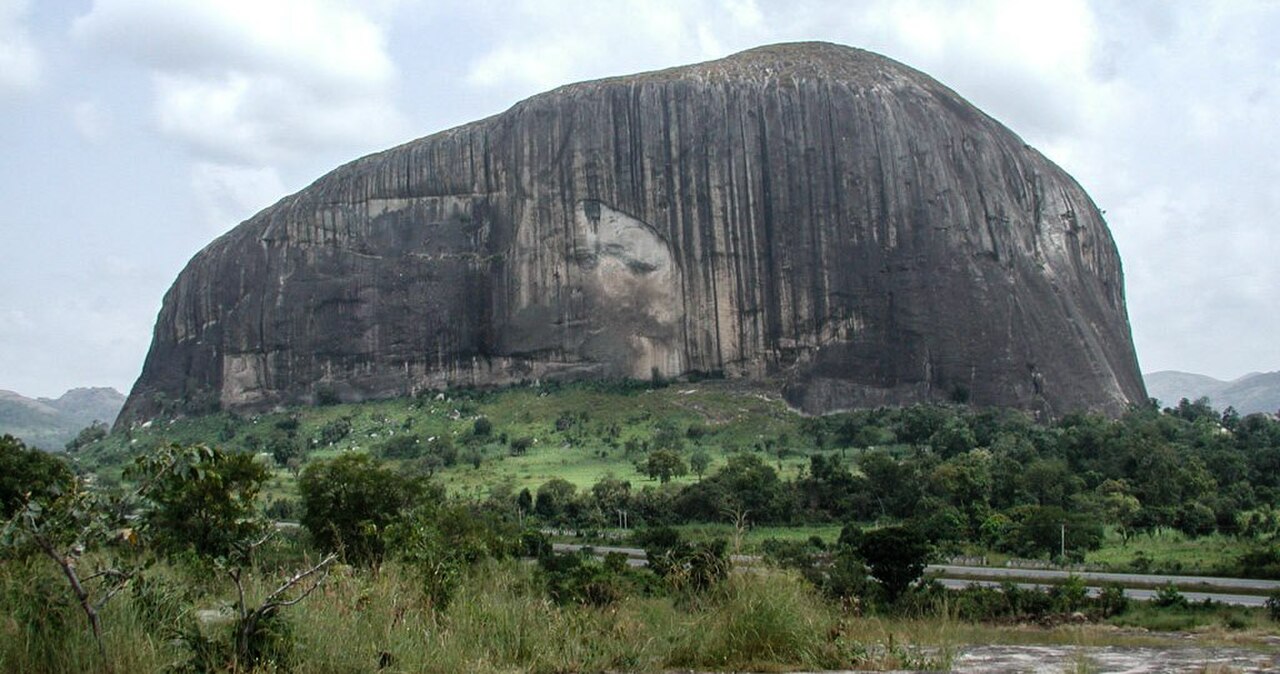
- No. Zuma Rock is in Niger State near Abuja, while Aso Rock stands beside Abuja’s federal government district. Their names describe different rock formations.
More about Nigeria: landmarks
The Osun-Osogbo Sacred Grove preserves a forest sanctuary associated with Yoruba religious practice beside Osogbo. Shrines, sculpture and an annual festival connect it with a living community. Sukur Cultural Landscape in Adamawa includes a hilltop settlement, stone architecture, terraces and evidence of iron working. Both are UNESCO World Heritage properties. Other important places include the palace traditions of Benin City and Ile-Ife, the walls and dye pits of Kano, and the historic emirate centres of Zaria and Katsina.
Olumo Rock stands above Abeokuta and is associated with Egba history. Zuma Rock rises in Niger State near Abuja; it should not be confused with Aso Rock beside the federal government district. Lagos combines older neighbourhoods, the National Theatre built for FESTAC 77 and modern structures such as the cable-stayed Lekki–Ikoyi Link Bridge. Abuja’s National Mosque is a different landmark from the northern city mosques. Sights pins mark representative locations for learning, not confirmed entrances or current opening arrangements.
People and communities of Nigeria
Africa’s most populous country has many regional identities, growing cities and far-reaching diaspora connections.
- Is Nigeria Africa’s most populous country?
- Yes. Nigeria has the largest population of any African country. Precise totals should be labelled with their reference year and identified as census counts or estimates.
- Which religions are practised in Nigeria?
- Islam and Christianity have large followings, alongside Indigenous religious traditions. Belief and practice vary within regions, communities, households and individual lives.
- Who is Ngozi Okonjo-Iweala?
- She is a Nigerian economist who became director-general of the World Trade Organization in 2021, the first woman and first African to hold that office.
More about Nigeria: people & society
Nigeria is Africa’s most populous country. Its population is comparatively young, but exact totals depend on the estimate and year; a dated census count is different from a later population projection. Hausa, Fulani, Yoruba and Igbo communities are among many groups with distinct and overlapping histories. Kanuri, Tiv, Edo, Ibibio, Ijaw, Nupe and numerous other communities belong to this landscape. Language, religion, ancestry and place of residence do not map onto one another in a single fixed pattern.
Islam and Christianity both have large followings, alongside Indigenous religious practices and varied combinations of belief. Cities bring people from different backgrounds together through markets, universities, workplaces and neighbourhood life. Migration connects Nigerian families with communities across Africa, Europe, North America and elsewhere. Public figures include economist Ngozi Okonjo-Iweala, who became director-general of the World Trade Organization in 2021, and Lagos-born basketball player Hakeem Olajuwon. Their careers illustrate international connections without defining the ambitions or experiences of every Nigerian.