Facts about Niger
Explore Niger from the Niger River and the southern Sahel to the Aïr Mountains, the Ténéré and the oases of the northeast. Ten illustrated topics connect landscapes with history, languages, music, food and everyday life.
- Capital
- Niamey
- Area
- About 1.27 million km²
- Currency
- West African CFA franc (XOF)
- National language (2025 charter)
- Hausa
- Working languages (2025 charter)
- French and English
- Independence
- 3 August 1960
Niger · 0 of 20 rounds passed
Two timed rounds per topic, 20 seconds a question
Niamey stands beside the Niger River in the southwest. Dosso, Maradi and Zinder connect the southern farming belt and cross-border trade, while Diffa and N’Guigmi orient the Lake Chad basin in the southeast. Niger and Nigeria are separate countries; Nigerien is the adjective used here.
Tahoua links the Sahel with the north. Agadez is a historic Saharan trading centre, Arlit is associated with uranium mining, and Bilma is an eastern oasis town. Twelve city pins and ten heritage and landscape locations introduce a large country with seven regions and the capital district of Niamey.
Geography of Niger
A Saharan north, a Sahelian south and a river crossing the southwest.
- Are Niger and Nigeria the same country?
- No. They are separate countries sharing a border. Niamey is Niger’s capital; Abuja is Nigeria’s.
- Where does the Niger River cross Niger?
- Across the southwest, flowing generally southeast from Mali toward Benin and Nigeria.
- What are the Aïr and Ténéré?
- The Aïr is a mountain massif in northern Niger; the Ténéré is a neighbouring Saharan desert region.
More about Niger: geography
Niger is a landlocked country in West Africa, distinct from its southern neighbour Nigeria. It covers about 1.27 million square kilometres and borders Algeria, Libya, Chad, Nigeria, Benin, Burkina Faso and Mali. Niamey, the capital, stands beside the Niger River in the southwest. The river crosses only one corner of the country; it does not run through the northern desert.
The Sahara occupies much of the north, where the rocky Aïr Mountains rise beside the sands of the Ténéré. Farther south, the Sahel supports rain-fed crops and grazing, with rainfall concentrated in a short wet season. The Diffa region belongs to the Lake Chad basin in the southeast. Lake shorelines and wetlands change with rainfall, river inflows and water use, so a fixed outline cannot describe every season.
History of Niger
Saharan trade, Sahelian states and independence on 3 August 1960.
- When did Niger become independent?
- On 3 August 1960, from France.
- Why was Agadez important before colonial rule?
- It connected Saharan caravan routes and served as the centre of the Aïr sultanate.
- Which city preceded Niamey as capital?
- Zinder, before the colonial administration moved the capital to Niamey in 1926.
More about Niger: history
Present-day Niger brings together regions with different histories. Songhay influence extended into the west, Hausa states shaped the south, and Kanem-Bornu connected the east with Lake Chad. Agadez developed as a major Saharan trading centre and the seat of an Aïr sultanate. Caravans moved salt, grain and other goods, while the history of slavery also forms part of these trading networks.
French colonial conquest brought these regions into French West Africa. Niger became independent on 3 August 1960, with Hamani Diori as its first president. Niamey had replaced Zinder as the colonial capital in 1926. Since independence, severe droughts, military coups, periods of elected government and Tuareg rebellions have shaped public life. The July 2023 coup removed President Mohamed Bazoum and began the present military-led transition.
Hausa and Niger’s languages
Hausa and Zarma meet Tuareg, Fulani, Kanuri and other linguistic worlds.
- What language roles does the 2025 charter specify?
- Hausa is named as the national language; English and French are working languages.
- Where is Zarma widely spoken?
- In the southwest, including the wider Niamey region.
- What is the difference between Ajami and Tifinagh?
- Ajami adapts Arabic script to other languages, including Hausa. Tifinagh is a separate writing tradition associated with Amazigh and Tuareg languages.
More about Niger: language
Hausa is the most widely spoken first language in Niger and an important language of trade across the border with Nigeria. Zarma and related Songhay varieties are prominent in the southwest. Tuareg communities speak related Tamajaq varieties, often grouped under broader names such as Tamasheq. Fulfulde, Kanuri, Tebu languages and others belong to the country’s linguistic life. Ethnic identity, home language and the languages used at work do not always coincide.
The 2025 Refoundation Charter names Hausa as the national language and English and French as working languages. This differs from the arrangements under the suspended 2010 constitution and does not mean that other community languages have disappeared. Hausa has traditions of Arabic-derived Ajami writing as well as Latin spelling; Tuareg languages also have a distinct Tifinagh tradition. The linked Hausa and French courses introduce those languages generally, rather than every Nigerien variety.
Culture of Niger
Guitars, oral traditions, silverwork and gatherings with local meanings.
- What is Bombino known for?
- Tuareg guitar music and singing; his name is Omara Moctar.
- What connects Cure Salée with pastoral life?
- Seasonal gatherings around In-Gall are connected with grazing, livestock and social exchange.
- Do Gerewol and Cure Salée mean the same thing?
- No. Gerewol refers to Wodaabe performance traditions; Cure Salée is a wider pastoral gathering, although events may overlap.
More about Niger: culture
Nigerien music includes oral praise traditions, flute and string instruments, popular song and contemporary guitar music. Bombino, born Omara Moctar, is a Tuareg guitarist and singer from the Agadez region whose work has reached international audiences. Tuareg silverwork, including pendants often called crosses of Agadez, and leatherwork are living crafts with regional and family traditions rather than a single national style.
The Cure Salée gathering around In-Gall is associated with pastoral communities and the seasonal movement of livestock toward mineral-rich grazing. Gerewol performances are linked particularly with Wodaabe communities: men may dress, sing and dance in elaborate displays. These traditions are not interchangeable, and no festival represents everyone in Niger. Traditional wrestling, known as lutte traditionnelle, is another major arena of public celebration and competition.
Economy of Niger
Millet fields, livestock markets, uranium and oil depend on very different networks.
- Which crops are important in Niger?
- Millet, sorghum and cowpeas are important, alongside other crops suited to local conditions.
- What resource is associated with Arlit?
- Uranium, mined in the surrounding northern desert.
- What currency does Niger use?
- The West African CFA franc (XOF), issued by the BCEAO.
More about Niger: economy
Farming, herding and small-scale trade support many Nigerien households. Millet, sorghum and cowpeas are important crops; livestock connect rural producers with regional markets. Rainfall, access to pasture and the movement of goods across borders affect food availability and income. Nigeria is a major trading neighbour, while Niger’s landlocked position makes roads, border procedures and access to coastal ports especially significant.
Uranium mining around Arlit has long connected the northern desert with international energy markets. Oil production and the export pipeline toward Benin have added another source of revenue, but extractive exports do not describe the livelihoods of most households. Political disputes, insecurity and transport interruptions can affect these industries and wider trade. Niger uses the West African CFA franc, currency code XOF, issued by the BCEAO and linked to the euro at a fixed exchange rate.
Politics of Niger
A military-led transition follows the coup of July 2023.
- What happened in July 2023?
- A military coup removed President Mohamed Bazoum and interrupted elected government.
- Which framework followed in March 2025?
- The Refoundation Charter, establishing a military-led transition framework.
- How is Niger divided at the top administrative level?
- Seven regions plus the capital district of Niamey. The city map does not show their boundaries.
More about Niger: politics
The presidential guard removed elected president Mohamed Bazoum in July 2023. Military authorities subsequently led the state, and the Refoundation Charter adopted in March 2025 established a new transition framework. The suspended 2010 constitutional system should not be presented as the current operating government. Rules and institutions during a transition can change; this guide describes the framework adopted in 2025 rather than predicting an election date.
Niger has seven regions and the capital district of Niamey. National security, access to public services and relations with neighbouring states are central political issues. Niger joined Mali and Burkina Faso in the Alliance of Sahel States, and the three countries’ withdrawal from ECOWAS took effect in January 2025. Current official travel advice warns against all travel to Niger. The maps and heritage descriptions are learning material, and do not establish safe or permitted access.
Nature & Wildlife of Niger
Desert reserves, Sahelian giraffes and the river habitats of W.
- Why is W National Park called W?
- The name refers to W-shaped bends in the Niger River.
- Where are West African giraffes associated with Niger?
- The Kouré area in the southwest; conservation translocations have also taken giraffes to Gadabedji.
- What distinguishes the Aïr and Ténéré reserves from W?
- The former protect Saharan mountains and desert; W belongs to a more southerly savanna and river landscape.
More about Niger: nature & wildlife
Niger’s wildlife occupies contrasting habitats: mountain and desert environments in the north, dry savanna in the south, and wetter corridors along rivers and seasonal wetlands. The Aïr and Ténéré Natural Reserves protect an immense Saharan landscape associated with species such as the addax. Protection on paper does not guarantee wildlife abundance: drought, poaching, insecurity and habitat pressures have affected conservation.
West African giraffes survive in southwestern Niger, including the Kouré area, and conservation translocations have also re-established giraffes in the Gadabedji reserve. The W National Park area takes its name from bends in the Niger River and forms part of the transboundary W-Arly-Pendjari World Heritage property with Benin and Burkina Faso. Conservation depends on neighbouring communities and land use as well as park boundaries; these places are not presented as currently accessible excursions.
Food & Cuisine of Niger
Millet, sauces, cowpeas and moringa link meals with fields and seasons.
- What is tuwo?
- A thick cooked grain preparation, often made with millet or sorghum and served with a sauce.
- What is kilishi?
- Thin, seasoned dried meat, found in Niger and neighbouring countries.
- What leaf is often used in dambou?
- Moringa leaves, although recipes and other ingredients vary.
More about Niger: food & cuisine
Millet and sorghum are important grains in Niger. Thick cooked grain dishes, often called tuwo in Hausa, can be eaten with sauces made from vegetables, leaves, legumes or groundnuts. Rice also features in meals, particularly where markets or irrigation make it available. Dambou commonly combines steamed grain with leafy ingredients such as moringa. Recipes and names vary between households, languages and regions.
Cowpeas supply protein and are eaten in several forms, while milk and other dairy foods connect cooking with herding. Kilishi is thin dried meat seasoned with a spiced coating, a food tradition shared with neighbouring Nigeria and the wider region. Grilled meats are sold in towns and prepared for celebrations. A photograph of millet at a market shows an ingredient, not a finished dish; the same grain may become different meals depending on household practice and the season.
Landmarks of Niger
Earthen Agadez and Zinder meet rock engravings and Saharan oasis landscapes.
- Which historic centre gained World Heritage status in 2013?
- Agadez, recognised for its earthen townscape and role in Saharan trade.
- What are the Dabous giraffes?
- Large prehistoric rock engravings, not a living herd or a carved wooden object.
- Where is the Musée National Boubou Hama?
- In Niamey, Niger’s capital.
More about Niger: landmarks
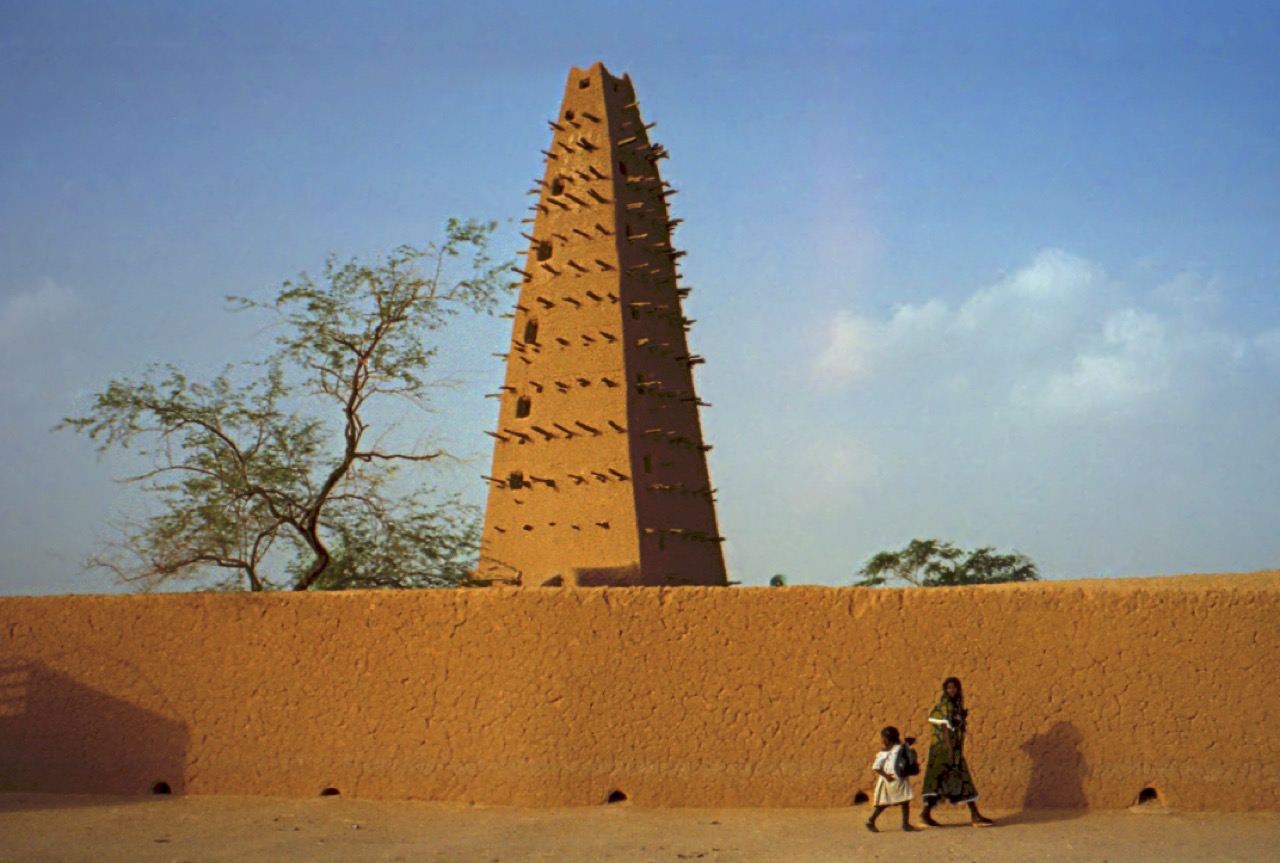
The Historic Centre of Agadez was inscribed on the UNESCO World Heritage List in 2013. Its earthen buildings and distinctive mosque minaret reflect a Saharan trading city shaped by the Aïr sultanate. Zinder’s older quarters and Sultan’s Palace offer a different urban history in the south. In Niamey, the Musée National Boubou Hama brings together displays about regional cultures, craft traditions and natural history.
North of Agadez, the Dabous rock engravings include large giraffe figures that record a very different Saharan environment in the distant past. The Djado area preserves ruined earthen settlements in an oasis landscape, while Bilma is associated with salt production and caravan exchange. These places have different heritage statuses: a location pin does not make every site a UNESCO property. Archaeological surfaces and historic buildings need protection, and present access must be checked separately.
People & Society of Niger
Cross-border communities and a young population connect towns with rural life.
- What is the difference between Nigerien and Nigerian?
- Nigerien refers to Niger; Nigerian refers to Nigeria.
- Does an ethnic label determine how someone makes a living?
- No. Language, identity, occupation and place of residence overlap in many different ways.
- Why should population figures be dated?
- Population size, age estimates and rankings change, and different sources use different methods.
More about Niger: people & society
Nigerien is the adjective for Niger; Nigerian refers to Nigeria. Hausa, Zarma-Songhay, Tuareg, Fulani, Kanuri, Tebu and other communities have distinct histories, and none can be reduced to one occupation or a single way of dressing. Many family and trading networks cross present national borders. Islam is the majority religion, with minority religious communities also part of society.
Niger has a very young population, but claims about a world ranking or an exact median age need a source and reference year. Many people live in rural areas, while Niamey, Maradi and Zinder connect education, employment, administration and trade. Schooling, healthcare and reliable access to food and water are major concerns. Farming and pastoral households adapt to seasonal conditions, and movement between village, town and grazing areas takes many forms.