Facts about Lebanon
Explore Lebanon from Beirut’s Mediterranean waterfront and the old ports of Byblos, Tripoli and Sidon to the Bekaa Valley, Baalbek and the cedar forests of Mount Lebanon. Discover the languages, food, music and communities that connect its coast, mountains and inland towns.
- Capital
- Beirut
- Currency
- Lebanese pound (LBP)
- Official language
- Arabic
- Governorates
- 9
- Coast
- Mediterranean Sea
- UNESCO World Heritage
- 7 properties (2026)
Lebanon · 0 of 20 rounds passed
Two timed rounds per topic, 20 seconds a question
Lebanon lies on the eastern Mediterranean, with Syria to the north and east and Israel to the south. A narrow coastal plain rises into Mount Lebanon; across the range, the Bekaa Valley separates it from the Anti-Lebanon mountains. Beirut is the capital, Tripoli anchors the northern coast, and Sidon and Tyre link the south with a long maritime history. Zahle, Baalbek and Anjar offer different perspectives on the interior.
Ancient ports and Roman temples are only part of the story. Mountain villages, urban neighbourhoods, Armenian workshops, Arabic publishing, family cooking and communities abroad also shape Lebanon. This is a guide for learning about places and heritage. Conflict has damaged communities and infrastructure, and official advice warns against travel to parts of the country. Check current advice and local access before planning any visit; a map pin does not establish that a place is open or safe to reach.
Geography of Lebanon
A Mediterranean coast, two mountain systems and the Bekaa Valley fit into a compact country.
- What separates Mount Lebanon from the Anti-Lebanon mountains?
- The Bekaa Valley, an important agricultural and settlement corridor in the interior.
- Is Qaraoun a natural lake?
- No. It is a reservoir created by a dam on the Litani River. Its water level and shoreline change.
- Is Mount Lebanon a mountain range or a governorate?
- Both names exist, but they describe different areas. The physical range extends beyond the governorate.
More about Lebanon: geography
Lebanon’s terrain changes sharply from west to east. Coastal cities sit below the Mount Lebanon range, whose higher slopes receive winter snow. The Bekaa Valley runs between Mount Lebanon and the Anti-Lebanon mountains along the Syrian frontier. The physical mountain range called Mount Lebanon is larger than the administrative governorate bearing the same name. Neither is a synonym for the entire country.
The Litani rises in the Bekaa, flows south through the Qaraoun reservoir and turns west towards the Mediterranean. It is the longest river entirely within Lebanon. Qaraoun is an artificial lake created by a dam, with changing water levels. The Orontes, also called the Assi, rises in Lebanon and continues north into Syria. This guide’s water map introduces the Litani and Mediterranean rather than every waterway in the country.
History of Lebanon
Coastal city-states, imperial rule and a modern republic left overlapping layers of history.
- Did Phoenician history fit within today’s borders?
- No. Phoenician city-states and trading networks extended beyond modern Lebanon and across the Mediterranean.
- When is Lebanon’s independence commemorated?
- On 22 November 1943. The final French troops departed in 1946.
- What was the Taif Agreement?
- The 1989 agreement that provided a framework for political reforms and ending the civil war, which lasted from 1975 to 1990.
More about Lebanon: history
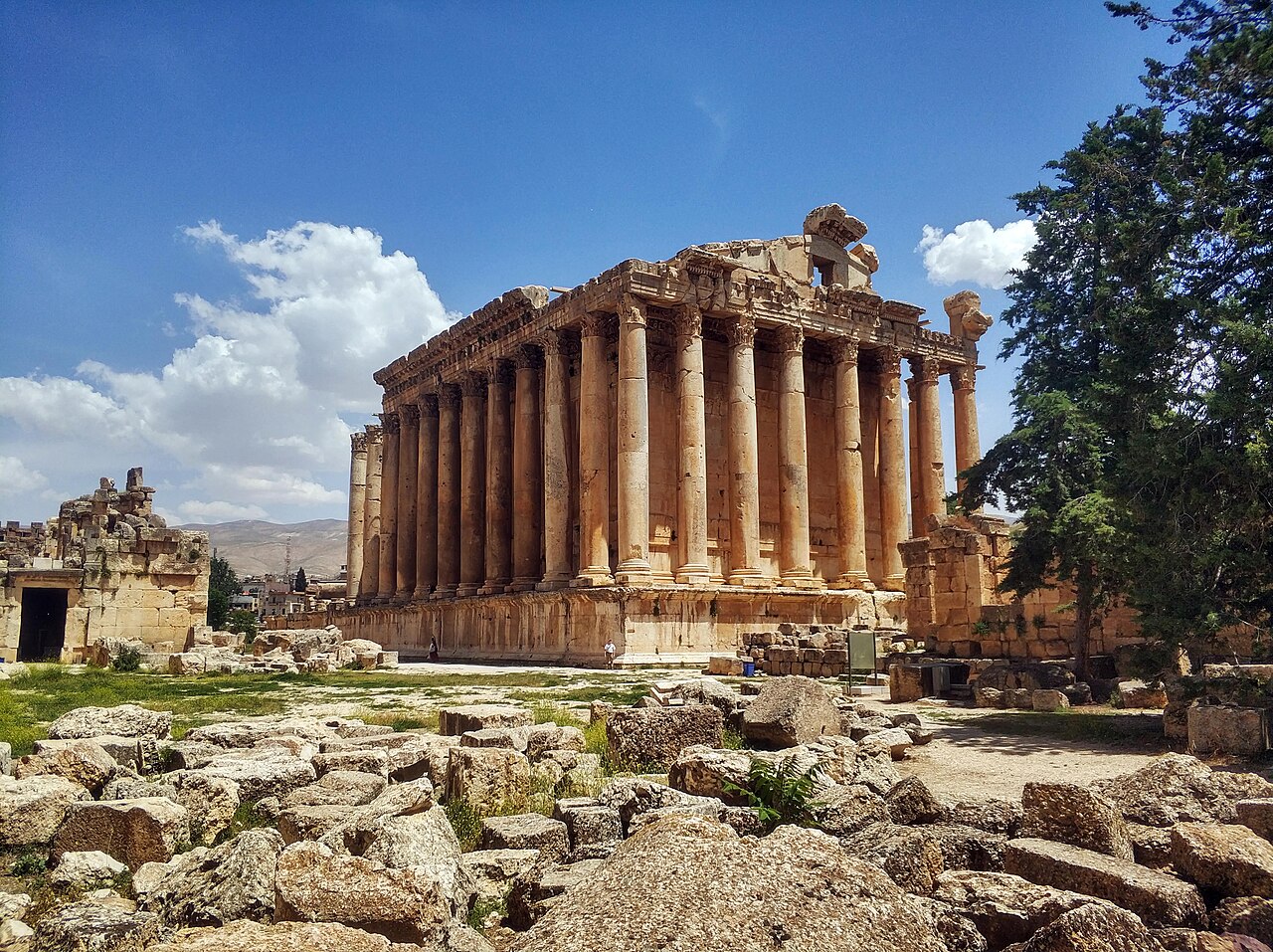
Byblos, Sidon and Tyre were important Phoenician city-states connected by maritime trade. Phoenician culture extended beyond the boundaries of present-day Lebanon. Its alphabet helped shape later writing systems, but alphabetic writing had earlier predecessors. Successive Persian, Hellenistic, Roman and Byzantine periods changed the region. Baalbek’s monumental temples belong largely to its Roman-era development, while Anjar preserves a very different early Islamic urban plan.
After centuries under Ottoman rule, Greater Lebanon was proclaimed in 1920 under French authority. Independence is commemorated on 22 November 1943; the final French troops left in 1946. The civil war of 1975–1990 involved Lebanese factions and outside powers and displaced many families. The 1989 Taif Agreement provided a framework for political reform and ending the war. Later conflicts and the Beirut port explosion of 4 August 2020 have also left deep marks on the country.
Arabic and the languages of Lebanon
Formal Arabic, Lebanese speech and several community languages meet in everyday life.
- What is Lebanon’s official language?
- Arabic. French and English are also used in education, business and cultural life.
- Do the linked lessons teach Lebanese spoken Arabic?
- They introduce Modern Standard Arabic. Lebanese Arabic is a spoken Levantine variety with different everyday forms.
- Why do Sidon and Saida both appear on maps?
- They are different names for the same city. Tyre and Sour are another example.
More about Lebanon: language
Arabic is Lebanon’s official national language. Modern Standard Arabic appears in formal writing, news and education, while Lebanese Arabic belongs to the wider Levantine group of spoken varieties. These registers overlap in people’s lives but are not identical. Worldly’s linked Arabic lessons introduce Modern Standard Arabic, rather than a dedicated Lebanese dialect course. Arabic script runs from right to left.
French and English are used in education, business and cultural life, with patterns that vary between schools, generations and households. Switching languages within a conversation is familiar to many speakers, but multilingual fluency should not be assumed of everyone. Armenian is maintained in community institutions, including in Bourj Hammoud, and Syriac has a liturgical role in several churches. Latin spellings also vary: Sidon and Saida, Tyre and Sour, or Zahle and Zahlé can name the same place.
Culture of Lebanon
Zajal, dabke, publishing and music connect local traditions with a wider cultural world.
- What is zajal?
- Vernacular poetry that is recited or sung, sometimes in exchanges between poets at social gatherings.
- Who wrote The Prophet?
- Kahlil Gibran, born in Bsharri, who wrote in Arabic and English and lived part of his life in the United States.
- Is dabke unique to Lebanon?
- No. Related line-dance traditions are shared across the Levant, with local and community variations.
More about Lebanon: culture
Zajal is recited or sung vernacular poetry, sometimes performed as an exchange between poets at social gatherings. UNESCO recognises it as living heritage. Dabke, a line dance associated with celebrations, belongs to traditions shared across the Levant. The photograph here shows Palestinian children dancing in Burj el-Shemali camp in Lebanon; it records one community’s cultural life rather than standing for every Lebanese celebration.
Fairuz’s singing and the work of the Rahbani brothers have reached audiences across the Arab world. Kahlil Gibran, born in Bsharri, wrote in Arabic and English and became widely known for The Prophet. Beirut has long supported publishing, theatre and visual arts, while festivals and craft traditions also develop outside the capital. These activities depend on working artists, venues and audiences, whose lives have been disrupted by economic crisis and conflict.
Economy of Lebanon
Trade, services, agriculture and family transfers operate amid a prolonged financial crisis.
- What currency does Lebanon use?
- The Lebanese pound, also called the lira, with the code LBP.
- When did the financial crisis begin?
- In 2019. It severely affected banking, incomes and services; later shocks compounded the damage.
- What are remittances?
- Money transferred by people abroad, often to relatives. Their amount and economic share vary over time.
More about Lebanon: economy
Services, commerce, education, food production and tourism contribute to Lebanon’s economy. Beirut and Tripoli are important ports, while the Bekaa supports farming and wine production. Olive growing, fruit cultivation and small enterprises sustain livelihoods in other regions. Money sent by people abroad helps many households, though the size of remittances and their share of the economy change by year. The currency is the Lebanese pound, also commonly called the lira, abbreviated LBP.
A financial crisis beginning in 2019 severely damaged the banking system, household incomes and public services. The pound lost much of its value, access to bank deposits became restricted and dollar cash transactions grew. The 2020 port explosion and subsequent conflicts compounded these problems. World Bank reporting in 2026 describes renewed conflict interrupting a fragile recovery. A historic reputation for banking does not describe present economic conditions; exchange rates, prices and growth figures all need dates.
Politics of Lebanon
A parliamentary republic combines elected institutions with confessional power sharing.
- How many governorates are on the map?
- Nine, including Keserwan-Jbeil as a separate unit from Mount Lebanon. Older datasets can show a different framework.
- How many seats are in parliament?
- 128, divided equally between Christian and Muslim representatives under the current framework.
- How are the three senior offices traditionally allocated?
- The president is Maronite Christian, the prime minister Sunni Muslim and the parliamentary speaker Shia Muslim, by longstanding political convention.
More about Lebanon: politics
Lebanon is a parliamentary republic. Its Chamber of Deputies has 128 seats, divided equally between Christian and Muslim representatives under the current framework and allocated further among communities and constituencies. Parliament elects the president. By longstanding political convention, the president is Maronite Christian, the prime minister Sunni Muslim and the parliamentary speaker Shia Muslim. This distribution of senior offices is not a description of every citizen’s political views.
The constitution and the Taif settlement shape institutions, while political parties, civil society and competing armed actors influence public life. Hezbollah is both a political organisation and an armed actor; it is distinct from the Lebanese Armed Forces. Lebanon’s nine governorates include Akkar, Baalbek-Hermel and Keserwan-Jbeil, which older maps can omit as separate units. Administrative boundaries do not show religious communities, current military control or safe routes through a conflict.
Nature & Wildlife of Lebanon
Cedar forests, limestone caves, wetlands and offshore islands support varied habitats.
- Is the Cedars of God Lebanon’s only cedar forest?
- No. Other protected stands include forests in Shouf and Tannourine.
- Is a biosphere reserve the same as a World Heritage property?
- No. They are different UNESCO programmes. Biosphere reserves connect conservation with sustainable livelihoods.
- Does a lake photograph establish water quality?
- No. The Litani and Qaraoun have serious documented pollution problems, and local restrictions must be checked.
More about Lebanon: nature & wildlife
The Lebanon cedar, Cedrus libani, appears on the national flag and survives in protected mountain stands. The Cedars of God near Bsharri is one well-known grove; Shouf and Tannourine protect other forests. Lebanon’s ecosystems also include oak woodland, high mountain habitats, river valleys and coastal wetlands. Limestone landscapes help explain caves such as Jeita and deep gorges, where water has shaped the rock over long periods.
Shouf and Jabal Moussa are UNESCO biosphere reserves, a designation connecting conservation with people’s livelihoods. It differs from World Heritage inscription. The Palm Islands off Tripoli support coastal and island habitats, and Lebanon lies on major bird migration routes. Habitat loss, fires, hunting and pollution create pressures. The Litani River Authority documents serious pollution in the Litani and Qaraoun reservoir; a scenic photograph should not be read as an assurance of water quality or suitability for swimming.
Food & Cuisine of Lebanon
Man’oushe, kibbeh, parsley salads and shared mezze express regional and household traditions.
- Is all kibbeh served raw?
- No. Kibbeh includes baked, fried, raw and meat-free preparations. Kibbeh nayyeh is the raw version.
- How do tabbouleh and fattoush differ?
- Tabbouleh is rich in chopped parsley and includes bulgur. Fattoush includes pieces of bread.
- What is man’oushe?
- A flatbread often topped with za’atar and olive oil or cheese, with preparation traditions recognised by UNESCO.
More about Lebanon: food & cuisine
Man’oushe is a flatbread often topped with za’atar and olive oil or cheese; manakish is a familiar plural form. Its preparation and social traditions are recognised by UNESCO. Mezze brings several small dishes to the table, such as hummus, labneh and vegetable dishes. Tabbouleh is rich in chopped parsley, with tomatoes, mint and bulgur, while fattoush includes pieces of bread. These foods also have histories shared with neighbouring cuisines.
Kibbeh describes a family of dishes commonly using bulgur and finely ground meat, with baked, fried and raw versions as well as meat-free regional variations. Kibbeh nayyeh names the raw preparation specifically. Toum is a garlic sauce; knafeh combines a pastry or semolina layer with a filling, often cheese, and syrup. Arak is an anise-flavoured spirit, but drinking practices vary. Family recipes and religious calendars shape meals, and no single dish represents every household.
Landmarks of Lebanon
Seven World Heritage properties span ancient cities, monastic landscapes and modern architecture.
- Why can property and monument counts differ?
- A serial World Heritage property contains several places. Mount Amel Castles, inscribed in 2026, includes five fortified sites but counts as one property.
- Who designed Tripoli’s Rachid Karami International Fair?
- Brazilian architect Oscar Niemeyer. Its modern architecture adds a different period to Lebanon’s heritage.
- Does heritage recognition mean a site is open to visitors?
- No. Conflict, conservation work and local operating decisions affect access. Check current official travel advice and site information.
More about Lebanon: landmarks
Lebanon has seven UNESCO World Heritage properties as of 2026: Anjar, Baalbek, Byblos, Tyre, the Qadisha Valley and Cedars of God, the Rachid Karami International Fair in Tripoli, and Mount Amel Castles. The castles joined the list in 2026 as one serial property comprising five fortified sites. A count of properties is therefore different from a count of individual monuments. The fair, designed by Oscar Niemeyer, represents twentieth-century architecture.
Sidon’s sea castle, the Temple of Eshmun, Batroun’s historic centre and Beirut’s National Museum offer further perspectives. A site on UNESCO’s Tentative List, such as Eshmun, has a different status from an inscribed World Heritage property. The museum holds objects from several periods, including the Ahiram sarcophagus from Byblos. Heritage significance does not establish present access: several southern places lie in areas covered by official warnings against travel, and conflict can change a site’s condition.
People & Society of Lebanon
City neighbourhoods, village ties, migration and a large diaspora shape overlapping identities.
- Are nationality and religious identity interchangeable?
- No. Citizenship, religion, language and family background describe different aspects of identity.
- Can refugee registrations be used as a total population count?
- No. Registrations and population estimates cover different groups and dates.
- Does Lebanese ancestry imply current Lebanese citizenship?
- No. Diaspora ancestry estimates and counts of citizens abroad are different measures.
More about Lebanon: people & society
Lebanon’s people include Muslim, Christian, Druze and other communities, with varied religious practice and many secular outlooks. Armenian communities maintain schools, churches and cultural organisations. Nationality, religion, language and family background are distinct parts of identity. Beirut and its surrounding urban area concentrate institutions and employment, while ties to villages and towns remain important for many families. A governorate’s name does not describe a single community.
Palestinian and Syrian refugees, migrant workers and other residents have their own histories and legal circumstances. Registration totals, resident population estimates and citizen counts measure different groups and should not be substituted for one another. Lebanese communities abroad maintain family, cultural and economic ties across the Americas, Africa, Europe, the Gulf and Australia. Estimates of people with Lebanese ancestry are not counts of current Lebanese citizens living overseas, so simple diaspora rankings can mislead.