Facts about Kuwait
Explore Kuwait from the capital and Jahra to the southern coast and Wafra. Learn six governorates, place sixteen cities and districts, explore the Gulf’s coastal waters and discover the country’s heritage.
- Capital
- Kuwait City
- Official language
- Arabic
- Currency
- Kuwaiti dinar (KWD)
- Governorates
- 6
- Independence
- 19 June 1961
- UNESCO World Heritage
- 0 properties (2026)
Kuwait · 0 of 20 rounds passed
Two timed rounds per topic, 20 seconds a question
The capital stands on the southern shore of Kuwait Bay, with Salmiya and Hawalli to the southeast, Jahra to the west and Ahmadi and Fahaheel farther down the coast. Beyond the dense urban corridor lie agricultural settlements at Abdali and Wafra, desert landscapes and offshore islands including Failaka and Bubiyan.
Learn the locations first, then connect the old port, the oil era, coastal habitats and everyday cultural life. The maps teach six governorates and sixteen settlement centres, alongside Kuwait Bay and the country’s Gulf waters.
Geography of Kuwait
Kuwait Bay, low desert and offshore islands meet at the northwestern end of the Gulf.
- Which countries share Kuwait’s land borders?
- Iraq and Saudi Arabia. Kuwait’s eastern coast faces the Gulf.
- Is Salmiya a separate governorate?
- No. It is an urban district in Hawalli Governorate, within the wider Kuwait City metropolitan area.
- Does Kuwait have permanent rivers?
- No. Desalination, groundwater and treated wastewater serve different water needs.
More about Kuwait: geography
Kuwait borders Iraq to the north and west and Saudi Arabia to the south. Its eastern shore faces the Persian Gulf, called the Arabian Gulf locally. Kuwait Bay indents the coast beside the capital, while Bubiyan and Warbah lie in the northeast. Much of the country is low desert, interrupted by features such as the Jal Al Zor escarpment. There are no permanent rivers.
Kuwait City and adjoining districts form a continuous urban area extending south along the coast. Hawalli, Salmiya and Farwaniya belong to this wider metropolitan landscape; Jahra lies west of the bay and Ahmadi farther south near the oil industry. Kuwait has six governorates, whose boundaries are different from town or neighbourhood centres. Desalination, groundwater and treated wastewater serve different water needs in an arid climate.
History of Kuwait
Ancient island exchange, a maritime trading town, independence and the 1990–91 occupation shape the story.
- When did Kuwait become independent?
- On 19 June 1961, when its treaty relationship with Britain ended.
- Do National Day and Liberation Day commemorate the same event?
- No. National Day is 25 February; Liberation Day on 26 February marks the end of the 1990–91 Iraqi occupation.
- What does Failaka add to Kuwait’s history?
- Archaeology associated with Bronze Age Dilmun exchange and later Hellenistic settlement, long before the oil era.
More about Kuwait: history
Failaka preserves traces of Bronze Age exchange associated with Dilmun and later Hellenistic settlement. The modern port of Kuwait developed in the eighteenth century under the Al Sabah family. Boatbuilding, fishing, pearling and long-distance trade linked its inhabitants with Iraq, Iran, India and other Gulf ports. A treaty with Britain in 1899 constrained Kuwait’s external relations; it did not make Kuwait a British settler colony.
Oil was discovered at Burgan in 1938 and the first export shipment left in 1946. Independence followed on 19 June 1961, and a constitution was promulgated in 1962. Iraqi forces invaded on 2 August 1990; the occupation ended with liberation in February 1991. Retreating forces set oil wells alight, leaving major environmental damage. National Day on 25 February and Liberation Day on 26 February mark different events from the June independence date.
Arabic and the languages of Kuwait
Official Arabic, Kuwaiti speech and residents’ many languages connect everyday life.
- Which language is official?
- Arabic. English is widely used without being a second official language.
- Do the linked lessons teach Kuwaiti dialect?
- They introduce Modern Standard Arabic. Kuwaiti Arabic is an everyday spoken variety within the broader Gulf Arabic landscape.
- Why are many languages heard in Kuwait?
- Residents have varied family, work and migration connections. A home language does not by itself establish citizenship.
More about Kuwait: language
Arabic is Kuwait’s official language. Modern Standard Arabic is used in formal writing, education and news, while Kuwaiti Arabic belongs to the broader Gulf Arabic landscape. Everyday speech varies by family, community and situation, and its vocabulary reflects historical contact around the Gulf and Indian Ocean. The linked Arabic lessons introduce Modern Standard Arabic rather than a dedicated Kuwaiti dialect course.
English is widely used in business and between residents with different first languages. Hindi, Urdu, Malayalam, Bengali, Tagalog, Persian and other languages reflect the country’s varied communities. Arabic and English appear together on many signs; widespread English use does not give it official-language status. A person’s home language, citizenship and place of birth describe different aspects of identity.
Culture of Kuwait
Diwaniya conversation, Sadu weaving and a strong theatre tradition connect heritage with contemporary life.
- What is a diwaniya?
- A place and occasion for social gathering, conversation and hospitality, with roles in public debate as well as family and business life.
- What is Al Sadu?
- A weaving tradition associated with Bedouin communities and geometric designs, with knowledge historically transmitted especially by women.
- Is Kuwait’s cultural life only traditional?
- No. Theatre, television drama, publishing, modern art and contemporary performance are also important parts of it.
More about Kuwait: culture
A diwaniya is a place and occasion for gathering, conversation and hospitality. Many are associated with men’s social networks, while women also organise gatherings and diwaniyas. Their roles have included public debate and election campaigning as well as family and business life. Arabic coffee and dates often accompany a welcome; practices vary between households and occasions.
Al Sadu weaving carries geometric designs and knowledge associated with Bedouin communities, especially women’s craft traditions. Wooden boats and maritime songs recall fishing, pearling and trade. Kuwait also has a substantial history of theatre, television drama, publishing and modern art. Sadu House and the Sheikh Jaber Al-Ahmad Cultural Centre offer different ways into this cultural landscape: one through craft knowledge, the other through performance and contemporary institutions.
Economy of Kuwait
Oil exports and long-term investment connect Burgan and coastal refineries with global markets.
- How many fils make a dinar?
- One thousand. The currency’s international abbreviation is KWD.
- Why is Burgan important?
- It is a major oil field. Petroleum remains central to exports and public finances.
- What does the Kuwait Investment Authority manage?
- The General Reserve Fund and Future Generations Fund. The investment history reaches back to a predecessor board established in 1953.
More about Kuwait: economy
Petroleum remains central to Kuwait’s exports and public finances. Burgan is a major oil field south of the capital, while refineries and export facilities line parts of the southern coast. Ahmadi’s planned company town grew with the oil industry. Hydrocarbon income helped finance infrastructure, public services and overseas investment, but an economy’s aggregate wealth does not describe every resident’s earnings.
The Kuwait Investment Authority manages the General Reserve Fund and Future Generations Fund; its investment history reaches back to the Kuwait Investment Board established in 1953. Banking, trade, logistics and other services also contribute to economic life. New Kuwait 2035 describes diversification goals rather than a completed transition away from oil. The Kuwaiti dinar, abbreviated KWD, is divided into 1,000 fils. The value of one currency unit is different from national income or household purchasing power.
Politics of Kuwait
A hereditary emirate’s constitutional history includes the suspension announced in May 2024.
- What changed on 10 May 2024?
- The emir dissolved the National Assembly and suspended several constitutional provisions for a stated period not exceeding four years.
- Who appoints the prime minister?
- The emir, who is Kuwait’s head of state.
- What political rights did women gain in 2005?
- The right to vote and stand for parliament. This historical milestone is separate from parliament’s current operating status.
More about Kuwait: politics
Kuwait is a hereditary emirate ruled by the Al Sabah family. The emir is head of state and appoints the prime minister. The 1962 Constitution established institutions including an elected National Assembly, historically with 50 elected members alongside ministers serving ex officio. Women gained the right to vote and stand for parliament in 2005. These describe the constitutional framework and political history, rather than proof that parliament is currently sitting.
On 10 May 2024, Emir Mishal Al-Ahmad Al-Jaber Al-Sabah dissolved the National Assembly and suspended several constitutional provisions for a period stated not to exceed four years. The order provided for the emir and Council of Ministers to exercise the Assembly’s powers. An undated description of Kuwait as having an actively operating elected parliament therefore misses this change. Kuwait is a founding member of the Gulf Cooperation Council and a member of the United Nations.
Nature & Wildlife of Kuwait
Tidal flats, desert plants and coral islands support wildlife adapted to heat and scarce freshwater.
- Why are Bubiyan’s wetlands important?
- They support breeding and migratory birds. Mubarak Al-Kabeer Reserve is a Ramsar wetland site.
- Are all Kuwait’s wetlands freshwater?
- No. Tidal flats, saltwater channels and brackish habitats are part of its coastal environment.
- What happened to the environment in 1991?
- Oil-well fires and oil spills during the Gulf War caused major damage to desert and marine habitats.
More about Kuwait: nature & wildlife
Bubiyan’s tidal channels and mudflats form part of an important northern Gulf wetland landscape. The Mubarak Al-Kabeer Reserve is a Ramsar site, supporting breeding and migratory birds. Jahra’s wetlands offer another habitat beside the desert and urban area. Wetlands include saltwater and brackish environments, so the presence of wet ground does not imply a permanent freshwater river or lake.
Desert vegetation responds to rainfall, and flowering can vary greatly between years. Sand cats and other desert animals depend on suitable habitat and prey; a photograph of a species does not establish that it is common or easily seen. Coral communities occur around southern offshore islands including Qaruh and Kubbar. Heat, salinity, coastal development and pollution place pressures on marine habitats. The 1991 oil fires and spills are a major episode in the country’s environmental history.
Food & Cuisine of Kuwait
Machboos, fish, aromatic cake and coffee reflect Gulf cooking and Indian Ocean connections.
- What is machboos?
- Spiced rice served with meat or fish, with recipes varying between households and related dishes elsewhere in the Gulf.
- What is balaleet?
- Sweetened vermicelli paired with savoury egg.
- What is gers ogaily?
- A fragrant cake associated with cardamom, saffron and sesame.
More about Kuwait: food & cuisine
Machboos brings spiced rice together with meat or fish and is strongly associated with Kuwaiti home cooking. Mutabbaq samak pairs fish with rice; harees combines wheat and meat in a soft preparation. Balaleet contrasts sweetened vermicelli with savoury egg. Spice blends and dried limes contribute to flavour, but ingredients and methods vary between households and related dishes occur across the Gulf.
Gers ogaily is a fragrant cake associated with ingredients such as cardamom, saffron and sesame. Luqaimat are small fried dough pieces served with syrup, while dates and Arabic coffee are familiar parts of hospitality. Maritime commerce helped ingredients and techniques travel, and the cooking of resident communities continues to broaden everyday food. Souq Al Mubarakiya’s eateries are one setting in which market history and contemporary tastes meet.
Landmarks of Kuwait
Water towers, a working souq, museums and Failaka’s archaeology reveal several layers of the country.
- Are Kuwait Towers an inscribed World Heritage Site?
- No. They are on UNESCO’s Tentative List. Kuwait has no inscribed properties as of October 2026.
- Are the two major cultural centres the same institution?
- No. Sheikh Jaber Al-Ahmad Cultural Centre and Sheikh Abdullah Al Salem Cultural Centre are separate institutions.
- Where is the Red Fort?
- At Jahra, west of Kuwait Bay. Failaka’s archaeological sites lie offshore to the east of the capital.
More about Kuwait: landmarks
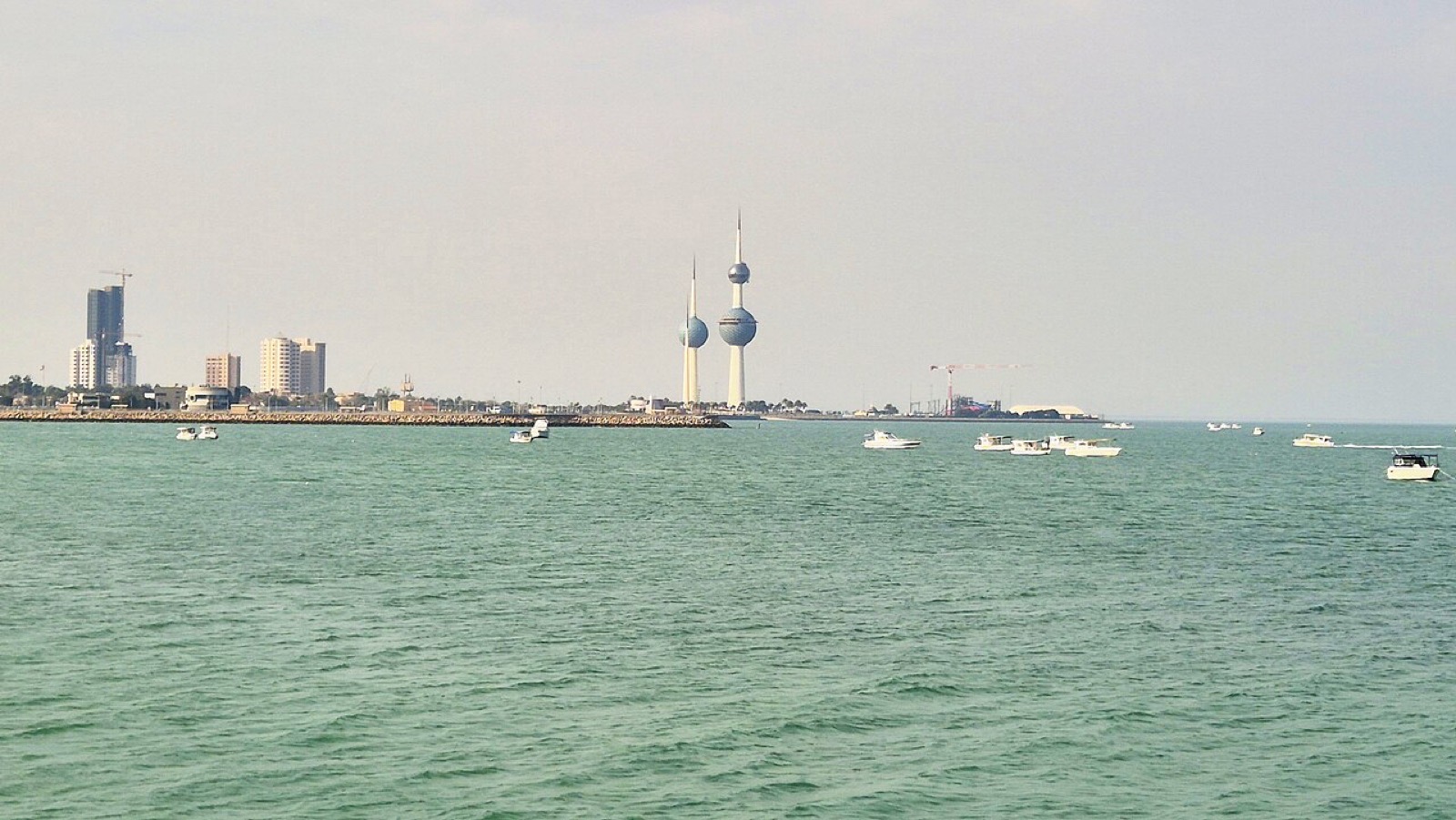
The Kuwait Towers are three towers, not three identical spherical water tanks. Their functions include water storage, visitor facilities and lighting. Souq Al Mubarakiya, the Grand Mosque, Sadu House and the National Museum connect central Kuwait City with commerce, worship, craft and collections. The Sheikh Jaber Al-Ahmad Cultural Centre and Sheikh Abdullah Al Salem Cultural Centre are separate institutions, devoted to different cultural and museum programmes.
Beyond the capital, the Red Fort at Jahra and archaeological remains on Failaka broaden the story. Kuwait has no inscribed UNESCO World Heritage properties as of October 2026. Kuwait Towers, sites on Failaka and other places appear on the Tentative List; tentative status is different from inscription. Ahmadi Company Town was added to that list in 2026. Map pins identify representative learning locations, while venue access and opening arrangements come from the responsible institution.
People & Society of Kuwait
Citizens, foreign residents and stateless Bidoon have distinct legal circumstances and varied lives.
- Are all non-citizens Bidoon?
- No. Bidoon refers to a distinct stateless population with unresolved citizenship status, not foreign residents generally.
- Does national wealth describe everyone’s income?
- No. Aggregate economic measures cannot establish the earnings, benefits or circumstances of an individual resident.
- When did Kuwait University open?
- In 1966. It was Kuwait’s first public university.
More about Kuwait: people & society
Kuwait’s population includes Kuwaiti citizens and a large non-citizen majority from many countries. Foreign residents include people living there for work, study and family reasons. Stateless Bidoon are a distinct population with unresolved citizenship status; the word does not mean all expatriates or all non-citizens. Population totals, workforce counts and citizenship categories measure different things and require a date and definition.
Islam is the state religion, and Sunni and Shia communities are part of Kuwaiti society. Residents also practise other faiths. Family histories include urban, maritime, desert and migration connections that overlap rather than divide everyone neatly into fixed categories. Kuwait University opened in 1966, and education, professions, sport and the arts provide further ways people participate in public life. Access to benefits and opportunities varies by legal status and individual circumstances.