Facts about Gabon
Explore Gabon from Libreville’s estuary and Port-Gentil to the Ogooué valley, forest parks and southeastern plateaus. Twelve city locations, ten heritage and wildlife pins and ten illustrated topics connect places with history, languages and everyday life.
- Capital
- Libreville
- Area
- About 267,700 km²
- Official language
- French
- Currency
- Central African CFA franc (XAF)
- Independence
- 17 August 1960
- World Heritage sites
- Two inscribed properties
Gabon · 0 of 20 rounds passed
Two timed rounds per topic, 20 seconds a question
Gabon straddles the equator on the Atlantic coast of central Africa, between Equatorial Guinea, Cameroon and the Republic of the Congo. Coastal estuaries and lagoons give way to forested hills, the Ogooué basin and the Batéké plateaus.
Libreville is the capital, Port-Gentil an oil-industry centre and Franceville a southeastern rail terminus. Lambaréné, Oyem, Makokou and the other towns on the map introduce different parts of the country.
Geography of Gabon
An equatorial country of Atlantic estuaries, forested hills and the Ogooué basin.
- Which three countries border Gabon?
- Equatorial Guinea, Cameroon and the Republic of the Congo.
- Where is Libreville?
- Beside the Gabon Estuary on the Atlantic side of the country.
- Which river drains much of Gabon?
- The Ogooué, together with its tributaries.
More about Gabon: geography
Gabon straddles the equator on the Atlantic coast of central Africa. Equatorial Guinea and Cameroon lie to the north; the Republic of the Congo borders the east and south. Libreville, the capital, stands beside the Gabon Estuary. Port-Gentil lies farther south on the coast, while Franceville anchors the southeastern interior. The country covers about 267,700 square kilometres, with a coastal plain, forested uplands and areas of savanna.
The Ogooué and its tributaries link much of the interior with the Atlantic. Lambaréné lies along its lower course, and the Ivindo drains northern forests. The Chaillu Massif rises inland; the Batéké plateaus extend across the southeast toward Congo. Mangroves, lagoons and sandy shores mark parts of the coast. Rainfall, river levels and access vary through the year in this generally hot, humid climate. The city map helps locate settlements across these landscapes.
History of Gabon
Long human histories, Atlantic trade, French colonial rule and independence.
- When did Gabon become independent?
- On 17 August 1960, from France.
- What does Libreville’s name recall?
- A settlement of formerly enslaved people established in 1849.
- Did Ali Bongo immediately hold the presidency after Omar Bongo’s death?
- No. Rose Francine Rogombé served as interim president before the 2009 election.
More about Gabon: history
Archaeological remains in the Lopé-Okanda landscape document human occupation, migration and iron-working along the Ogooué corridor long before colonial borders. Coastal communities including Mpongwe and Orungu took part in Atlantic trade, which also brought the violence of the slave trade. French agreements with coastal rulers in the nineteenth century preceded colonial expansion. Libreville’s name, meaning “free town”, recalls a settlement of formerly enslaved people established in 1849 on an already inhabited coast.
Gabon became part of French Equatorial Africa in 1910 and independent from France on 17 August 1960. Léon M’ba was its first president. Omar Bongo governed from 1967 until his death in 2009; Ali Bongo won the subsequent presidential election. Senate president Rose Francine Rogombé held the interim presidency between them. A military coup removed Ali Bongo in August 2023 after a disputed election. The 2024 constitution and 2025 presidential election opened a new institutional period.
French and Gabon’s community languages
French connects public life alongside many community languages.
- Which language is official in Gabon?
- French.
- Is Bantu a single language?
- No. It is a branch of the Niger–Congo family containing many languages, including Fang.
- What does the linked language course teach?
- General French, rather than all of Gabon’s community languages.
More about Gabon: language
French is Gabon’s official language and is widely used in education, administration, the media and everyday urban conversation. It is also a home language for many people. This shared language coexists with a rich multilingual landscape. Fang, Myene varieties, Punu, Nzebi, Kota and Teke are among the languages spoken by Gabonese communities. Most of these belong to the Bantu branch of the Niger–Congo language family; Bantu describes a linguistic relationship rather than one language.
Language use changes between households, generations and places. Myene varieties have long coastal connections, while Fang is spoken across northern Gabon and neighbouring countries. Migration adds further languages to city life. A person may use French at school and another language with relatives, or several languages in the same day. The linked lessons teach general French. They offer one practical starting point, while dedicated lessons in Fang, Punu and Gabon’s other languages are not currently included.
Culture of Gabon
Storytelling, sculpture, dance and contemporary music.
- What does mvett combine?
- Epic storytelling and music, with a stringed instrument also called mvett.
- Are Kota reliquary figures face masks?
- No. They are a distinct form associated with the care and remembrance of ancestors.
- Name one Gabonese musician to explore.
- Pierre-Claver Akendengué, Patience Dabany or Oliver N’Goma.
More about Gabon: culture
Gabon’s cultural traditions differ across communities and continue to change. Fang mvett brings together epic storytelling and music, sharing its name with a stringed instrument. Punu masks and Kota reliquary figures belong to distinct artistic traditions; reliquary figures are not simply another type of face mask. Performance, movement and social or spiritual settings give objects meanings that a museum display alone cannot convey.
Writers, filmmakers and musicians connect local experiences with wider audiences. Pierre-Claver Akendengué, Patience Dabany and Oliver N’Goma are useful starting points for exploring Gabonese music. Bwiti encompasses spiritual traditions associated with communities including the Mitsogo and Fang; its practices vary. Christianity, Islam and local spiritual traditions also shape cultural life, sometimes in overlapping ways. The photograph shows a Fang dancer in Lambaréné, one particular performance rather than a picture of a single national custom.
Economy of Gabon
Oil, manganese and timber connect resource wealth with questions about livelihoods.
- Which three resources are central to exports?
- Oil, manganese and timber.
- What currency does Gabon use?
- The Central African CFA franc (XAF).
- Which town is associated with manganese mining?
- Moanda, in the southeast.
More about Gabon: economy
Oil, manganese and timber are central to Gabon’s exports. Port-Gentil is an important oil-industry centre; Moanda is associated with manganese mining. Okoumé is a valuable timber used in plywood. The Trans-Gabon Railway connects the Owendo port area near Libreville with Franceville, carrying freight as well as passengers. These links help explain the locations of mining and transport towns on the city map.
Gabon uses the Central African CFA franc, currency code XAF, issued by the Bank of Central African States. Natural-resource income has not produced equal opportunities for all households. Employment, public services and economic diversification remain major challenges. Agriculture, fisheries, wood processing and tourism contribute to livelihoods alongside extractive industries. Forests also store carbon and sustain biodiversity and local livelihoods. Protecting those functions while creating jobs requires choices about land use, infrastructure and how the benefits of development are shared.
Politics of Gabon
The Fifth Republic and a new constitutional framework.
- How long is a presidential term under the 2024 constitution?
- Seven years, renewable once.
- What are the two chambers of parliament?
- The National Assembly and the Senate.
- When did Oligui Nguema’s elected presidency begin?
- With his swearing-in on 3 May 2025, following the April election.
More about Gabon: politics
Gabon’s 2024 constitution establishes a republic in which the president holds executive power. Article 42 sets a seven-year presidential term, renewable once, and provides for a two-round election. Parliament has a National Assembly and a Senate. The country has nine provinces, a different layer of geography from the settlement points shown in this guide’s city game. The constitutional text sets out institutions and rights; understanding their operation also requires following elections, public debate and independent reporting.
Brice Clotaire Oligui Nguema led the transition after the August 2023 coup. The Constitutional Court proclaimed him elected following the presidential vote of 12 April 2025; he was sworn in on 3 May 2025. Those dates distinguish the transition from the elected presidency. Gabon participates in regional institutions including CEMAC and joined the Commonwealth in 2022. French remains official. The photograph depicts the Senate Palace in Libreville, linking an institution to a real place in the capital.
Nature & Wildlife of Gabon
Forest elephants, western lowland gorillas and Atlantic coastal habitats.
- Which type of gorilla lives in Gabon?
- The western lowland gorilla.
- What kinds of habitat meet at Loango?
- Forest, savanna, lagoons and Atlantic beaches.
- When was Ivindo inscribed on the World Heritage List?
- In 2021.
More about Gabon: nature & wildlife
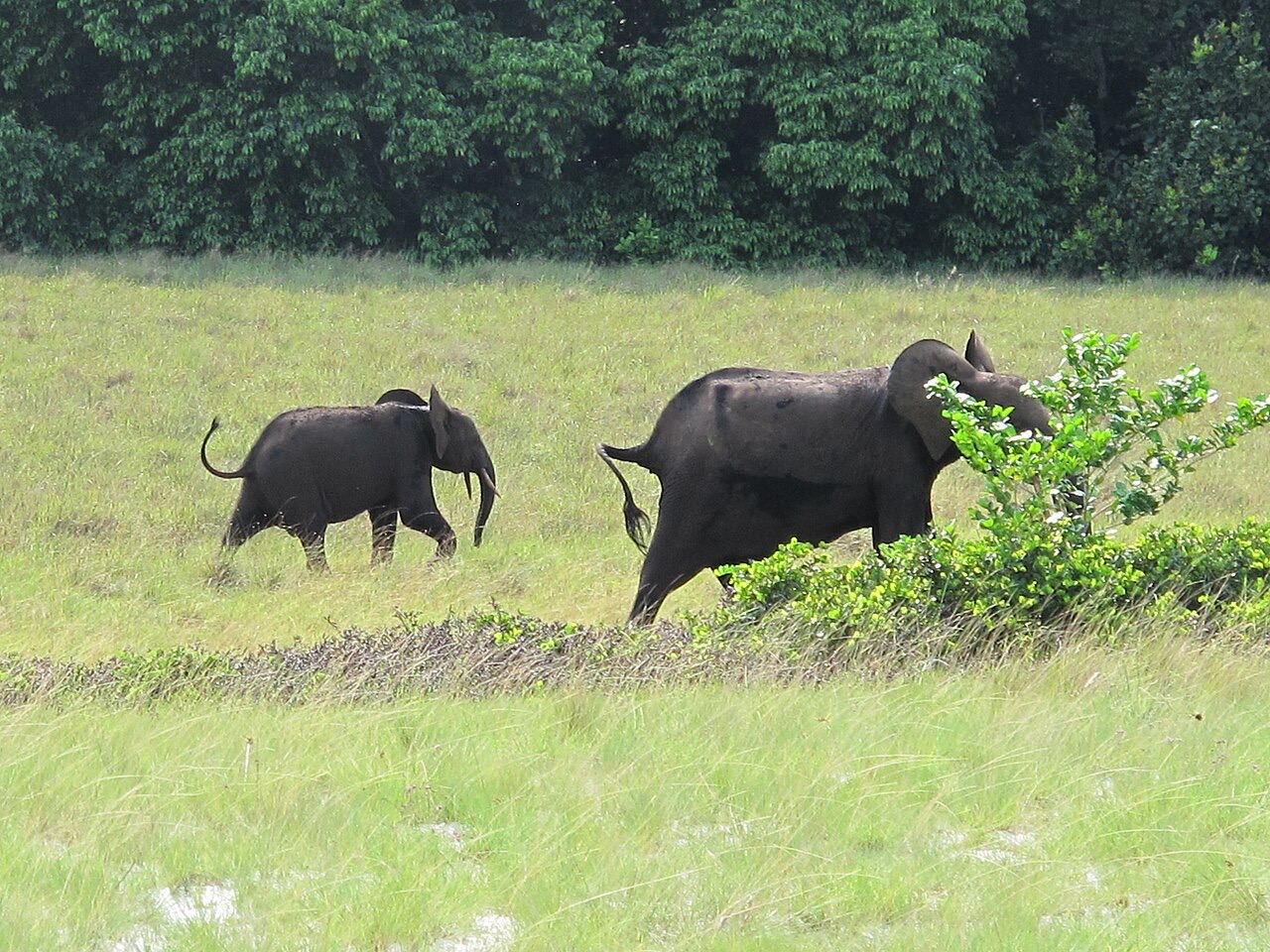
Gabon’s protected landscapes include tropical forest, savanna, rivers, mangroves and marine environments. Forest elephants and western lowland gorillas live here, alongside chimpanzees and mandrills. These species occupy different habitats and are not guaranteed sightings at any one location. Thirteen national parks were established in 2002. Loango brings together beaches, lagoons, savanna and forest; the elephant-and-calf photograph was taken there.
Ivindo National Park, inscribed as World Heritage in 2021, protects rainforest and blackwater rivers with waterfalls and rapids. Lopé-Okanda, inscribed in 2007, combines forest and relict savanna with archaeological heritage. Poaching, habitat disturbance and pressures on rivers and coasts require sustained conservation work. Forest communities have knowledge, livelihoods and rights that matter to this work. The guide’s representative park pins introduce habitats; they do not indicate park boundaries, trails or visitor entrances.
Food & Cuisine of Gabon
Palm-fruit sauces, cassava, fish and market ingredients.
- What is nyembwe sauce made from?
- The pulp of oil-palm fruit.
- What is atanga?
- A fruit, also called safou or African pear, that softens when heated.
- What does the food photograph show?
- Vegetables and peanut paste at Potos market.
More about Gabon: food & cuisine
Poulet nyembwe is a well-known Gabonese chicken dish prepared with a sauce made from oil-palm fruit pulp. It is distinct from a groundnut sauce. Cassava, plantains, rice and yams provide starches in different meals, while fish links coastal and river kitchens. Cassava can be prepared as a dense dough wrapped in leaves; appropriate processing is essential before eating roots or leaves.
Atanga, also known elsewhere as safou or African pear, softens when heated and has a rich texture. Vegetables, chillies, groundnuts and fruit contribute to household cooking, while urban markets and bakeries reflect wider regional connections and French influence. Recipes vary by family and region rather than following one national menu. The photograph shows vegetables and peanut paste at Potos market; it does not depict a finished plate of poulet nyembwe.
Landmarks of Gabon
Lopé-Okanda, Ivindo and places that connect landscapes with human history.
- Which two properties are on Gabon’s World Heritage List?
- Lopé-Okanda and Ivindo National Park.
- What makes Lopé-Okanda a mixed heritage site?
- It combines important natural habitats with archaeological and cultural evidence.
- Which town is associated with the Schweitzer Hospital?
- Lambaréné.
More about Gabon: landmarks
Gabon has two inscribed World Heritage properties: the Ecosystem and Relict Cultural Landscape of Lopé-Okanda and Ivindo National Park. Lopé-Okanda’s forest–savanna mosaic preserves evidence of occupation and movement along the Ogooué valley, including rock carvings and iron-working remains. Mount Brazza, shown in the photograph, introduces the Lopé landscape. Ivindo’s river network includes Kongou Falls, a broad waterfall complex within the rainforest.
In Libreville, Saint-Michel de Nkembo Church is known for carved wooden columns. Lambaréné is associated with the Albert Schweitzer Hospital, founded in 1913, whose history includes both medical work and the inequalities of colonial medicine. The Léconi canyon landscape lies in the southeast, while Cape Lopez sits near Port-Gentil on the Atlantic. Learning pins identify buildings or representative landscapes. Check current visitor arrangements and official travel advice separately when planning a visit.
People & Society of Gabon
Cities, smaller towns and many community histories.
- Is Gabon’s population mainly rural or urban?
- Mainly urban, with large concentrations around Libreville and Port-Gentil.
- Which sport is Anthony Obame known for?
- Taekwondo.
- Can a community label describe everyone’s beliefs or occupation?
- No. Individual lives and choices vary within every community.
More about Gabon: people & society
Most Gabonese people live in urban areas, particularly around Libreville and Port-Gentil, while smaller towns and rural settlements connect the wider country. Fang, Punu, Nzebi, Myene, Kota, Teke and many other communities have distinct histories and languages. Indigenous forest peoples also contribute knowledge and cultural traditions while facing inequalities in access to services and recognition. Community names do not determine a person’s language choices, occupation or beliefs.
Family connections link cities, villages and relatives abroad. Migration from neighbouring countries and farther away also shapes everyday urban life. Schools, markets, workplaces, religious organisations and sports bring people together across these connections. Footballer Pierre-Emerick Aubameyang and Olympic taekwondo medallist Anthony Obame offer two paths into Gabonese sporting history. Writer Angèle Rawiri offers another perspective through literature. Individual achievements sit alongside the experiences of people whose lives rarely appear in international headlines.