Facts about Ivory Coast
Explore Côte d’Ivoire from Abidjan’s lagoons and the Atlantic ports to cocoa-growing country, the western mountains and northern savannas. Ten illustrated topics connect the map with history, languages, food and everyday life.
- Capital
- Yamoussoukro
- Population (2021 census)
- About 29.4 million
- Area
- 322,463 km²
- Currency
- West African CFA franc (XOF)
- Official language
- French
- Independence
- 7 August 1960
Ivory Coast · 0 of 20 rounds passed
Two timed rounds per topic, 20 seconds a question
Abidjan anchors the southeast around the Ébrié Lagoon, with Grand-Bassam farther east. San-Pédro and Sassandra face the southwestern coast. Inland, Yamoussoukro is the political capital, Bouaké a central crossroads and Daloa a major city of the agricultural west.
Man introduces the western highlands, while Korhogo, Ferkessédougou and Kong orient the northern savanna. The city map includes sixteen settlements; twelve sights add Grand-Bassam, churches, mosques, coastal landscapes and the contrasting forests of Taï and savannas of Comoé.
Geography of Côte d’Ivoire
Lagoons and cocoa country in the south, mountain ridges in the west and savanna farther north.
- Where is Côte d’Ivoire?
- On the Gulf of Guinea in West Africa, between Ghana, Burkina Faso, Mali, Guinea and Liberia.
- Is Abidjan the capital?
- Yamoussoukro has been the political capital since 1983. Abidjan remains the largest commercial city and hosts many national institutions.
- What connects Abidjan’s port to the Atlantic?
- The Vridi Canal, opened in 1950, links the Ébrié Lagoon to the ocean.
More about Ivory Coast: geography
Côte d’Ivoire lies on the Gulf of Guinea in West Africa, between Liberia and Guinea to the west and Ghana to the east. Mali and Burkina Faso border the north. The country covers about 322,463 square kilometres. Its low coastal plain contains lagoons separated from the Atlantic by narrow sand barriers. Abidjan grew around the Ébrié Lagoon; the Vridi Canal connects the lagoon and port to the ocean.
Rolling plateaus rise inland, with mountains around Man and the Nimba range in the west. The wetter south once held extensive tropical forest; much is now farmland, including cocoa plantations. The north has a more strongly seasonal savanna climate. The Cavally, Sassandra, Bandama and Comoé rivers drain generally southward. Yamoussoukro is the political capital, while Abidjan remains the largest city and the principal commercial centre.
History of Côte d’Ivoire
Trading states, French colonial rule and independence, followed by a difficult struggle over citizenship and power.
- When did Côte d’Ivoire become independent?
- On 7 August 1960, from France.
- Who was its first president?
- Félix Houphouët-Boigny, who held office from independence until 1993.
- What was the Ivorian miracle?
- A period of strong post-independence economic growth, driven especially by cocoa and coffee exports.
More about Ivory Coast: history
Long before the modern border, communities traded across forest and savanna. Kong became an important northern commercial and Islamic centre, while Akan migrations helped shape Baoulé and other societies farther south and east. European merchants named the coast for its ivory trade. France established a colony in 1893, but conquest met sustained resistance, including that of Samori Touré. Colonial government imposed forced labour and promoted export crops.
Independence came on 7 August 1960 under Félix Houphouët-Boigny, president until his death in 1993. Coffee and cocoa exports supported the growth called the Ivorian miracle, alongside dependence on world prices and migrant labour. A 1999 coup and a 2002 rebellion preceded years of division. The disputed 2010 presidential election led to renewed violence in 2010–11. Reconstruction followed, but land rights, nationality, accountability and political inclusion remain central to understanding this history.
Côte d’Ivoire’s languages
French links public life; Dioula connects trade, and Nouchi gives urban conversation a distinctive voice.
- What is the official language?
- French, alongside many community languages in everyday use.
- What is Dioula used for?
- It is both a community language and a widely used language of trade and communication between groups.
- Does the French course teach Nouchi?
- It introduces general French. Nouchi is a distinct Ivorian urban speech variety discussed in the reading.
More about Ivory Coast: language
French is the official language, used in administration, schooling and much national media. Ivorian French has its own pronunciations, vocabulary and everyday expressions. Many people also speak one or more African languages, including Baoulé, Bété, Dan, Senufo varieties and Dioula, also spelled Jula or Dyula. Counts of languages vary with how related varieties are classified; no single number captures everyone’s speech.
Dioula, a Manding language, is widely used for trade and communication across communities, particularly in the north and in markets. Baoulé belongs to the Akan group and connects the central country with a wider linguistic world extending into Ghana. Nouchi developed in urban youth networks, especially in Abidjan, drawing on French and African languages. Music has helped spread it beyond those origins. The linked French course introduces general French rather than a dedicated Nouchi or Ivorian French course.
Culture of Côte d’Ivoire
Zaouli performance, regional weaving and carving, zouglou, reggae and coupé-décalé.
- What is Zaouli?
- A Guro performance tradition combining mask carving, costume, music and dance.
- Where did zouglou develop?
- In Ivorian student and urban youth settings in the 1990s, especially around Abidjan.
- Why is the 2023 AFCON also associated with 2024?
- The tournament kept its 2023 edition name but was played in January and February 2024; Côte d’Ivoire hosted and won it.
More about Ivory Coast: culture
Art and performance take different forms across the country. Zaouli, associated with Guro communities, combines a carved mask, a costume, music and intricate footwork; UNESCO recognises it as living cultural heritage. Senufo craft traditions are prominent around Korhogo, while Baoulé weaving, gold work and carving have their own histories. Masks are part of specific social and ceremonial settings, rather than a single tradition shared identically by every community.
Abidjan is a major centre of popular music. Zouglou emerged from student and youth settings in the 1990s, mixing dance with social commentary. Coupé-décalé developed through connections between the Ivorian diaspora in Paris and Abidjan in the early 2000s. Magic System’s Premier Gaou carried zouglou to international audiences, while Alpha Blondy and Tiken Jah Fakoly made reggae another influential voice. Football brings a further shared stage: the national team, Les Éléphants, won the Africa Cup of Nations hosted in 2024.
Economy of Côte d’Ivoire
Cocoa and cashews link farms with global markets, while two ports connect the country with the region.
- What is the main export crop?
- Cocoa is central to export earnings; Côte d’Ivoire is the leading producer of cocoa beans.
- Which currency is used?
- The West African CFA franc, with the currency code XOF.
- Why is San-Pédro important?
- Its port connects the agricultural southwest, especially cocoa-growing areas, with overseas markets.
More about Ivory Coast: economy
Côte d’Ivoire is the world’s leading cocoa producer, though its share of supply changes with harvests and prices. Cocoa farming supports many households in the southern and western growing zones. Cashews are especially important farther north, alongside cotton and food crops; rubber, palm oil and coffee also contribute to agricultural production. A large harvest does not automatically mean a secure farm income, and disease, weather and the terms of trade all matter.
Abidjan combines banking, telecommunications, manufacturing and port services. San-Pédro is another major export port, closely connected with the cocoa-growing southwest. Roads and the Abidjan–Ouagadougou railway link coastal trade with the interior and neighbouring landlocked countries. The currency is the West African CFA franc, XOF, issued by the BCEAO within the West African Economic and Monetary Union. Forest loss, child labour in cocoa supply chains and uneven access to services are important challenges alongside economic growth.
Politics of Côte d’Ivoire
A presidential republic with a National Assembly and Senate, shaped by debates over belonging and representation.
- What are the two chambers of parliament?
- The National Assembly and the Senate.
- How long is a presidential term?
- Five years under the 2016 constitution.
- Why does ivoirité matter to recent history?
- It was used to contest belonging and political eligibility, contributing to exclusion and tensions over nationality.
More about Ivory Coast: politics
The 2016 constitution sets out a presidential republic. The president is head of state and appoints the prime minister, who leads the government. Parliament has two chambers, the National Assembly and the Senate; the Senate began operating in 2018. Presidential terms last five years. Yamoussoukro is the capital in law, but Abidjan continues to house major government institutions and much political activity.
Formal institutions alone do not explain political life. The idea of ivoirité became a tool of exclusion in the 1990s, tying nationality and eligibility for office to contested ideas of ancestry. Conflict and displacement deepened disputes over land and documentation. Post-conflict growth and rebuilding have therefore existed alongside arguments about reconciliation, opposition participation and the distribution of opportunity. These historical issues help explain political debates without treating an election result or a constitutional rule as the whole story.
Nature & Wildlife of Côte d’Ivoire
Taï rainforest, Comoé savanna and the shared Nimba highlands protect very different habitats.
- Why is Taï National Park important?
- It protects Upper Guinean rainforest and wildlife including chimpanzees and pygmy hippopotamuses.
- How does Comoé differ from Taï?
- Comoé includes savanna, woodland and river-associated forest; Taï is primarily tropical rainforest.
- Which countries share the Nimba World Heritage property?
- Guinea and Côte d’Ivoire. The wider mountain range also reaches Liberia.
More about Ivory Coast: nature & wildlife
Taï National Park in the southwest protects a major remnant of the Upper Guinean tropical forest. Its wildlife includes chimpanzees, pygmy hippopotamuses and several forest monkey species. Researchers there have studied chimpanzees using stones and wooden tools to crack nuts. In the northeast, Comoé National Park contains savanna, woodland and forest habitats associated with the Comoé River. Both parks are World Heritage properties, but they protect different ecosystems.
The Mount Nimba Strict Nature Reserve World Heritage property is shared by Guinea and Côte d’Ivoire. The wider Nimba range also extends into Liberia; that does not make Liberia part of this two-country UNESCO property. Banco National Park preserves forest within metropolitan Abidjan. Forest clearance, habitat fragmentation, hunting and pressure from agriculture threaten biodiversity. Park pins identify representative locations for learning, rather than boundaries, entrances or confirmation of access.
Food & Cuisine of Côte d’Ivoire
Fermented cassava, fried plantains and slow-cooked stews, shared at home and in the maquis.
- Is attiéké made from wheat?
- No. It is made from processed and fermented cassava, then steamed.
- What is alloco?
- Fried ripe plantain, commonly served as a snack or an accompaniment.
- What makes kedjenou distinctive?
- Slow cooking in a covered pot, usually with little or no added water.
More about Ivory Coast: food & cuisine
Attiéké is made from cassava that is processed, fermented, granulated and steamed. Its couscous-like texture makes it a versatile accompaniment to fish, onions, tomatoes and chilli. UNESCO recognises the knowledge and skills of making attiéké as living heritage. Garba pairs attiéké with fried tuna, while alloco is ripe plantain fried and served with accompaniments that vary from stall to stall.
Foutou is a pounded staple made in different combinations of plantain, yam and cassava, eaten with sauces such as sauce graine, based on palm fruit, or groundnut sauce. Kedjenou slowly cooks chicken or other meat with vegetables in a covered pot, using little or no added water. A maquis is a popular place to eat, drink and socialise; menus often include grilled fish or chicken. Ginger drink, commonly called gnamakoudji, is another familiar flavour. Recipes and meal habits vary between regions and households.
Landmarks of Côte d’Ivoire
Grand-Bassam’s historic quarter, monumental churches and northern earthen mosques tell different stories.
- Is Grand-Bassam only a colonial monument?
- No. Its World Heritage significance includes the N’zima settlement and the relationship between African and colonial urban life.
- How many UNESCO properties are the eight northern mosques?
- One serial property, with eight mosque components across seven settlements.
- Which city contains the Basilica of Our Lady of Peace?
- Yamoussoukro, the political capital.
More about Ivory Coast: landmarks
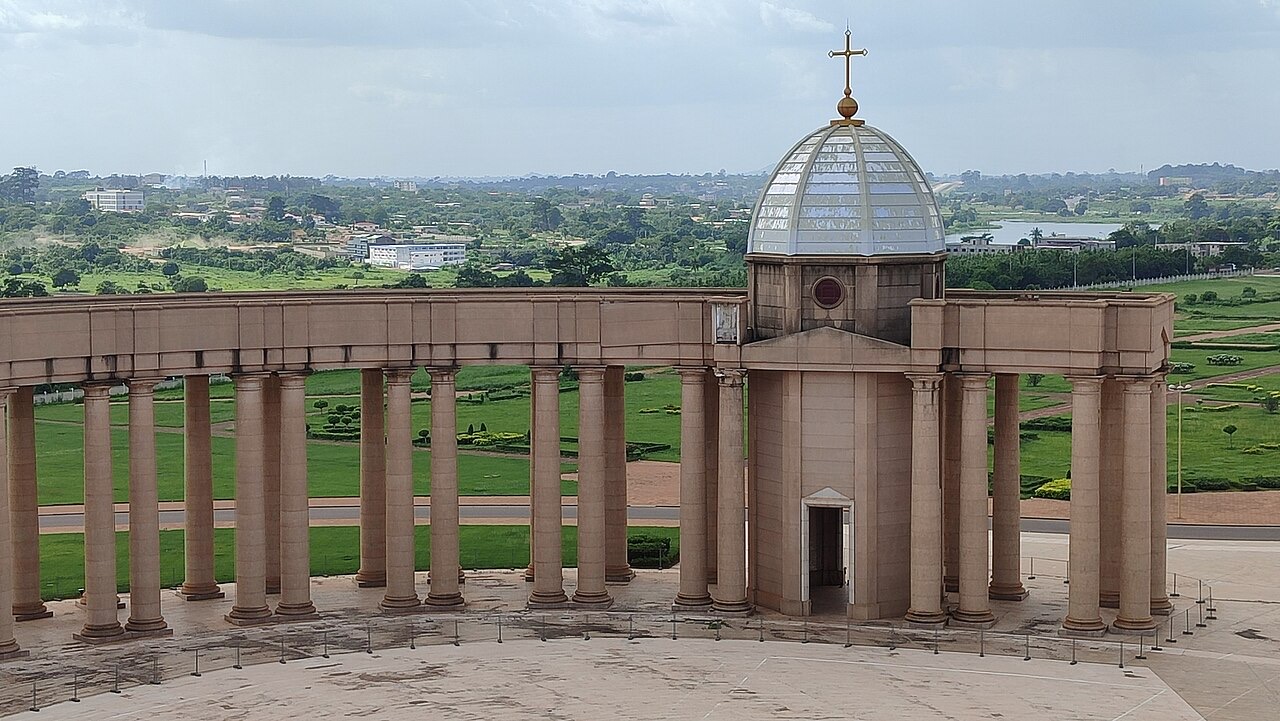
Grand-Bassam was the first colonial capital of Côte d’Ivoire. Its World Heritage area brings together the colonial administrative and commercial town and the N’zima settlement, so its significance extends beyond European buildings. In Yamoussoukro, the Basilica of Our Lady of Peace, consecrated in 1990, uses a monumental domed design inspired by St Peter’s in Rome. Abidjan’s Saint Paul’s Cathedral offers a contrasting modern landmark above the Plateau district.
Northern heritage includes the Sudanese-style mosques inscribed by UNESCO in 2021. Eight earthen mosques in Tengréla, Kouto, Sorobango, Samatiguila, M’Bengué, Kong and Kaouara form one serial property; Kong contains two components. Their buttresses, projecting timbers and maintenance traditions reflect long links between the savanna, trade and Islam. These remain places of worship. Around Man, forested hills and rock formations add a landscape dimension to a guide that includes living towns as well as designated heritage.
People & Society of Côte d’Ivoire
A young and diverse population connected by migration, markets, faith, literature and football.
- What population did the 2021 census record?
- About 29.4 million residents; later population estimates use different reference years.
- Are religious affiliations split into equal thirds?
- No. Islam and Christianity are the largest affiliations; indigenous practices and other or no affiliations also form part of society.
- Did one football speech end the civil war?
- No. Drogba’s appeal became a powerful symbol, while peace depended on longer political and social processes.
More about Ivory Coast: people & society
The 2021 census counted about 29.4 million residents. Abidjan is the largest urban centre, but towns such as Bouaké, Daloa and Korhogo connect farming regions and trading networks across the interior. Akan, Kru, Mandé and Gur-speaking communities contain many distinct identities; broad language categories should not be mistaken for uniform cultures. Migration from neighbouring countries, especially Burkina Faso and Mali, has been important to agricultural work, commerce and city life.
Islam and Christianity are the largest religious affiliations, alongside indigenous religious practices and people who report no religion. They do not divide the population into three equal groups, and practice can cross neat labels. Writers such as Ahmadou Kourouma explored colonial and postcolonial power, while footballers including Didier Drogba became internationally recognisable voices. Drogba’s 2005 appeal for peace mattered symbolically, but a long conflict cannot be explained as having ended through a single speech. Family, work and neighbourhood ties connect these national stories with everyday life.