Facts about Republic of Congo
Explore the Republic of the Congo from Brazzaville and Pointe-Noire to the Niari valley, inland plateaus and northern forests. Twelve city locations, ten heritage and landscape pins and ten illustrated topics connect geography, history, languages and everyday life.
- Capital
- Brazzaville
- Area
- About 342,000 km²
- Official language
- French
- National languages
- Lingala and Kituba
- Currency
- Central African CFA franc (XAF)
- Independence
- 15 August 1960
Republic of Congo · 0 of 20 rounds passed
Two timed rounds per topic, 20 seconds a question
Brazzaville stands on Pool Malebo in the southeast, while Pointe-Noire is the main Atlantic port. The coastal plain rises toward the Mayombe mountains; farther inland, plateaus and the Congo River basin give way to vast northern forests and wetlands.
The country shares borders with Gabon, Cameroon, the Central African Republic, the Democratic Republic of the Congo and Angola’s Cabinda exclave. River routes, roads and railways connect regions with different histories and livelihoods.
Geography of the Republic of the Congo
From the Atlantic coast to the forests and wetlands of the Congo Basin.
- Are Congo-Brazzaville and the DRC one country?
- No. The Republic of the Congo has Brazzaville as its capital; the DRC has Kinshasa.
- Which city is the main Atlantic port?
- Pointe-Noire, on the southwestern coast.
- Does the Kouilou-Niari drain into the Congo River?
- No. It has its own outlet to the Atlantic Ocean.
More about Republic of Congo: geography
The Republic of the Congo, also called Congo-Brazzaville, covers about 342,000 square kilometres in central Africa and crosses the equator. Its neighbours are Gabon, Cameroon, the Central African Republic, the Democratic Republic of the Congo and Angola’s Cabinda exclave. Brazzaville faces Kinshasa across Pool Malebo on the Congo River; the two capitals belong to separate countries. Pointe-Noire is the main Atlantic port. The Kouilou-Niari river system drains toward the ocean independently of the Congo River.
The coastal plain rises into the forested Mayombe mountains, then the Niari valley and inland plateaus. Dolisie, Nkayi and Madingou help locate the southern transport corridor; Sibiti and Djambala lie farther inland. Owando, Oyo and Makoua introduce the central river country. Ouesso stands on the Sangha, while Impfondo lies on the Ubangi. Northern forests, swamp forests and peatlands form part of the Congo Basin. Rainfall and river levels vary seasonally, shaping farming and navigation.
History of the Republic of the Congo
Kingdoms, colonial rule, independence and political change.
- When did the Republic of the Congo become independent?
- On 15 August 1960, from France.
- What did building the Congo-Ocean Railway cost workers?
- Forced African labourers suffered an enormous death toll during colonial construction.
- Did the 1944 Brazzaville Conference grant immediate independence?
- No. It proposed reforms within French colonial rule.
More about Republic of Congo: history
The histories of Kongo, Loango and Teke societies extend across present-day national borders. Coastal and inland trade connected communities long before French colonial rule; the Atlantic slave trade caused profound disruption. Pierre Savorgnan de Brazza negotiated an agreement with the Teke ruler Makoko in 1880, a step in French expansion. Brazzaville became the capital of French Equatorial Africa, and the territory was known as Middle Congo. Forced African labour built the Congo-Ocean Railway between Brazzaville and Pointe-Noire at an enormous human cost.
Brazzaville became an important Free French centre during the Second World War. The 1944 Brazzaville Conference proposed colonial reforms, rather than immediate independence. Independence came from France on 15 August 1960, with Fulbert Youlou as the first president. A Marxist-Leninist People’s Republic was proclaimed in 1969; multiparty politics returned in the early 1990s. Pascal Lissouba won the 1992 presidential election. The 1997 civil war brought Denis Sassou Nguesso back to power, and further conflict and displacement followed. This history is distinct from the neighbouring DRC’s Belgian colonial past.
French, Lingala and Kituba
French, Lingala, Kituba and many local languages.
- Which language is official?
- French, under Article 4 of the 2015 Constitution.
- Which two national vehicular languages does the constitution name?
- Lingala and Kituba.
- What does the linked language course teach?
- General French; dedicated Lingala and Kituba courses are not provided here.
More about Republic of Congo: language
Article 4 of the 2015 Constitution identifies French as the official language and Lingala and Kituba as national vehicular languages: languages used between different speech communities. French is prominent in government and formal education. Lingala is widely used in the north and around Brazzaville, as well as across the river in the DRC. Kituba, based largely on Kikongo, is especially important in the south. These patterns overlap; they do not divide everyone into fixed language regions.
Many community languages are also spoken, including varieties of Kikongo, Teke and Mbochi and languages of Indigenous forest peoples. Most belong to the Bantu branch of the Niger–Congo language family. Lari is associated with Brazzaville and the Pool region. People may use several languages at home, at school, in markets and in music. The linked Worldly lessons introduce general French. They are a starting point for one official language, rather than a dedicated course in Lingala, Kituba or every Congolese variety of French.
Culture of the Republic of the Congo
Music, literature, visual arts and the style of la Sape.
- Is Congolese rumba associated with just one Congo?
- No. UNESCO’s 2021 inscription is shared by the Republic of the Congo and the DRC.
- What does La Sape emphasise?
- Carefully chosen clothing, elegance and expressive personal presentation.
- What is the Poto-Poto school?
- A painting school founded in Brazzaville in 1951, known for colourful, stylised work.
More about Republic of Congo: culture
Brazzaville and Kinshasa share a musical conversation across the Congo River. Congolese rumba combines local musical histories with influences including Cuban son; UNESCO inscribed it jointly for both countries in 2021. Soukous developed related guitar and dance traditions, with musicians such as Brazzaville-born Aurlus Mabélé taking their work abroad. La Sape is associated with expressive, carefully assembled clothing and public performance of elegance. Its French name is Société des Ambianceurs et des Personnes Élégantes.
The Poto-Poto painting school, founded in Brazzaville in 1951, became known for colourful scenes and stylised figures. Teke masks include circular forms with geometric decoration, but neither one school nor one mask type represents the country’s whole visual culture. Writers such as Alain Mabanckou connect Congolese memories and cities with wider francophone literature. Theatre, oral storytelling, dance and religious life vary across communities. Urban fashion and internationally known artists sit alongside many less visible local creative traditions.
Economy of the Republic of the Congo
Oil, forests, agriculture and the challenge of diversification.
- Why do oil prices matter to public finances?
- Petroleum is a major source of exports and government revenue.
- Which currency is used?
- The Central African CFA franc (XAF), distinct from the DRC’s Congolese franc.
- What does the Congo-Ocean Railway connect?
- Brazzaville and the Atlantic port of Pointe-Noire.
More about Republic of Congo: economy
Petroleum, including offshore production around Pointe-Noire, is central to export earnings and government revenue. This dependence exposes public finances to oil-price changes. The port handles international trade, while the Congo-Ocean Railway links it with Brazzaville. Timber and wood processing are also important, alongside services, construction, agriculture, fishing and informal trading. The currency is the Central African CFA franc, abbreviated XAF, issued within the regional monetary union; it is different from the DRC’s Congolese franc.
The country belongs to the Central African Economic and Monetary Community, or CEMAC. Roads, rail and navigable rivers connect different markets, though rapids below Brazzaville interrupt a direct inland river journey to the Atlantic. Many households depend on small-scale farming and trade, while infrastructure and access to finance constrain businesses. Economic diversification, public debt and the distribution of resource income are recurring policy issues. Forest management also involves carbon storage, biodiversity and local and Indigenous peoples’ rights, alongside the commercial value of timber.
Politics of the Republic of the Congo
A presidential republic with a history of contested politics.
- What are the two parliamentary chambers?
- The National Assembly and the Senate.
- Did the 2015 Constitution remove every presidential term limit?
- No. It provides for five-year terms renewable twice and removed the previous upper-age restriction.
- When did Sassou Nguesso return to the presidency?
- In 1997, after previously serving from 1979 to 1992.
More about Republic of Congo: politics
The Republic of the Congo is a presidential republic with a government and a bicameral parliament: the National Assembly and the Senate. Denis Sassou Nguesso held the presidency from 1979 to 1992 and returned in 1997. The World Bank’s country overview reports his re-election in March 2026. The Congolese Party of Labour has been a central political organisation. Elections, opposition participation and political freedoms have been contested, so official institutions and election results alone do not describe every citizen’s political experience.
The 2015 Constitution replaced the previous constitutional framework. It removed the former presidential upper-age restriction and set a five-year presidential term renewable twice; saying that it abolished all term limits would be inaccurate. The constitution also sets out rights and responsibilities and recognises the official and national languages. Congo participates in the African Union, United Nations and CEMAC, with international relationships shaped by regional cooperation, colonial history and resource trade. The reading gives institutional context; named officeholders and political conditions should always be checked against dated reporting.
Nature & Wildlife of the Republic of the Congo
Forest elephants, western lowland gorillas and the Congo Basin.
- Which kind of gorilla lives in Odzala-Kokoua?
- The western lowland gorilla.
- What is a bai?
- A natural forest clearing where wildlife gathers for water, food and minerals.
- Why do the Cuvette Centrale peatlands matter for climate?
- Their waterlogged soils store large amounts of carbon that disturbance can release.
More about Republic of Congo: nature & wildlife
Northern forests shelter western lowland gorillas, chimpanzees, African forest elephants and many other species. Natural forest clearings called bais attract animals seeking water, vegetation and minerals, allowing researchers to observe otherwise elusive wildlife. Odzala-Kokoua contains forest, savanna and wetland habitats; the Forest Massif of Odzala-Kokoua became a UNESCO World Heritage property in 2023. Nouabalé-Ndoki is the Congolese component of the Sangha Trinational, inscribed in 2012 and shared with Cameroon and the Central African Republic.
Conkouati-Douli National Park adds coastal forests, lagoons and marine environments near Gabon. The Cuvette Centrale peatlands, shared with the DRC, store very large quantities of carbon in waterlogged soils. Drainage, deforestation and changing rainfall can threaten that store. Logging, poaching, habitat change and disease affect different species and places in different ways. Conservation depends on research, effective protection and the rights and knowledge of local and Indigenous communities. A representative park pin is a learning location rather than a boundary, visitor entrance or guarantee of access.
Food & Cuisine of the Republic of the Congo
Cassava, fish, greens and regional cooking traditions.
- What is saka-saka made from?
- Pounded cassava leaves, commonly cooked with palm oil and seasonings.
- What is maboké?
- Seasoned fish or meat cooked in leaf parcels.
- What does the food photograph show?
- Salted fish for sale at Total market in Brazzaville.
More about Republic of Congo: food & cuisine
Cassava is a staple in many Congolese meals, alongside plantains, rice and other crops. Chikwangue is made from fermented cassava paste wrapped in leaves, while fufu is a dense starchy preparation served with sauces; ingredients and names vary across regions. Saka-saka uses pounded cassava leaves, commonly cooked with palm oil and seasonings. Cassava roots and leaves require appropriate preparation before eating. A single national menu cannot capture the differences between family kitchens, urban markets, coastal communities and inland villages.
Fish from rivers and the Atlantic coast is sold fresh, dried, smoked or salted. Maboké refers to seasoned fish or meat cooked in leaf parcels, while moambe or mwamba is a sauce made from oil-palm fruit pulp. Vegetables, groundnuts and chillies contribute to many preparations, and plantains may be fried or boiled. The photograph shows salted fish at Brazzaville’s Total market, rather than a finished cassava dish. Food names and techniques cross borders, including with the DRC and other central African countries, while household recipes remain diverse.
Landmarks of the Republic of the Congo
Brazzaville, the Atlantic coast and protected forests.
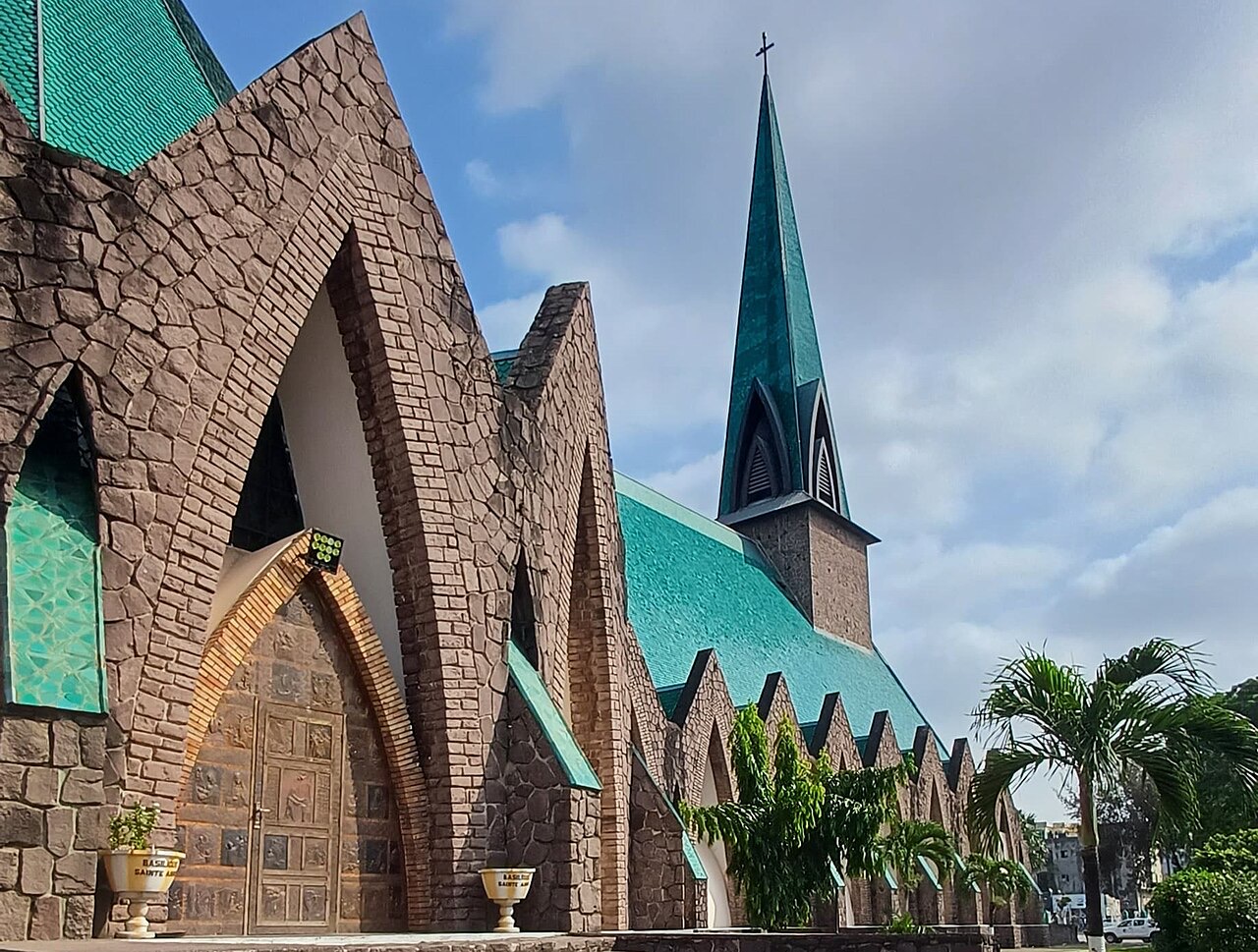
- What distinguishes Sainte-Anne’s roof?
- Its green tiles.
- Which two natural properties are on UNESCO’s World Heritage List?
- Sangha Trinational and the Forest Massif of Odzala-Kokoua.
- Are park pins visitor entrances?
- No. They represent learning locations within broad landscapes; access needs separate checking.
More about Republic of Congo: landmarks
Brazzaville’s Sainte-Anne-du-Congo Basilica is known for its green tiled roof. The Nabemba Tower rises beside the river, while the de Brazza memorial recalls the explorer whose name the city bears and invites reflection on the colonial past. Poto-Poto’s painting school introduces a different part of the capital’s cultural life. Downstream, the Congo rapids help explain why navigation between Pool Malebo and the Atlantic is interrupted. These are different kinds of landmarks, from working cultural institutions to historic buildings and river landscapes.
Near Pointe-Noire, the Diosso Gorge exposes striking eroded cliffs. Loufoulakari Falls lie southwest of Brazzaville where the Loufoulakari meets the Congo. The Forest Massif of Odzala-Kokoua and Sangha Trinational are Congo’s two inscribed natural World Heritage properties; Conkouati-Douli adds an Atlantic coastal park. The guide’s pins mark particular buildings or representative landscape locations. Distances, seasonal conditions and visitor arrangements vary, so use current local information and official advice when arranging visits rather than treating the learning map as an itinerary.
People & Society of the Republic of the Congo
Urban life, rural communities and diverse identities.
- Which two cities are major population centres?
- Brazzaville and Pointe-Noire.
- Can one ethnic label explain a person’s whole life?
- No. People’s languages, beliefs, livelihoods and experiences vary within communities.
- Which sport is Serge Ibaka known for?
- Basketball.
More about Republic of Congo: people & society
Many Congolese people live in Brazzaville and Pointe-Noire, while smaller towns, river settlements and rural communities connect the wider country. Kongo, Teke, Mbochi, Sangha and many other communities contribute distinct languages and histories. Indigenous forest peoples have long-standing knowledge of forest environments, alongside diverse experiences of exclusion and struggles for recognition. Broad community names do not determine an individual’s occupation, political views, language choices or way of life.
Family networks often connect urban households, villages and relatives abroad. Christianity is widely practised alongside other religions and local spiritual traditions. Access to education, health care, transport and employment varies between places and households. Marien Ngouabi University in Brazzaville is a major higher-education institution. Congolese figures known internationally include writer Alain Mabanckou, musician Aurlus Mabélé and basketball player Serge Ibaka. Their work offers starting points for learning about individual lives, alongside the everyday experiences of people who do not appear in international headlines.