Facts about United Arab Emirates
Explore the United Arab Emirates beyond its skylines: oasis paths in Al Ain, pearling settlements in Ras Al Khaimah, Sharjah’s archaeology and the mountain-backed Gulf of Oman coast. Connect all seven emirates with the histories, languages, food and communities that shape them.
- Capital
- Abu Dhabi
- Emirates
- 7
- Official language
- Arabic
- Currency
- UAE dirham (AED)
- Federation founded
- 2 December 1971
- UNESCO World Heritage
- 2 properties (2026)
United Arab Emirates · 0 of 20 rounds passed
Two timed rounds per topic, 20 seconds a question
The UAE occupies the southeastern Arabian Peninsula between Saudi Arabia and Oman. Abu Dhabi is both the federal capital and the name of the largest emirate; Dubai is a separate city and emirate farther northeast. Sharjah, Ajman, Umm Al Quwain, Ras Al Khaimah and Fujairah complete the federation. Most major cities face the Persian Gulf, called the Arabian Gulf locally, while Fujairah and Sharjah’s eastern territories face the Gulf of Oman.
The coast, desert and mountains have long supported different ways of life. Pearling and overseas trade connected harbours with the Indian Ocean; date farming and irrigation sustained inland oases. Today, ports, aviation, energy production and migration link the country with the wider world. Learn the emirates first, then use the cities and sights to distinguish the capital’s islands, Al Ain’s heritage landscapes, Liwa’s dunes and the Hajar valleys.
Geography of the UAE
Two gulf coasts, Hajar mountain valleys and the Empty Quarter frame a country of separate territories.
- Is Abu Dhabi just the capital city?
- No. Abu Dhabi is also the largest emirate, including Al Ain, Al Dhafra and many islands.
- Why does Sharjah appear in separate pieces on the map?
- Its territory includes a western main area, east-coast territories at Khor Fakkan, Kalba and Dibba Al Hisn, and the small Nahwa enclave inside Oman’s Madha exclave.
- Does the UAE have permanent rivers?
- No. Wadis may carry water after rain, while reservoirs store water; neither is the same as a permanent river system.
More about United Arab Emirates: geography
Abu Dhabi stretches across much of the southwest, from islands and coastal salt flats called sabkhas to the Liwa oasis belt beside the Rub al Khali, or Empty Quarter. The Hajar Mountains rise in the east and northeast. Valleys called wadis can be dry for long periods and carry water after rain. The UAE has no permanent rivers; reservoirs and seasonal channels are different from year-round river systems.
The emirates are not seven simple blocks. Dubai includes the separate Hatta territory, while Ajman includes Manama and Masfout. Sharjah has territory on both gulfs, including Khor Fakkan, Kalba and Dibba Al Hisn. Its small Nahwa enclave lies inside Oman’s Madha exclave, which is itself surrounded by the UAE. Oman’s Musandam peninsula continues north of the UAE towards the Strait of Hormuz.
History of the UAE
Early desert occupation, oasis farming and pearl trading preceded the federation established in 1971.
- Did all seven emirates found the federation on the same day?
- Six formed the UAE on 2 December 1971. Ras Al Khaimah joined on 10 February 1972.
- What were the Trucial States?
- Coastal sheikhdoms linked by treaties with Britain before the UAE was formed.
- Why did the pearl economy decline?
- Competition from cultured pearls combined with the worldwide economic downturn in the early twentieth century.
More about United Arab Emirates: history
Archaeological layers in Sharjah’s Faya Palaeolandscape record intermittent human occupation through major changes in climate. Al Ain’s tombs, settlements and irrigation remains reveal later communities linking farming with regional exchange. Coastal livelihoods included fishing, pearling, boatbuilding and trade. The pearl economy declined with competition from cultured pearls and the worldwide economic downturn in the early twentieth century.
Treaties with Britain gave the coastal sheikhdoms the collective name Trucial States. After Britain announced its withdrawal, negotiations led to a federation of six emirates on 2 December 1971. Ras Al Khaimah joined on 10 February 1972. Sheikh Zayed bin Sultan Al Nahyan of Abu Dhabi and Sheikh Rashid bin Saeed Al Maktoum of Dubai played central roles in building the union. Oil revenues helped fund rapid changes in infrastructure, education and public services.
Arabic and the languages of the UAE
Arabic is official; Emirati speech and the languages of a diverse resident population fill daily life.
- What do the linked Arabic lessons teach?
- Modern Standard Arabic, rather than a dedicated Emirati dialect course.
- Is English a second national official language?
- No. Arabic is the official language. English is widely used in business and communication between speakers of different first languages.
- Does everyone speak the same Arabic at home?
- No. Emirati Arabic varies between communities, and residents use many other languages too.
More about United Arab Emirates: language
Arabic is the UAE’s official language. Modern Standard Arabic is used in formal writing, education and news, while Emirati Arabic belongs to the wider Gulf Arabic landscape and varies between communities. The linked lessons introduce Modern Standard Arabic. They provide a starting point for reading and basic communication rather than a dedicated course in Emirati dialect.
English is widely used between people with different first languages, particularly in business and visitor settings. Hindi, Urdu, Malayalam, Bengali, Tagalog, Persian and other languages reflect residents’ varied backgrounds and longstanding connections across the Gulf and Indian Ocean. Bilingual signs do not make English a second national official language, and neither citizenship nor a person’s appearance tells you which languages they speak at home.
Culture of the UAE
Coffee, poetry, weaving and performance connect hospitality with skills passed between generations.
- What is a majlis?
- A gathering space and a social setting for conversation, hospitality and community exchange.
- What is Al-Ayyala?
- A performing tradition shared with Oman that combines chanted poetry, drums and coordinated movement.
- What is Al Sadu?
- A weaving tradition associated with Bedouin communities, using geometric patterns in textiles and furnishings.
More about United Arab Emirates: culture
A majlis is a gathering space as well as a social setting for conversation and hospitality. Arabic coffee and dates often accompany a welcome, with customs that vary by household and occasion. Falconry, camel husbandry, boatbuilding and poetry connect cultural practice with older landscapes and livelihoods. These traditions continue alongside contemporary art, film, design and everyday urban life.
Al-Ayyala, shared with Oman, combines chanted poetry, drums and coordinated movement, often with rows of performers holding slender sticks. Al Sadu weaving uses geometric patterns and skills associated with Bedouin communities. UNESCO recognises both as living intangible heritage. A kandura is a long robe worn by many Emirati men; an abaya is an outer garment worn by many women. Clothing choices and participation in traditions vary, so no single outfit or performance describes everyone.
Economy of the UAE
Oil and gas, international ports, aviation and services support different economies within one federation.
- How many fils make one dirham?
- 100 fils make one UAE dirham, abbreviated AED.
- Which emirate holds most of the UAE’s oil reserves?
- Abu Dhabi. The economies of individual emirates have different mixes of energy, manufacturing, trade and services.
- What is Jebel Ali?
- A major Dubai port and associated industrial and free-zone area connecting shipping with trade and manufacturing.
More about United Arab Emirates: economy
Abu Dhabi holds most of the federation’s oil reserves, and hydrocarbons remain important to exports and public finances. Dubai developed large trading, aviation, tourism, finance and property sectors. Jebel Ali connects a container port with an industrial and free-zone economy; Fujairah’s east-coast position supports shipping outside the Strait of Hormuz. Manufacturing, construction and services also matter across the other emirates.
The UAE dirham, abbreviated AED, is divided into 100 fils. Economic diversification has expanded activity beyond oil, but dependence on international trade, energy markets and cross-border movement remains significant. Citizens and migrant workers participate in different parts of the labour market. Desalination, electricity demand, coastal development and the energy transition connect economic choices with the environment. A policy target describes an ambition rather than an outcome already achieved.
Politics of the UAE
Seven hereditary emirates share federal institutions while retaining substantial local authority.
- Who sits on the Federal Supreme Council?
- The rulers of the seven emirates, or their substitutes as provided for in the Constitution.
- Are all forty Federal National Council members directly elected?
- No. Twenty are appointed and twenty are elected through electoral colleges; these are not universal parliamentary elections.
- Is Dubai a separate country?
- No. Dubai is one of the seven emirates in the UAE federation, with its own local government as well as federal institutions.
More about United Arab Emirates: politics
The UAE is a federation of seven hereditary monarchies. Its Constitution divides responsibilities between federal institutions and the emirates. The Federal Supreme Council consists of the seven rulers and selects the federation’s president and vice-president from among its members. The presidency has traditionally been held by Abu Dhabi’s ruler, while Dubai’s ruler has traditionally served as prime minister. These are federal offices as well as relationships between emirate governments.
The Federal National Council is a consultative body of forty members: twenty appointed by the rulers and twenty elected through electoral colleges. This is not a system of universal parliamentary elections. The council discusses legislation and public policy within its constitutional role. Federal and local government responsibilities overlap in areas such as services and development, so a rule or working schedule in one emirate should not automatically be described as applying throughout the country.
Nature & Wildlife of the UAE
Mangroves, seagrass, mountains and desert habitats sustain life beyond the dunes.
- Why do dugongs need seagrass?
- Seagrass is their food, so conserving its underwater habitat is central to protecting dugongs.
- What do mangroves contribute?
- They shelter fish and birds, store carbon and help protect shorelines. They are living coastal ecosystems.
- Are all animals in island reserves native wild populations?
- No. Some reserves contain managed or introduced populations. A reserve sighting does not establish that a species occurs naturally throughout the UAE.
More about United Arab Emirates: nature & wildlife
The UAE’s habitats include mangrove lagoons, seagrass beds, rocky mountain valleys, gravel plains and sand dunes. Abu Dhabi’s coastal waters support dugongs that feed on seagrass, as well as turtles and other marine life. Mangroves provide shelter for fish and birds, store carbon and help protect shorelines. Kalba’s mangrove landscape on the east coast shows that these habitats extend beyond the capital.
Arabian oryx and gazelles feature in desert conservation, while mountain and wadi habitats support species adapted to limited water. Protected islands such as Sir Bani Yas also contain managed wildlife populations; animals seen in a reserve should not all be assumed to occur naturally across the UAE. Water scarcity, habitat fragmentation, marine pollution and coastal development place pressure on ecosystems. Seasonal water in a wadi should never be confused with a permanent river.
Food & Cuisine of the UAE
Spiced rice, wheat and meat, seafood, dates and sweet dumplings connect home cooking with regional exchange.
- What is the difference between machboos and harees?
- Machboos is spiced rice with meat or fish; harees is wheat and meat cooked into a soft preparation.
- What are luqaimat?
- Small fried dough dumplings, often served with date syrup.
- How do gahwa and karak differ?
- Gahwa is Arabic coffee; karak is a strong milk tea associated with South Asian connections.
More about United Arab Emirates: food & cuisine
Machboos, also written majboos, combines spiced rice with meat or fish. Harees is a slow-cooked preparation of wheat and meat, associated with family gatherings and celebrations. Coastal cooking draws on fish, while dates link meals to oasis farming. Breakfasts may include khameer bread, chebab pancakes or balaleet, sweetened vermicelli commonly paired with egg. Recipes and names vary between households and across the Gulf.
Luqaimat are small fried dough dumplings often served with date syrup. Arabic coffee, or gahwa, is commonly offered with dates as part of hospitality. Karak, a strong milk tea, reflects South Asian connections and has become a familiar part of daily life. The country’s restaurants also serve the food of its many resident communities; contemporary dining is much broader than a single national menu.
Landmarks of the UAE
Two World Heritage properties join oasis landscapes and early archaeology with modern civic landmarks.
- How many World Heritage properties does the UAE have?
- Two as of 2026: the Cultural Sites of Al Ain and Faya Palaeolandscape, inscribed in 2011 and 2025 respectively.
- Does the Al Ain inscription consist of a single oasis?
- No. It is a serial property with components at Hafit, Hili, Bidaa Bint Saud and oasis areas.
- Is Louvre Abu Dhabi simply a branch of the Paris museum?
- It is a museum established through an agreement between Abu Dhabi and France, with its own collection alongside international loans.
More about United Arab Emirates: landmarks
The UAE has two World Heritage properties as of 2026. The Cultural Sites of Al Ain, inscribed in 2011, comprise a serial property with components at Hafit, Hili, Bidaa Bint Saud and oasis areas. Faya Palaeolandscape in Sharjah was inscribed in 2025. It preserves evidence of early human occupation and adaptation to changing environments. A representative pin cannot describe the full extent of either property.
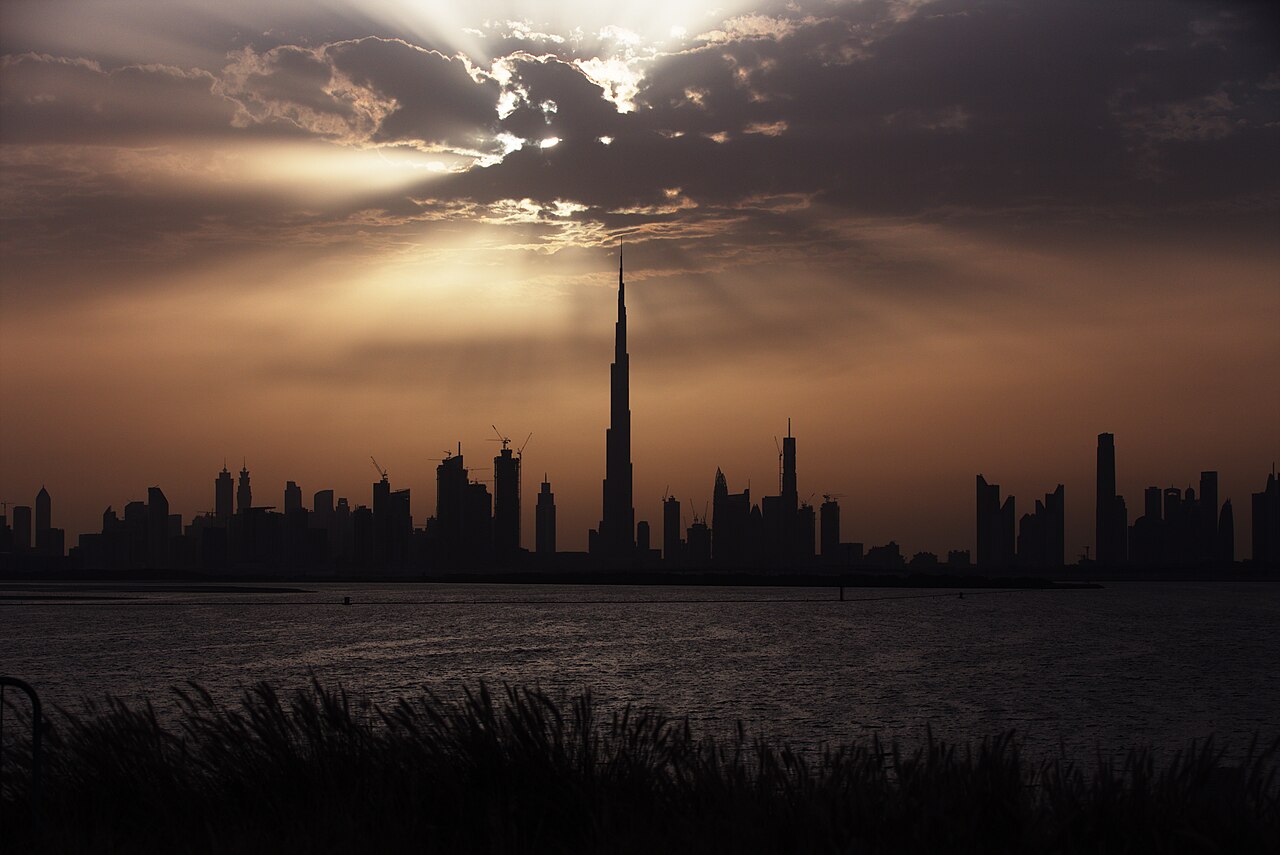
Dubai’s Burj Khalifa opened in 2010 and rises 828 metres. Abu Dhabi’s Sheikh Zayed Grand Mosque and the dome of Louvre Abu Dhabi show different approaches to large civic architecture. Louvre Abu Dhabi is a museum established through an agreement between Abu Dhabi and France, with its own collection and international loans. Older places such as Al Fahidi, Ajman’s fort and Al Jazirah Al Hamra connect architecture with everyday settlement and trade.
People & Society of the UAE
Citizens, long-established trading communities and migrants bring many languages and experiences to the federation.
- Does living in the UAE mean someone is Emirati?
- Emirati citizenship and UAE residence are different. The resident population includes citizens and people with many other nationalities.
- Does everyone have the same weekend?
- No. Federal government, emirate government and private-sector arrangements differ. Sharjah’s local government has a different pattern from the federal government.
- Why avoid an undated citizenship percentage?
- Population figures change, and citizenship, residence and employment count different things. A useful statistic identifies its date and definition.
More about United Arab Emirates: people & society
Emirati describes a citizen of the UAE; resident and citizen are different categories. Migration has brought people from South Asia, other Arab countries, Southeast Asia, Africa and elsewhere to work, study and build family lives. Coastal, oasis, mountain and Bedouin histories remain part of local identities. A resident population total is not a count of workers, and any demographic percentage needs a date and a clear definition.
Islam is the state religion, and residents also practise other religions. Family, neighbourhood and professional networks shape daily life alongside international connections. Women participate in education, public service, business, science and the arts, with experiences that differ by setting. Working schedules also vary: the federal government’s pattern differs from Sharjah’s local government, and private employers have their own arrangements within the applicable rules.