Facts about Maldives
Explore the Maldives from northern Utheemu to Malé and southern Addu. Learn twenty administrative atolls and the capital division, place ten islands and settlements, explore the surrounding seas and discover island heritage.
- Capital
- Malé
- National language
- Dhivehi
- Currency
- Rufiyaa (MVR)
- Natural atolls
- 26
- Ocean
- Indian Ocean
- Independence
- 26 July 1965
Maldives · 0 of 20 rounds passed
Two timed rounds per topic, 20 seconds a question
The archipelago stretches across the equator southwest of India and Sri Lanka. Start in Malé and reclaimed Hulhumalé, then look north to Baa and the service centre of Kulhudhuffushi. Utheemu recalls resistance to Portuguese intervention; far south, Fuvahmulah and Addu have distinct landscapes and community histories.
Learn twenty administrative atolls and Malé, place ten islands and settlements, explore the surrounding seas and discover ten sights. Natural atolls and administrative reference areas differ, and island and city councils have their own jurisdictions. Boats and flights connect them; transfer arrangements and sea conditions matter more than a straight-line distance. Dhivehi reading is included, while a dedicated language course is not yet available.
Geography of the Maldives
Coral islands, lagoons and channels form a long chain across the equator.
- What is an atoll?
- A coral reef formation surrounding a lagoon, often with islands along its rim.
- Is Hulhumalé the same island as the airport?
- No. Hulhumalé is reclaimed land; Velana International Airport is on nearby Hulhulé.
- Do natural and administrative atolls match?
- No. The 26 natural atolls describe geography; administrative divisions follow different groupings.
More about Maldives: geography
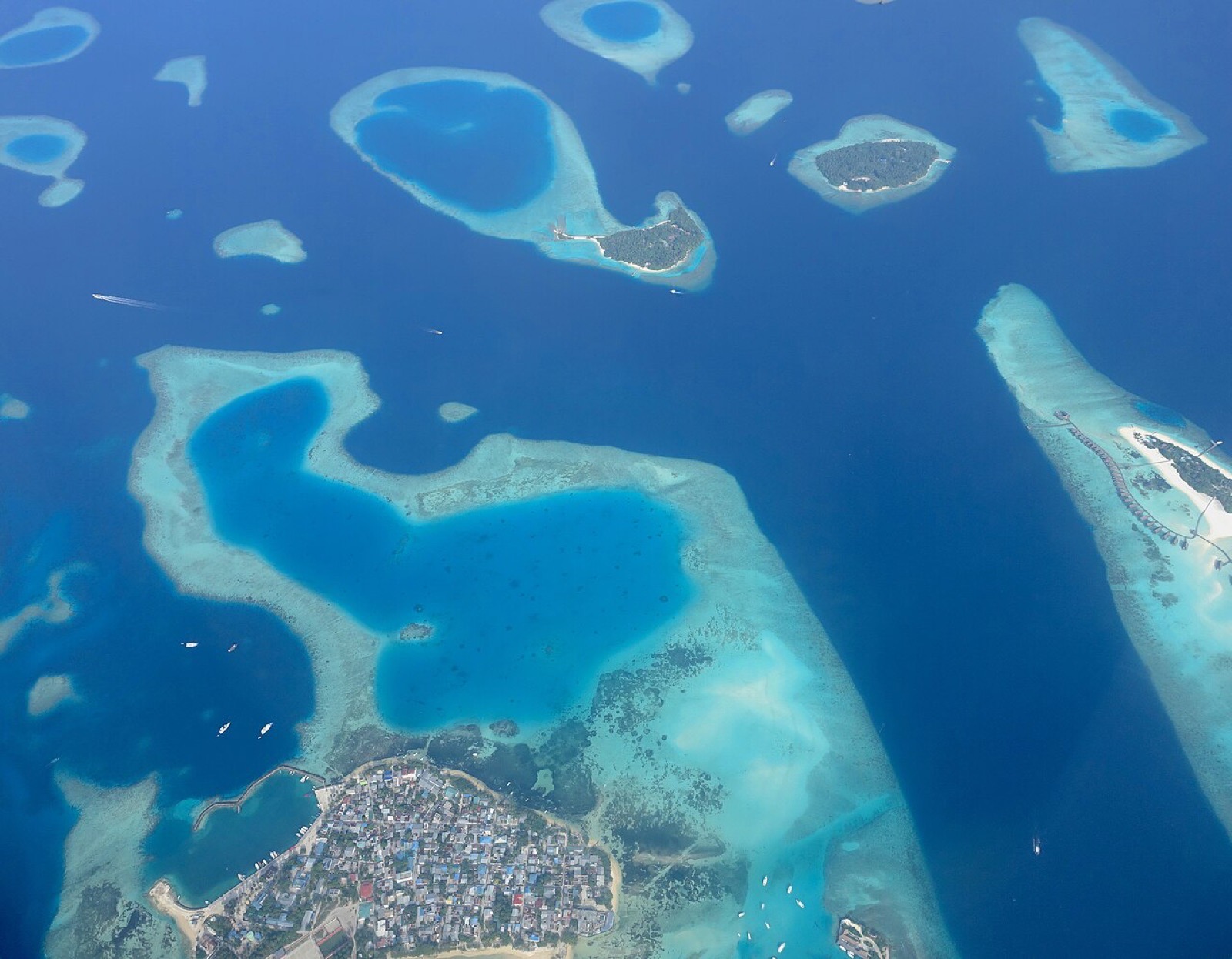
The Maldives lies in the Indian Ocean southwest of India and Sri Lanka. Roughly 1,200 coral islands are grouped into 26 natural atolls stretching north to south across the equator. An atoll is a reef-and-lagoon formation, often supporting many separate islands. The English word comes from Dhivehi atholhu. Land occupies only a small fraction of this ocean landscape, and the country has no land borders.
Malé, the capital, sits at the southern edge of North Malé Atoll. Hulhumalé is a reclaimed island in the capital region, while the airport occupies Hulhulé. Kulhudhuffushi is a northern urban centre; Eydhafushi serves Baa, and Rasdhoo serves Alif Alif. Farther south, Thinadhoo lies in Huvadhu Atoll, followed by Fuvahmulah and Addu beyond the equator. Administrative atolls are government divisions and do not match the 26 natural atolls one for one. Monsoons influence rainfall, sea conditions and travel between islands.
History of the Maldives
Indian Ocean exchange, Buddhist remains, a sultanate and independence in 1965.
- When did the Maldives gain independence?
- 26 July 1965, ending the British protectorate.
- What is remembered at Utheemu?
- Muhammad Thakurufaanu, associated with ending Portuguese intervention in 1573.
- Why are 1965 and 1968 different anniversaries?
- 1965 marks independence; 1968 marks the establishment of the present republic.
More about Maldives: history
The islands have long been connected with Sri Lanka, India and wider Indian Ocean trading routes. Archaeological remains record a Buddhist past before the conversion to Islam, traditionally dated to 1153. Cowrie shells and dried fish linked island livelihoods with distant markets. The traveller Ibn Battuta visited in the fourteenth century and served as a judge. Accounts of rulers and conversion include traditions that need to be distinguished from archaeological evidence.
Portuguese intervention in the sixteenth century ended with resistance associated with Muhammad Thakurufaanu in 1573. His home island, Utheemu, remains an important place of national memory. The Maldives became a British protectorate in 1887, retaining internal rulers while Britain controlled external relations. Independence came on 26 July 1965. A short-lived republic in 1953 preceded the lasting replacement of the sultanate by a republic on 11 November 1968. A new constitution and the first multiparty presidential election marked another turning point in 2008.
Language of the Maldives
Dhivehi, right-to-left Thaana and regional voices from north to south.
- What language is national?
- Dhivehi, an Indo-Aryan language related to Sinhala.
- In which direction is Thaana read?
- From right to left, with vowel marks accompanying consonant signs.
- Does everyone speak exactly the same variety?
- No. The archipelago includes regional varieties, notably in southern islands such as Addu and Fuvahmulah.
More about Maldives: language
Dhivehi is the national language of the Maldives. It belongs to the Indo-Aryan branch of the Indo-European family and is related to Sinhala, although the two are distinct languages. Contact around the Indian Ocean has contributed vocabulary from Arabic and other languages. Modern Dhivehi is written in Thaana, a script read from right to left. Its consonant signs have numerical origins, and vowel marks accompany the consonants.
Dhivehi varies across the archipelago. Southern varieties, including those of Addu and Fuvahmulah, have features that differ from the standard associated with Malé. English is widely used in tourism, business and education; Arabic has a role in religious learning. Migrant communities bring further languages into workplaces and neighbourhoods. Worldly does not currently offer a Dhivehi lesson course, so this guide introduces the language through reading rather than linking an unrelated language as a substitute.
Culture of the Maldives
Bodu beru, boatbuilding, woven mats and an island calendar shaped by Islam.
- What is bodu beru?
- A tradition of drumming, song and dance whose name means big drum.
- What is a dhoni?
- A Maldivian boat form adapted for fishing and transport, with changing materials and propulsion.
- Why distinguish local islands from resorts?
- They have different visitor arrangements, while inhabited islands are communities with homes, worship and everyday routines.
More about Maldives: culture
Bodu beru means big drum and names a performance tradition combining drumming, singing and dance. A performance can build from a measured rhythm to an energetic communal celebration. Dhoni boats connect another set of skills with island life: builders have adapted hulls, sails and engines to fishing and transport. Modern vessels use different materials, so the familiar boat form should not be reduced to one timeless construction method.
Mat weaving, lacquered wooden objects and embroidered clothing express local knowledge and craft. Thundu kunaa mats are associated especially with southern islands, while lacquer work has a strong connection with Thulhaadhoo. Islam shapes public holidays, Friday worship and Ramadan. Everyday customs on inhabited islands differ from arrangements at tourist resorts: visitors should respect homes, mosques and local dress expectations. Living communities have schools, workplaces and family routines alongside the cultural performances visitors may encounter.
Economy of the Maldives
Tourism and tuna connect small islands to global markets.
- When did modern resort tourism begin?
- The first resorts opened in 1972, followed later by a wider mix of accommodation.
- What is the national currency?
- The Maldivian rufiyaa, MVR, divided into 100 laari.
- What does pole-and-line fishing mean?
- Fishers catch tuna individually with baited poles and lines; sustainability also depends on the wider fishery.
More about Maldives: economy
Tourism expanded after the first resorts opened in 1972. The familiar one-island resort model sits alongside guesthouses on inhabited islands, liveaboard boats and other accommodation. Visitors are not universally confined to resort islands. Hotels, transfers, construction and imported supplies connect tourism with many other livelihoods. The industry also exposes the economy to international travel shocks, fuel costs and pressure on waste systems and water supplies.
Fishing, especially tuna, remains central to livelihoods, exports and food. Pole-and-line fishing catches tuna individually using bait and poles; its wider environmental impact still depends on bait fisheries, stocks and management. The currency is the Maldivian rufiyaa, MVR, divided into 100 laari. Imports supply much of the country’s food, fuel and building materials. Transport, public services and housing are costly across dispersed islands, while economic opportunities are unevenly distributed between the capital, other inhabited islands and resort workplaces.
Politics of the Maldives
A presidential republic, the People’s Majlis and island-level government.
- What is the People’s Majlis?
- The unicameral national parliament of the Maldives.
- What changed in 2008?
- A new constitution and the first multiparty presidential election reshaped national institutions.
- Why is climate policy a foreign-policy priority?
- Very low islands face sea-level rise, coastal flooding and costly adaptation needs.
More about Maldives: politics
The Maldives is a presidential republic. The president is head of state and government, while the unicameral People’s Majlis is the national legislature. The 2008 constitution established the framework for multiparty elections and independent institutions. Islam is the state religion, and the constitution bars non-Muslims from citizenship. Constitutional rights, religious requirements and the practical exercise of political power all matter when understanding the country.
Local councils govern atoll, island and city areas under decentralisation arrangements. A city council’s territory can include several islands, so a settlement pin does not show its legal boundary. Elections and changes of government have coexisted with disputes about judicial independence, opposition rights and the balance of executive power. In international affairs, climate adaptation, development finance and relations with India, China and other partners are important. The country’s very low land makes sea-level rise a question of infrastructure, livelihoods and long-term national security.
Nature & Wildlife of the Maldives
Living reefs, manta rays, mangroves and freshwater wetlands.
- What builds the reef framework?
- Reef-building corals, living animals whose skeletons form the reef structure.
- What is Hanifaru Bay known for?
- Seasonal manta-ray feeding aggregations within Baa Atoll’s biosphere reserve.
- Is a biosphere reserve a World Heritage inscription?
- No. They are separate UNESCO programmes with different designations.
More about Maldives: nature & wildlife
Corals build the reef structures on which the islands depend. These living ecosystems shelter fish and help protect coasts, while seagrass beds and mangroves provide different habitats. Baa Atoll is a UNESCO biosphere reserve, with Hanifaru Bay known for seasonal feeding aggregations of manta rays. Whale sharks are large filter-feeding fish; manta rays are rays, and turtles are reptiles. Wildlife sightings depend on conditions and are never guaranteed by a place name.
Land habitats include coastal vegetation, fruit bats and birds, while Fuvahmulah and Addu contain important wetlands. Coral bleaching during marine heatwaves, dredging, reclamation, pollution and coastal erosion affect ecosystems in different ways. A biosphere reserve designation is distinct from inscription as a UNESCO World Heritage Site. Bioluminescent plankton can sometimes produce a blue glow in the sea, but this is a variable natural event. Protected-area rules, licensed local guidance and avoiding contact with coral help reduce disturbance.
Food & Cuisine of the Maldives
Tuna, coconut, roshi and the small snacks served with tea.
- What is mas huni?
- A mixture of tuna, grated coconut, onion and chilli, commonly served with roshi.
- What is garudhiya?
- A clear fish broth, often eaten with rice, lime and other accompaniments.
- What are hedhikaa?
- Small snacks or short eats, often enjoyed with tea.
More about Maldives: food & cuisine
Fish, coconut and starches are foundations of Maldivian cooking. Mas huni combines tuna with grated coconut, onion and chilli, commonly eaten with roshi flatbread at breakfast. Garudhiya is a clear fish broth often served with rice, lime and accompaniments. Coconut milk enriches curries, while breadfruit, taro and other starches broaden meals beyond rice. Recipes vary between households and islands, and imported ingredients are part of contemporary cooking.
Rihaakuru is a concentrated fish paste made through prolonged cooking. Hedhikaa are small snacks or short eats often served with tea; examples include filled pastries and fish-based bites. Dried and smoked tuna connects home cooking with the older trade in Maldive fish across South Asia. Resort menus can look quite different from everyday island meals. Alcohol is restricted to authorised tourist settings, and current official advice should guide visitors about local laws rather than assumptions based on a resort restaurant.
Landmarks of the Maldives
Coral-stone carving, national collections and a northern wooden residence.
- Are the two Friday mosques in Malé the same building?
- No. Hukuru Miskiy is the historic coral-stone mosque; the Grand Friday Mosque is part of the modern Islamic Centre.
- What is Utheemu Ganduvaru?
- A historic wooden residence associated with Muhammad Thakurufaanu on Utheemu island.
- Are the coral-stone mosques inscribed as World Heritage?
- They are on the UNESCO Tentative List, which is not a World Heritage inscription.
More about Maldives: landmarks
Malé’s Hukuru Miskiy, or Old Friday Mosque, dates to the seventeenth century and is known for carved coral-stone work. It is different from the modern Grand Friday Mosque within the Islamic Centre. Mulee-aage stands nearby, and the National Museum and Sultan Park occupy part of the former royal precinct. The museum introduces periods of Maldivian history; some pre-Islamic objects were destroyed in an attack in 2012, so older accounts of its collections need care.
Utheemu Ganduvaru is a historic wooden residence associated with Muhammad Thakurufaanu on Utheemu island in the north. Koagannu cemetery at Meedhoo in Addu preserves coral-stone funerary heritage in the far south. These places complement the inhabited islands, harbours and reclaimed urban landscape of Hulhumalé. Coral Stone Mosques of Maldives is a UNESCO tentative-list proposal, not an inscribed World Heritage property. Sight pins mark approximate learning locations; active worship, conservation rules and local access determine what can be visited.
People & Society of the Maldives
Capital neighbourhoods, island communities and a diverse migrant workforce.
- Why has the capital region grown?
- People move there for education, healthcare, employment and other services.
- Who else lives and works in the country?
- A substantial migrant workforce, particularly from South Asia, alongside Maldivian citizens.
- Why date and define population figures?
- Counts differ by year, citizens versus residents, and the island or city territory being measured.
More about Maldives: people & society
Maldivian lives span the dense capital region, smaller inhabited islands and workplaces across the archipelago. Movement towards Malé for education, healthcare and employment has reshaped housing and family networks. Hulhumalé was developed partly to accommodate growth in the capital region. Residents of southern Addu and Fuvahmulah and northern centres such as Kulhudhuffushi maintain local identities and connections with other islands. A resort view alone cannot represent these varied experiences.
The population also includes many migrant workers, especially from South Asia, employed in construction, hospitality, domestic work and other services. Citizens and non-citizen residents have different legal positions, and access to services and secure employment can be unequal. Fishing skills, sport, music, education and digital media all contribute to contemporary life. Census figures must identify the year, whether they count citizens or all residents, and whether Malé means one island or the wider city; those definitions can change the comparison substantially.