Facts about Laos
Follow the Mekong through Laos, from northern mountain towns and Luang Prabang’s temples to Vientiane, the Bolaven Plateau and the river islands of Si Phan Don. Explore the histories, languages, food and forests behind the map, including the Plain of Jars and the limestone landscapes of Khammouane.
- Capital
- Vientiane
- Currency
- Lao kip (LAK)
- Administrative areas
- 17 provinces + capital prefecture
- Official language
- Lao
- Independence
- 22 October 1953
- UNESCO World Heritage
- 4 properties, including 1 shared
Laos · 0 of 20 rounds passed
Two timed rounds per topic, 20 seconds a question
Laos, officially the Lao People’s Democratic Republic, is the only landlocked country in Southeast Asia. China, Vietnam, Cambodia, Thailand and Myanmar are its five neighbours. The Mekong forms long stretches of the western border but also flows through the country’s interior. Mountains dominate the north and east; river valleys and plateaus connect communities with different farming, trading and cultural traditions.
Vientiane is the national capital, in a capital prefecture separate from Vientiane Province. Luang Prabang lies upstream at the meeting of the Mekong and Nam Khan; Savannakhet is a major southern river city, officially named Kaysone Phomvihane. Pakse links the Mekong valley with Champasak and the coffee-growing Bolaven Plateau. The guide’s eighteen administrative areas include Xaisomboun, re-established as a province in 2013.
Geography of Laos
Five neighbours, a landlocked mountain landscape and the connecting waters of the Mekong.
- Which countries border Laos?
- China, Vietnam, Cambodia, Thailand and Myanmar. Laos is Southeast Asia’s only landlocked country.
- Does the Mekong only follow Laos’s border?
- No. It marks long border stretches but also flows through the country’s interior, including Luang Prabang.
- Where is the coffee-growing Bolaven Plateau?
- In southern Laos, east of Pakse. It is different from the Xiangkhouang Plateau and its Plain of Jars in the northeast.
More about Laos: geography
The Mekong connects Laos with a much wider region. It marks stretches of the borders with Myanmar and Thailand, turns inland past Luang Prabang, and continues south towards Cambodia. Tributaries such as the Nam Ou, Nam Ngum and Sekong drain different mountain and plateau landscapes. The Annamite Range runs along much of the eastern frontier with Vietnam. Phou Bia, in Xaisomboun, is the country’s highest mountain.
The Xiangkhouang Plateau holds the archaeological landscapes known as the Plain of Jars. Farther south, the Bolaven Plateau is associated with coffee farms, cooler upland conditions and waterfalls. Si Phan Don means Four Thousand Islands: a name for the island-studded Mekong near Cambodia rather than an exact permanent island count. Monsoon rainfall changes river levels and travel conditions through the year; Laos has no sea coast.
History of Laos
Lan Xang, separate kingdoms, French colonial rule and the founding of the republic in 1975.
- Who founded Lan Xang in 1353?
- Fa Ngum is credited with its foundation. The name is commonly translated as Land of a Million Elephants.
- When did Laos gain full independence from France?
- On 22 October 1953. The republic was established later, on 2 December 1975, when the monarchy ended.
- Why does the wartime bombing still matter?
- Unexploded ordnance from the Indochina wars still harms people and constrains farming and land use. Clearance remains essential.
More about Laos: history
Fa Ngum is associated with the foundation of Lan Xang in 1353. Its name is commonly translated as Land of a Million Elephants. King Setthathirath moved the capital to Vientiane in 1560. Lan Xang later fragmented into kingdoms centred on Luang Prabang, Vientiane and Champasak. Their shifting relationships with neighbouring powers cannot be mapped directly onto the borders of present-day Laos.
French colonial control began in 1893, and Laos gained full independence on 22 October 1953. Civil war became entangled with the wider wars in Indochina. US bombing from 1964 to 1973 left unexploded ordnance that still affects farming and daily life. The Pathet Lao took power in 1975; the monarchy ended and the Lao People’s Democratic Republic was proclaimed on 2 December. The Secret War describes this wider conflict, rather than one official bombing-operation name.
Lao and the country’s other languages
A tonal Tai language written in Lao script, within a much wider multilingual country.
- Which language do the linked lessons teach?
- Lao, the official language and a Tai language within the Kra-Dai family.
- Are Khmu and Hmong varieties of Lao?
- No. Khmu belongs to the Austroasiatic family and Hmong to Hmong-Mien. They are distinct languages.
- Why does one place have several English spellings?
- Romanisation conventions differ. Xayaboury, Xaignabouli and Sayaboury can refer to the same province.
More about Laos: language
Lao is the official language and belongs to the Tai branch of the Kra-Dai family. Its script is related to Thai script through shared regional writing traditions. Tone helps distinguish words, and tone systems differ between varieties; a single tone count does not describe every Lao speaker. Sabaidee is a common greeting. Romanisations vary, which explains spellings such as Xayaboury, Xaignabouli and Sayaboury for the same province.
Lao is one of many languages spoken in the country. Khmu belongs to the Austroasiatic family, Hmong to Hmong-Mien, and Akha to Sino-Tibetan. There are also several other Tai languages. Ethnic identity, nationality and language are related but different concepts. The linked Worldly lessons introduce Lao; they do not teach every community language or turn Thai and Lao into interchangeable languages.
Culture of Laos
Pi Mai, baci blessings, woven textiles and the music of the khaen.
- What is a baci ceremony?
- A blessing ceremony that can include tying white threads around wrists, often for homecomings, marriages or departures.
- When is Pi Mai Lao celebrated?
- In April. The traditional New Year includes water celebrations, family gatherings and religious observances.
- What is the khaen?
- A bamboo mouth organ used in musical performance. Khaen music of the Lao people entered UNESCO’s intangible heritage list in 2017.
More about Laos: culture
Pi Mai Lao, the traditional New Year in April, brings water celebrations, family gatherings and religious observances. In a baci ceremony, participants may tie white threads around wrists while offering blessings; the practice marks events such as homecomings, marriages and departures. Theravada Buddhism shapes many temples and public festivals, alongside spirit practices and other religious traditions. These customs vary across households and communities.
The khaen is a bamboo mouth organ associated with singing and performance; UNESCO inscribed khaen music of the Lao people as intangible cultural heritage in 2017. Silk and cotton weaving carry regional patterns and techniques, and the sinh is a traditional tube skirt. A wat is a Buddhist temple complex. Living religious spaces, including morning almsgiving in Luang Prabang, deserve respectful observation rather than treatment as staged performances.
Economy of Laos
Farming, electricity exports, mining and a railway linking Laos with China.
- What is Laos’s currency?
- The Lao kip, abbreviated LAK. Its exchange rate changes over time.
- When did the Laos–China Railway open?
- In 2021. It links Vientiane with the Chinese border through northern Laos.
- What are the tradeoffs of hydropower?
- Electricity exports bring revenue, while dams can affect fisheries, sediment, river ecology and communities displaced by reservoirs.
More about Laos: economy
Agriculture remains central to employment and rural livelihoods. Rice farming is widespread, while the Bolaven Plateau is an important coffee-growing area. Mining, manufacturing, tourism and electricity exports also contribute to the economy. Hydropower projects connect Laos with regional power markets, especially Thailand, while changing river ecosystems, fisheries and the lives of communities affected by reservoirs and resettlement.
The Laos–China Railway opened in 2021, linking Vientiane with the Chinese border through northern Laos. Transport investment can support trade and tourism, but debt, inflation and uneven access to jobs remain major challenges. The currency is the Lao kip, abbreviated LAK. Exchange rates, mine production and export shares change, so fixed current rankings are less useful than understanding the country’s links to neighbouring markets.
Politics of Laos
A one-party republic with a National Assembly and eighteen first-level administrative areas.
- How many first-level administrative areas are there?
- Eighteen: seventeen provinces and the separate Vientiane Capital prefecture. Xaisomboun is included.
- What is the difference between the president and prime minister?
- The president is head of state and the prime minister heads the government. Laos is a one-party state led by the Lao People’s Revolutionary Party.
- When did Laos join ASEAN?
- In 1997. ASEAN connects Laos with other Southeast Asian countries.
More about Laos: politics
The Lao People’s Democratic Republic is a one-party state led by the Lao People’s Revolutionary Party. The president is head of state, while the prime minister heads the government. The National Assembly is the national legislature. Describing the party’s leading role is different from listing state offices: the party general secretary is not simply another name for the prime minister or president.
Seventeen provinces and Vientiane Capital form the first level of administration, with districts below them. Vientiane Capital is a prefecture, distinct from the neighbouring province of the same name. Xaisomboun became a province again in 2013. Laos joined ASEAN in 1997. The maps use reference administrative boundaries and do not represent travel permissions, political freedoms or local security conditions.
Nature & Wildlife of Laos
Annamite forests, limestone karst and conservation challenges along rivers and uplands.
- What is the saola?
- A critically endangered mammal of the Annamite region, scientifically described in 1992 from Vietnam. It is not a species visitors should expect to see.
- What happened to Hin Nam No in 2025?
- It became part of a shared World Heritage property with Vietnam’s Phong Nha–Ke Bang National Park.
- What creates the karst around Vang Vieng and Kong Lor?
- The dissolution of limestone by water creates steep hills, caves and underground drainage.
More about Laos: nature & wildlife
Laos has tropical and subtropical forests, mountain habitats and limestone karst. The Annamites are associated with rare species including the critically endangered saola, scientifically described in 1992 from neighbouring Vietnam. Asian elephants and many primates, birds and other mammals also belong to the region’s natural history. Hunting, wildlife trafficking, habitat fragmentation and infrastructure development threaten wildlife; a species’ historical range does not promise a sighting today.
Hin Nam No National Park protects a major karst landscape in Khammouane. In 2025 it joined Vietnam’s Phong Nha–Ke Bang National Park in a shared World Heritage property. Nakai–Nam Theun protects another important forest landscape in the east. Around Vang Vieng and Kong Lor, water has shaped limestone hills and caves. Unexploded ordnance remains a serious hazard in affected areas: use established routes and follow local guidance rather than exploring unmarked ground.
Food & Cuisine of Laos
Sticky rice, laap, green papaya salad and the fermented seasoning padaek.
- What are khao niao and a thip khao?
- Khao niao is sticky rice; a thip khao is the woven basket used to serve it.
- What is laap?
- A dish of minced meat or fish with herbs and seasonings, also spelled larb. Recipes vary, and cooked versions are common.
- What is padaek?
- A fermented fish seasoning used in many Lao dishes, including some preparations of green papaya salad.
More about Laos: food & cuisine
Sticky rice, khao niao, is a staple and is commonly served in a woven basket called a thip khao. Diners often form small portions with the hand to accompany other dishes. Laap, also written larb, combines minced meat or fish with herbs and seasonings; preparations vary and cooked versions are common. Tam mak hoong is a green papaya salad whose balance of heat, sourness and savoury flavours differs by cook.
Padaek is a fermented fish seasoning used in many Lao dishes. Khao piak sen is a noodle soup, while grilled foods, herbs and vegetable accompaniments appear in everyday meals. Food traditions cross modern borders, especially between Laos and northeastern Thailand, and also differ within Laos. Coffee from the Bolaven Plateau connects southern farming landscapes with cafés and export markets; there is no single menu shared by every community.
Landmarks of Laos
Luang Prabang, Vat Phou, the Plain of Jars and the shared Hin Nam No karst property.
- How many World Heritage properties include Laos?
- Four as of October 2026: Luang Prabang, Vat Phou’s cultural landscape, the Plain of Jars, and the shared Phong Nha–Ke Bang and Hin Nam No property.
- Is all of Luang Prabang Province a World Heritage site?
- No. The inscription covers a defined historic town area, not the whole modern city or province.
- Are Pha That Luang and Patuxai additional UNESCO inscriptions?
- No. They are important Vientiane monuments, but are not separate World Heritage properties.
More about Laos: landmarks
Laos participates in four UNESCO World Heritage properties as of October 2026. The Town of Luang Prabang was inscribed in 1995; Vat Phou and Associated Ancient Settlements within the Champasak Cultural Landscape in 2001; and the Megalithic Jar Sites in Xiengkhuang – Plain of Jars in 2019. The Luang Prabang inscription is a defined historic urban area, and the jar property contains eleven components. Neither means that every place in a modern province is inscribed.
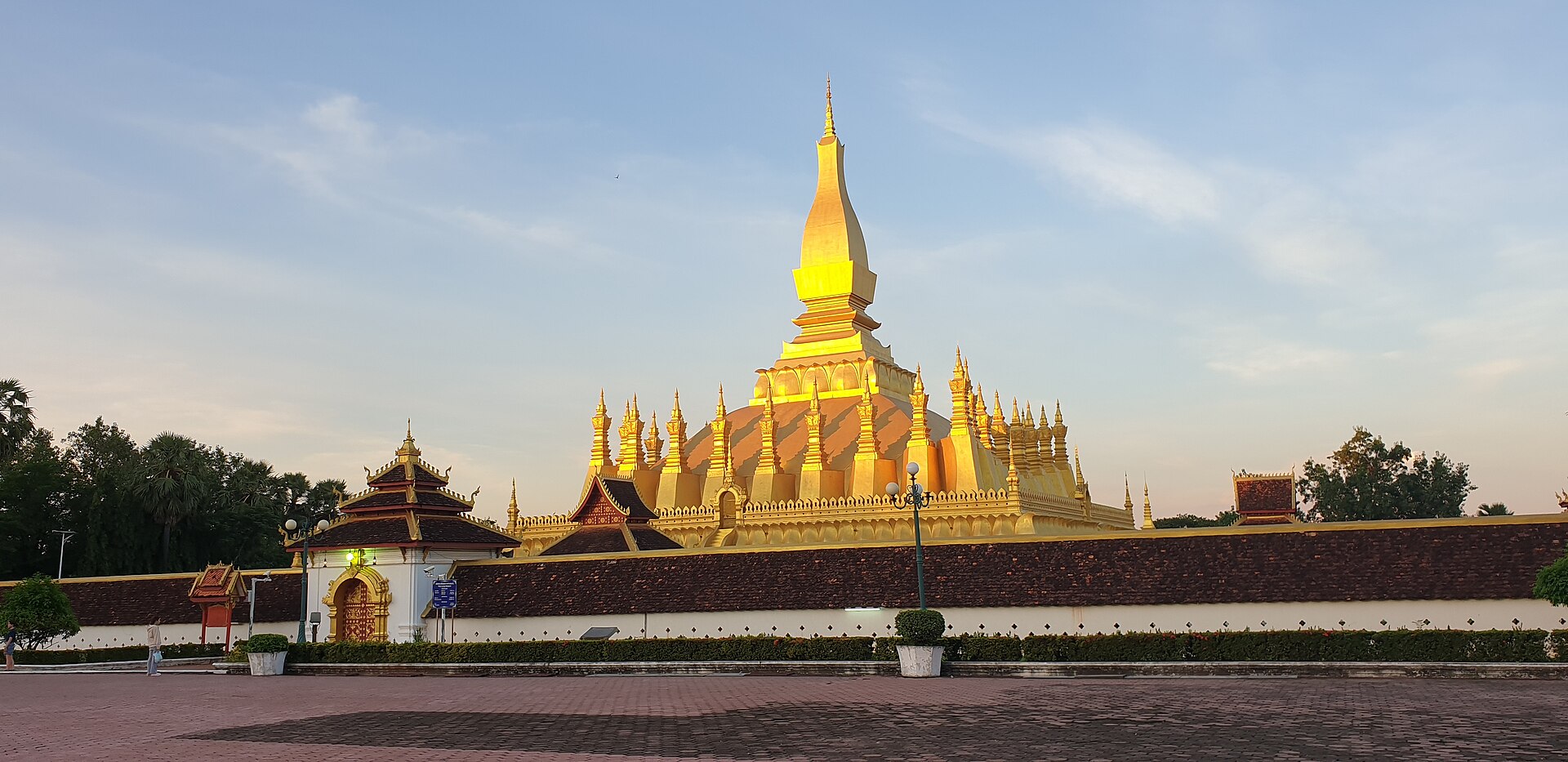
The fourth property is Phong Nha–Ke Bang National Park and Hin Nam No National Park, shared with Vietnam following the 2025 extension. In Vientiane, Pha That Luang, Patuxai and Wat Si Saket are significant monuments with separate histories; they are not additional World Heritage inscriptions. Kuang Si Falls, the Pak Ou Caves and Si Phan Don add other natural and cultural places to the sights map. Landscape pins locate representative areas rather than entrances.
People & Society of Laos
Lao, Khmu, Hmong and many other communities, connected across valleys and borders.
- Does Lao nationality mean ethnic Lao identity?
- No. Lao nationality includes members of many communities, including ethnic Lao, Khmu, Hmong, Akha and others.
- Why treat Lao Loum, Lao Theung and Lao Soung cautiously?
- These older altitude-based categories obscure cultural and linguistic differences. They are not three fixed ethnic peoples.
- Who were the republic’s first president and prime minister?
- Souphanouvong was its first president; Kaysone Phomvihane was its first prime minister.
More about Laos: people & society
Lao nationality includes people from many communities, including ethnic Lao, Khmu, Hmong, Akha and others. Ethnic Lao identity is different from the nationality shared across the country. Older labels such as Lao Loum, Lao Theung and Lao Soung grouped people by supposed lowland, upland or highland residence. They obscure linguistic and cultural differences and should not be treated as three fixed ethnic peoples or rules about where people live today.
Village ties, farming, urban work, migration and family networks shape daily life in different ways. Communities and diasporas also connect Laos with Thailand, Vietnam, France, the United States and other places. Souphanouvong was the first president of the Lao PDR, while Kaysone Phomvihane was its first prime minister. Their roles help explain the republic’s early history without reducing the country’s many people to a handful of political leaders.