The South Korea course
Facts about South Korea, for your next trip
Ten topics, two timed rounds each, played straight down this page. Finish a round and the next one starts itself, carrying you from a border that is still technically a ceasefire to an alphabet with a known inventor, memory chips, kimjang, and the lowest birth rate in the world.
Capital Seoul · Asia · 10 topics · 20 rounds · 80 questions · 20 seconds each
South Korea occupies the southern half of a peninsula divided since 1945 and rebuilt itself from one of the poorest countries in the world into a high-technology economy within about two generations. Its music, film and television now carry that transformation outward through what is usually called the Korean Wave.
The country is administered as nine provinces plus several self-governing cities, and its only land border runs along a demilitarised zone four kilometers wide and 250 long. Mountains cover about 70 percent of the land, so settlement and farming crowd into the western and southern coastal plains. Around 3,400 islands lie offshore, most of them small and uninhabited, with volcanic Jeju the largest and home to the highest peak in the country.
The Seoul metropolitan area holds roughly half the national population, which is an extraordinary concentration for any country, and combines the government, the chaebol headquarters and the entertainment industry in one place. Busan on the southeast coast is the second city and the great port, Incheon holds the main airport, and Gyeongju in the southeast was the capital of the Silla kingdom and is effectively an open-air museum. Visitors typically pair Seoul with either Busan, the temples and tombs of Gyeongju, or Jeju.
- Population
- 52 million
- Area
- 100,363 km²
- Currency
- South Korean won (₩)
- Official language
- Korean
- Provinces
- 9, plus self-governing cities
- Highest point
- Hallasan, 1,947 m
South Korea · Geography
Geography of South Korea
The southern half of a peninsula, mountainous across about seventy percent of its area, with one land border that nobody crosses and roughly 3,400 islands offshore.
Commonly asked
- Where is South Korea, and who does it border?
- It occupies the southern portion of the Korean Peninsula in East Asia, with the Yellow Sea to the west and the Sea of Japan to the east. Its only land border is with North Korea, along a demilitarised zone about four kilometers wide and 250 kilometers long.
- How big is South Korea, and what is its highest point?
- About 100,363 km², a little smaller than Iceland, administered as nine provinces plus several self-governing cities. The highest point is Hallasan on Jeju Island at 1,947 meters, a volcano rather than part of the mainland ranges.
- Why does everyone live on the coast?
- Mountains cover roughly 70 percent of the land, so farming and settlement crowd into the western and southern coastal plains. That is where Seoul, Incheon and Busan sit, and it is why the population is concentrated as tightly as it is.
South Korea · History
History of South Korea
Unified under Silla in the 7th century, ruled by Joseon for five centuries, annexed by Japan in 1910, divided in 1945, and democratic only since 1987.
Commonly asked
- Why is Korea divided into North and South?
- Japan ruled Korea from 1910 until its defeat in 1945, and the peninsula was then split along the 38th parallel between Soviet and American occupation zones. Two rival states formed in 1948, and the division hardened into the one that still stands.
- Did the Korean War ever end?
- Not formally. The fighting from 1950 to 1953 stopped with an armistice rather than a peace treaty, so the two Koreas remain technically at war more than seventy years later.
- When did South Korea become a democracy?
- In 1987. The south industrialised through decades of authoritarian rule, and mass protests that year forced a transition to direct presidential elections under the Sixth Republic constitution. It has held since.
South Korea · Language
The Korean language
Around 80 million speakers, no proven relatives, verb at the end of the sentence, and an alphabet that was designed on purpose and issued in 1446.
Commonly asked
- What language do they speak in South Korea?
- Korean, spoken by around 80 million people across both Koreas and the diaspora. Linguists generally treat it as an isolate, meaning no relationship to any other language has been proven.
- What is Hangul, and who invented it?
- The Korean alphabet, created under King Sejong and promulgated in 1446 to replace Chinese characters that few outside the elite could learn. Its letters are shaped to show the position of the tongue and lips, and Korea marks its creation with a national holiday each October.
- Is Korean hard to learn?
- The alphabet is unusually easy and can be read in an afternoon. The grammar is the work: the verb comes last, and several levels of formality change verb endings depending on who you are speaking to and about.
South Korea · Culture
Culture of South Korea
Confucian hierarchy and seniority underneath, and on top of it the most successful cultural export campaign any middle power has run.
Commonly asked
- What is the Korean Wave?
- The spread of Korean pop music, television drama and film to a global audience from the late 1990s onward, known in Korean as hallyu. It now functions as deliberate soft power, backed by the state as an industry rather than treated as a happy accident.
- Has a Korean film won an Oscar?
- Yes. Parasite won the Academy Award for best picture in 2020, the first film not in English ever to do so.
- Why do flights get rescheduled for a Korean exam?
- The university entrance exam is treated as a national event, and aircraft are kept from taking off or landing during the English listening section so the noise cannot disturb candidates. It is the clearest illustration of how much weight the country puts on educational outcomes.
South Korea · Economy
Economy of South Korea
Per capita income comparable to sub-Saharan Africa in 1960, and a high-income economy four decades later. The run is called the Miracle on the Han River.
Commonly asked
- How did South Korea get rich so fast?
- Through export-led industrialisation directed by the state in close coordination with a handful of family-controlled conglomerates, the chaebol. Samsung, Hyundai and LG grew out of that arrangement, moving from textiles to steel and ships to electronics.
- What does South Korea actually make?
- A large share of the world’s memory chips, plus ships, cars, batteries and displays. It spends more on research and development as a share of output than almost any other country.
- What is a chaebol?
- A large family-controlled conglomerate spanning many unrelated industries. They drove the growth and remain a structural weakness, since a few firms account for an outsized share of exports and the economy moves with them.
South Korea · Politics
Politics of South Korea
A presidential republic where the president gets one five-year term and cannot run again, a single-chamber assembly of 300, and a court that has removed a sitting president.
Commonly asked
- How long is a South Korean president’s term?
- Five years, once, with no re-election permitted. The limit was written into the 1987 constitution specifically to prevent any return to long personal rule.
- Has a South Korean president been impeached?
- Yes. The Constitutional Court removed a sitting president through impeachment in 2017, which is a real check rather than a symbolic one.
- How does the South Korean parliament work?
- The National Assembly is a single chamber of 300 members, combining constituency seats with proportional ones. Two large blocs dominate, and they differ sharply on how to handle North Korea.
South Korea · Nature & Wildlife
Nature and wildlife in South Korea
Hills stripped bare by colonial rule and war, replanted into forest covering about 63 percent of the country, plus a strip of no-man’s-land that turned into a wildlife refuge by accident.
Commonly asked
- Is South Korea forested?
- Heavily, at roughly 63 percent, but almost none of it is old. The hills were stripped during the colonial period and the war, and the forest was put back through a national reforestation campaign. Twenty-two national parks protect mountain and coastal habitat.
- What lives in the demilitarised zone?
- Almost nobody has entered it since 1953, so it has become an accidental nature reserve holding Asiatic black bears, musk deer and endangered red-crowned cranes.
- What are the Getbol tidal flats?
- The mudflats along the west coast, added to the World Heritage list in 2021. They are a critical refuelling stop for migratory shorebirds moving between Siberia and Australasia.
South Korea · Food & Cuisine
Korean food
Rice at the center, a spread of shared side dishes around it that get refilled for free, and fermentation running through nearly everything on the table.
Commonly asked
- What is kimchi?
- Fermented vegetables, most often napa cabbage, seasoned with chilli, garlic and salted seafood. It appears at nearly every meal, and the communal autumn preparation known as kimjang holds UNESCO heritage status.
- What is banchan?
- The array of small side dishes served alongside rice and shared across the table. They are refilled freely rather than ordered, which is why a modest Korean meal arrives covered in plates.
- What should I eat in South Korea?
- Korean barbecue, where marinated beef or pork is grilled at the table; bibimbap, rice under assorted vegetables and an egg; and Korean fried chicken with beer, which has become an institution at home and a successful export.
South Korea · Landmarks
Landmarks of South Korea
A royal palace destroyed twice and still being rebuilt, 8th-century Buddhist sculpture at Gyeongju, volcanic Jeju, and the one place you can look straight into North Korea.
Commonly asked
- What is Gyeongbokgung?
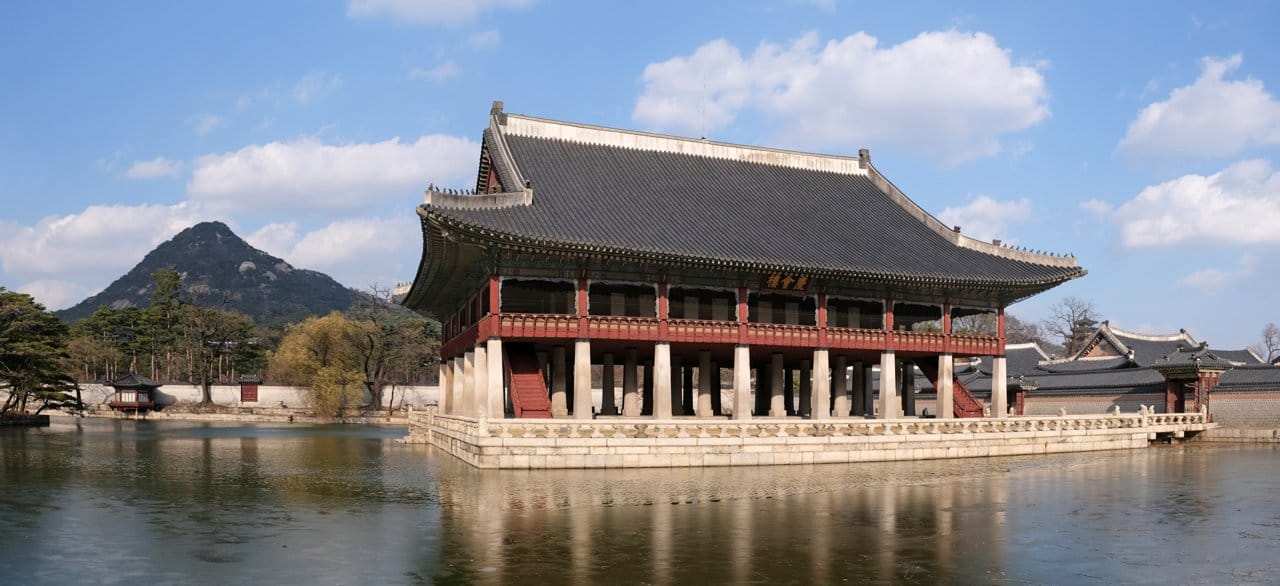
- The main royal palace of the Joseon dynasty in Seoul, built in 1395, destroyed during the Japanese invasions and again under colonial rule, and reconstructed steadily since 1990. The changing of the guard is staged outside its gate daily in period dress.
- What is there to see in Gyeongju?
- The capital of the Silla kingdom, effectively an open-air museum. The Bulguksa temple and the nearby Seokguram grotto date from the 8th century and hold some of the finest Buddhist sculpture in East Asia.
- Can you visit the North Korean border?
- You can reach the Joint Security Area at Panmunjom inside the demilitarised zone, on organised tours that run subject to conditions on the ground. It is the only place where visitors can look directly across at North Korea.
South Korea · People & Society
People and society of South Korea
About 52 million people, roughly half of them around one city, and the lowest fertility rate recorded anywhere in the world.
Commonly asked
- How many people live in South Korea?
- About 52 million, with around 81 percent living in cities. The Seoul metropolitan area alone holds roughly half the national population, which is an extraordinary concentration for any country.
- Why is South Korea’s birth rate so low?
- The fertility rate has fallen to roughly 0.7 births per woman, far below the 2.1 needed to hold a population steady. Housing costs, long working hours and the expense of private education are the reasons most often given for delayed marriage and childbearing.
- Is South Korea’s population shrinking?
- Yes. The total began declining in 2020, and government spending on incentives has so far not changed the trend.