Facts about Jamaica
Explore Jamaica through mountain valleys, harbour towns, music and food. Learn all 14 parishes, place 20 cities and towns, and follow three rivers into the wider Caribbean.
- Capital
- Kingston
- Currency
- Jamaican dollar (JMD)
- Official language
- English
- Everyday language
- Jamaican Creole (Patwa)
- Parishes
- 14
- Highest point
- Blue Mountain Peak, 2,256 m
Jamaica · 0 of 20 rounds passed
Two timed rounds per topic, 20 seconds a question
Kingston faces a sheltered harbour on the southeastern coast. The capital extends from small Kingston parish into Saint Andrew, with the Blue Mountains rising behind it. Spanish Town and Portmore lie farther west in Saint Catherine. Across the island, Mandeville sits on an upland plateau, while Black River and Savanna-la-Mar serve the southern coastal plains.
Montego Bay, Falmouth and Ocho Rios connect the north coast, while Port Antonio opens onto the wetter valleys of Portland. Three map games cover the parishes, selected settlements and waters. River courses continue to their mouths, and the Caribbean Sea extends to its wider geographic limits beyond Jamaica. Ten illustrated reading topics and 80 reviewed quiz questions connect these places with history and daily life.
Geography of Jamaica
A mountainous Greater Antillean island surrounded by the Caribbean Sea, south of Cuba and west of Hispaniola.
- How many parishes does Jamaica have?
- Jamaica has 14 parishes. Kingston and Saint Andrew remain separate parishes even though they share a municipal administration.
- Which river is Jamaica’s longest?
- The Rio Minho is generally identified as Jamaica’s longest river. It crosses Clarendon and reaches the Caribbean on the south coast.
- Which sea surrounds Jamaica?
- The Caribbean Sea surrounds Jamaica. Cuba lies to the north, Hispaniola to the east and the Central American coast much farther west.
More about Jamaica: geography
Jamaica is the third-largest island in the Greater Antilles, after Cuba and Hispaniola. The Blue Mountains rise in the east to Blue Mountain Peak, about 2,256 metres above sea level. Limestone covers much of the centre and west, where water has carved caves, sinkholes and the steep hills of Cockpit Country. The north coast and the drier southern plains have different landscapes and rainfall patterns.
Fourteen parishes divide the island. Kingston parish is a small part of the wider capital, whose urban area extends into Saint Andrew. Montego Bay lies in Saint James, Ocho Rios in Saint Ann and Port Antonio in Portland. The Rio Minho crosses Clarendon to the south coast; the Black River reaches the sea in Saint Elizabeth, while the Rio Grande drains the eastern mountains through Portland. The Caribbean continues far beyond the island’s coastline.
History of Jamaica
Taíno settlement, colonial plantation slavery, Maroon resistance and independence shaped the island’s history.
- When did Jamaica become independent?
- Jamaica became independent from Britain on 6 August 1962. Independence Day is separate from Emancipation Day, observed on 1 August.
- Who are Jamaica’s Maroons?
- Maroons are communities descended from Africans who escaped enslavement and resisted colonial rule. Their settlements maintain distinctive histories and cultural traditions.
- When did full emancipation arrive in Jamaica?
- Full emancipation came in 1838, ending the compulsory apprenticeship system that had followed the abolition legislation introduced in 1834.
More about Jamaica: history
Taíno communities lived on Jamaica before Columbus arrived in 1494. Spanish colonisation brought forced labour, disease and upheaval. England captured the island in 1655, and the British plantation economy later depended on the enslavement of Africans, especially for sugar production. Maroon communities resisted colonial control and established settlements in mountainous country. Their histories remain part of living communities rather than a closed chapter of the past.
Sam Sharpe helped lead the 1831–1832 uprising against slavery. An apprenticeship system followed the abolition legislation of 1834; full emancipation came in 1838. Paul Bogle’s leadership in the Morant Bay Rebellion of 1865 belongs to the later struggle over poverty, representation and justice. Jamaica became independent on 6 August 1962. National heroes also include Nanny of the Maroons, Marcus Garvey, George William Gordon, Alexander Bustamante and Norman Manley.
Languages of Jamaica
English and Jamaican Creole connect formal institutions, everyday conversation, storytelling and music.
- What is Patwa?
- Patwa is another name for Jamaican Creole, an English-based creole language with its own grammar, pronunciation and expressive traditions.
- What is Jamaica’s official language?
- English is the official language. Jamaican Creole is also widely spoken, and speakers often vary their language according to the setting.
- Is Jamaican Creole the same everywhere?
- Usage varies by community, speaker and situation. Jamaican speech includes a range of forms rather than one uniform way of speaking.
More about Jamaica: language
English is Jamaica’s official language and is widely used in government, education and formal writing. Jamaican Creole, also called Patwa or Patois, is a language with its own grammatical patterns, sound system and vocabulary. Its history is rooted in contact between English and African languages under colonial slavery. Treating it simply as incorrect English misses both its structure and its cultural importance.
Many Jamaicans move between Creole and varieties of English depending on the setting, audience and purpose. Speech differs between people and communities, and written Jamaican Creole can use several conventions. The University of the West Indies teaches its structure and usage as a language in its own right. Music, theatre and poetry carry Jamaican speech to international audiences, while diaspora communities develop their own ways of speaking across generations.
Culture of Jamaica
Reggae, sound systems, dancehall, poetry and community celebrations give Jamaican creativity a worldwide reach.
- When did reggae develop?
- Reggae developed in Jamaica in the late 1960s, following ska and rocksteady. It later reached audiences and musicians around the world.
- What is a Jamaican sound system?
- A sound system combines equipment, selectors and performers for public music events. It is also a social institution within Jamaican musical culture.
- When did UNESCO recognise reggae?
- UNESCO inscribed reggae music of Jamaica on its Representative List of the Intangible Cultural Heritage of Humanity in 2018.
More about Jamaica: culture
Reggae developed in the late 1960s, following ska and rocksteady and drawing on several musical influences. Its songs can address love, faith, social inequality and political resistance. UNESCO recognised reggae music of Jamaica as intangible cultural heritage in 2018. Sound systems bring selectors, recordings, microphones and audiences together, making the event and its community as important as the recorded song.
Dancehall developed its own performance styles, rhythms, dance and language. Rastafari has influenced Jamaican music and ideas about African identity, but it does not represent every Jamaican’s religion or beliefs. Poetry, visual art, theatre and storytelling belong alongside music in the country’s cultural life. Louise Bennett-Coverley’s performances helped bring Jamaican Creole to prominent public stages. Festivals and community events vary across the island and among Jamaican communities abroad.
Economy of Jamaica
Tourism, services, bauxite, farming and family remittances connect Jamaica with markets and communities overseas.
- What is Jamaica’s currency?
- Jamaica uses the Jamaican dollar, with the international code JMD. It is a separate currency from the United States dollar.
- What is bauxite used for?
- Bauxite is an ore used to produce alumina, which is then processed into aluminium. Mining and refining are important Jamaican export industries.
- What are remittances?
- Remittances are money sent home by people living abroad. They help connect Jamaican households with relatives and working communities in other countries.
More about Jamaica: economy
Tourism supports accommodation, restaurants, guiding and transport, particularly along the north and west coasts. Kingston is an important centre for business, public services, logistics and the port economy. Bauxite mining and alumina production connect the island with the aluminium industry. Coffee, sugar cane, yams and other crops support agricultural livelihoods, while markets and small businesses serve communities across the parishes.
Money sent by relatives overseas helps many households meet expenses. Imported fuel, food and equipment make international prices and shipping costs important locally. Hurricanes and flooding can damage farms, roads, homes and tourism facilities at the same time. Jamaica’s economic story therefore includes both overseas earnings and the resilience of everyday livelihoods. The currency is the Jamaican dollar, abbreviated JMD; a dollar sign alone does not identify a price as US dollars.
Government of Jamaica
A parliamentary system links an elected House of Representatives, an appointed Senate and a cabinet led by the prime minister.
- Who leads Jamaica’s government?
- The prime minister leads the government and cabinet. This role is distinct from the head of state and the governor-general’s constitutional duties.
- What are the chambers of Jamaica’s Parliament?
- Parliament includes the elected House of Representatives and appointed Senate. These chambers have different selection methods and roles in the legislative process.
- Are Kingston and Saint Andrew one parish?
- They are two separate parishes with a shared municipal administration. The wider Kingston urban area extends beyond the small Kingston parish.
More about Jamaica: politics
Jamaica’s constitution established the framework for independence in 1962. The prime minister leads the government and cabinet, while Parliament includes the House of Representatives and Senate. Voters elect members of the House; senators are appointed. The Jamaica Labour Party and People’s National Party have been the main parties of the independence era, alongside other political organisations and independent voices.
Jamaica remains a constitutional monarchy, with the monarch represented by a governor-general. Proposals to become a republic concern constitutional change rather than a change that independence automatically completed. Local government connects national politics with parish and municipal services; Kingston and Saint Andrew share an administration while retaining their separate parish identities. Jamaica also belongs to CARICOM, whose regional headquarters are in Georgetown, Guyana.
Nature and wildlife of Jamaica
Mountain forests, limestone country, wetlands and reefs shelter species found nowhere else.
- What is Jamaica’s national bird?
- The doctor bird, commonly identified with the red-billed streamertail hummingbird, is Jamaica’s national bird and is found naturally on the island.
- What is special about the Black River Lower Morass?
- This southern wetland provides habitat for crocodiles and waterbirds. Its rivers, marshes and mangroves form a connected ecological landscape.
- What is Jamaica’s national tree?
- The blue mahoe is Jamaica’s national tree. It is separate from lignum vitae, which is recognised as the national flower.
More about Jamaica: nature & wildlife
Jamaica’s isolation has allowed distinctive wildlife to evolve. The red-billed streamertail, widely known as the doctor bird, is an endemic hummingbird and national symbol. The national tree is the blue mahoe and the national flower is lignum vitae. The Blue and John Crow Mountains protect forests with many endemic plants and animals, while limestone landscapes farther west contain caves and important groundwater systems.
The Black River Lower Morass contains wetlands associated with the American crocodile and many waterbirds. Mangroves, seagrass beds and coral reefs connect coastal habitats with fisheries. Pedro Bank lies south of Jamaica; it is not a north-coast reef. Habitat loss, pollution, invasive species and extreme weather place pressure on these systems. Protecting an upland forest can also help the rivers and communities downstream, showing why parish borders are not ecological boundaries.
Food of Jamaica
Ackee and saltfish, jerk, rice and peas, patties and cassava bammy reflect several culinary inheritances.
- What is Jamaica’s national dish?
- Ackee and saltfish combines prepared ackee fruit with salted fish and seasonings. It is widely associated with Jamaican breakfast and home cooking.
- What is bammy made from?
- Bammy is a flatbread made from cassava. It has Indigenous Caribbean roots and is often served alongside fish in Jamaican cooking.
- What is festival in Jamaican cooking?
- Festival is a lightly sweet fried dumpling, commonly made with flour and cornmeal. It often accompanies fish, jerk and other savoury foods.
More about Jamaica: food & cuisine
Ackee and saltfish is Jamaica’s national dish, combining the prepared fruit with salted fish and seasonings. Jerk is both a cooking tradition and a style of seasoning associated with ingredients such as pimento and Scotch bonnet pepper. Its history is especially connected with Maroon communities. Rice and peas commonly uses beans rather than the green peas that the English name might suggest.
Bammy is a cassava flatbread with Indigenous Caribbean roots. Festival is a lightly sweet fried dumpling, while patties enclose savoury fillings in pastry. Yam, breadfruit, plantain and cooked greens appear in many meals, with recipes varying by household. Ital food is associated with Rastafari, though practices differ. Sorrel is a festive drink made from roselle calyces, often with ginger; Blue Mountain coffee links the table to eastern mountain farming.
Landmarks and heritage of Jamaica
Mountain paths, Port Royal’s archaeology, Spanish Town and waterfalls tell different stories of place.
- Why are the Blue and John Crow Mountains UNESCO listed?
- They combine important biodiversity with the cultural heritage of Maroon resistance, including settlements, routes and continuing relationships with the mountain landscape.
- When did Port Royal become a World Heritage site?
- The Archaeological Ensemble of 17th Century Port Royal was inscribed in 2025, becoming Jamaica’s second property on the World Heritage List.
- Where is Dunn’s River Falls?
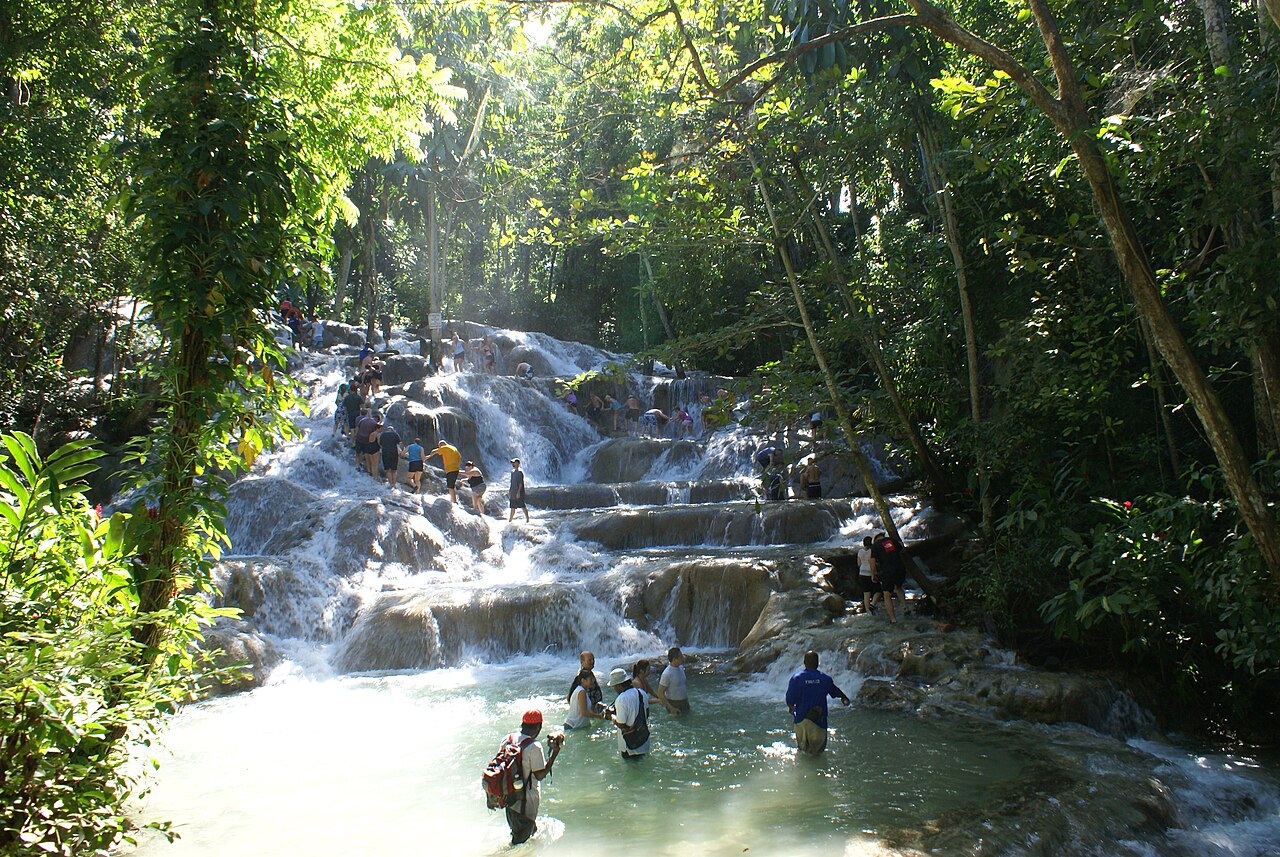
- Dunn’s River Falls is near Ocho Rios in Saint Ann parish on Jamaica’s north coast, where cascading water descends toward the sea.
More about Jamaica: landmarks
The Blue and John Crow Mountains became a UNESCO World Heritage property in 2015 for both natural and cultural significance. Forest biodiversity is linked with the history and living heritage of Maroon resistance. In 2025, the Archaeological Ensemble of 17th Century Port Royal joined the World Heritage List. The harbour settlement preserves evidence of a trading town partly submerged after the earthquake of 1692.
Spanish Town was the capital before Kingston and retains an important historic square. Devon House in Kingston is associated with George Stiebel, a wealthy nineteenth-century Jamaican businessman. Dunn’s River Falls descends toward the coast near Ocho Rios in Saint Ann, while YS Falls is in Saint Elizabeth. Nine Mile in Saint Ann is associated with Bob Marley’s birthplace and burial. These places are distributed across the island rather than clustered in the national capital.
People and communities of Jamaica
Local communities and a far-reaching diaspora connect Jamaican family life, creativity and achievement.
- What is Jamaica’s national motto?
- The national motto is “Out of Many, One People”. It expresses shared belonging across the different histories and communities of the country.
- Where was Bob Marley born?
- Bob Marley was born in Nine Mile in Saint Ann parish in 1945. His life later connected rural Jamaica, Kingston and international audiences.
- What is the Jamaican diaspora?
- The diaspora includes Jamaicans and their descendants living abroad. Family ties, cultural activity and remittances connect these communities with the island.
More about Jamaica: people & society
African ancestry is central to Jamaica’s population history, alongside Indigenous heritage and migrations from Europe, India, China and elsewhere. These histories overlap within families and communities. The national motto, “Out of Many, One People”, expresses an ideal of shared belonging. Maroon communities maintain particular histories and traditions, while rural districts, market towns and urban neighbourhoods have their own identities.
Migration has built strong connections with Britain, the United States, Canada and other Caribbean countries. Family visits, remittances, food and music keep those relationships active across generations. Bob Marley and Jimmy Cliff helped Jamaican music reach international audiences; Louise Bennett-Coverley championed Jamaican speech and performance. Athletics, cricket and other sports are also prominent. Usain Bolt came from Trelawny, while writers such as Claude McKay connected Jamaican experience with wider Black literary movements.
More countries in North America