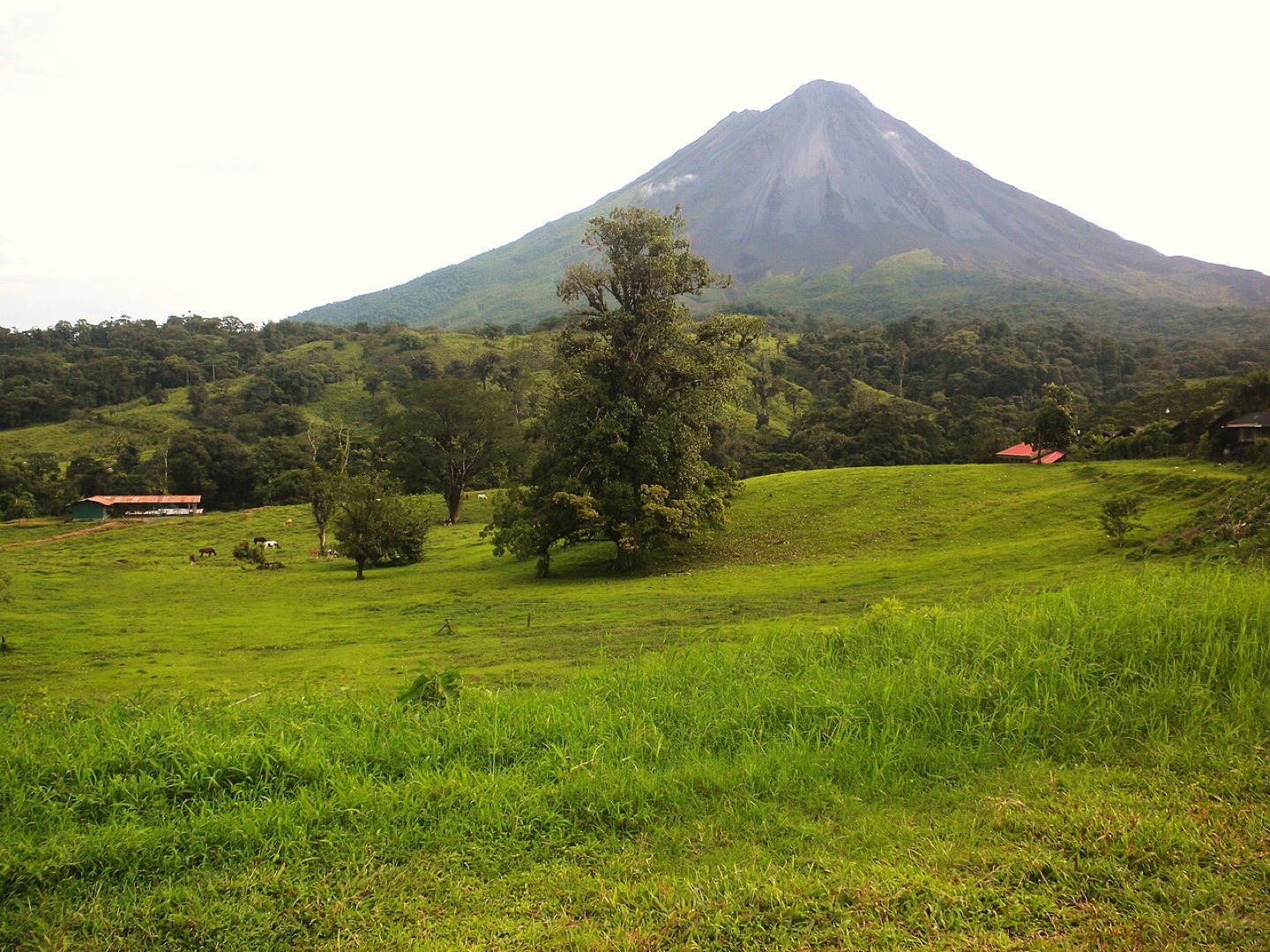
Facts about Costa Rica
Explore Costa Rica from the Central Valley and volcanic highlands to Guanacaste, the Caribbean coast and the Osa Peninsula. Learn its provinces, cities and waters, discover ten illustrated topics, then practise everyday Spanish.
- Capital
- San José
- Currency
- Costa Rican colón (CRC)
- Official language
- Spanish
- Provinces
- 7
- Highest point
- Cerro Chirripó, about 3,820 m
- Coasts
- Pacific Ocean and Caribbean Sea
Costa Rica · 0 of 20 rounds passed
Two timed rounds per topic, 20 seconds a question
Costa Rica borders Nicaragua and Panama, with the Pacific Ocean to the west and south and the Caribbean Sea to the east. San José, Alajuela, Heredia and Cartago anchor the Central Valley. Liberia opens onto Guanacaste, Puntarenas faces the Gulf of Nicoya, and Limón connects the Caribbean coast with its port and Afro-Caribbean heritage.
Three map games cover all seven provinces, selected cities and towns, and inland and coastal waters. Follow the Tempisque towards the Gulf of Nicoya, find Lake Arenal and distinguish Golfo Dulce from the open Pacific. The reading visits cloud forests, Indigenous communities, coffee-growing landscapes and the Diquís stone spheres. The linked lessons introduce general Spanish. Cocos Island is included in the reading but lies outside the mainland maps.
Geography of Costa Rica
Seven provinces connect the Central Valley with Guanacaste, the Caribbean lowlands and the southern Pacific.
- Which countries border Costa Rica?
- Nicaragua to the north and Panama to the southeast. Costa Rica also has Pacific Ocean and Caribbean Sea coastlines.
- How many provinces does Costa Rica have?
- Seven: San José, Alajuela, Cartago, Heredia, Guanacaste, Puntarenas and Limón. Liberia is the capital of Guanacaste.
- What is Costa Rica’s highest mountain?
- Cerro Chirripó, at about 3,820 metres in the Cordillera de Talamanca. It is a mountain rather than an active volcano.
More about Costa Rica: geography
Costa Rica lies in Central America between Nicaragua to the north and Panama to the southeast. The Pacific Ocean borders its longer western and southern coast; the Caribbean Sea lies to the east. Mountain ranges divide the interior, including the volcanic Cordillera Central and the Cordillera de Talamanca. Cerro Chirripó, in Talamanca, is the highest summit at about 3,820 metres. San José, Alajuela, Heredia and Cartago are important cities of the Central Valley.
The seven provinces are San José, Alajuela, Cartago, Heredia, Guanacaste, Puntarenas and Limón. Liberia is Guanacaste’s capital; the other provincial capitals share their province’s name. The Nicoya and Osa peninsulas project into the Pacific. The Gulf of Nicoya and Golfo Dulce are separate Pacific inlets. Lake Arenal is an enlarged reservoir in the north, while the Reventazón drains east towards the Caribbean. Cocos Island, far offshore in the Pacific, belongs to Puntarenas province and lies outside these mainland map games.
From Indigenous societies to the republic
Pre-Columbian settlements, coffee exports and the 1948 civil war all shaped modern Costa Rica.
- When did Costa Rica become independent from Spain?
- In 1821, during the wider Central American break with Spanish colonial rule. The republic was proclaimed later, in 1848.
- When did Costa Rica abolish its army?
- The abolition was announced on 1 December 1948. The 1949 constitution then prohibited the army as a permanent institution in article 12.
- Who was Juan Santamaría?
- A national hero remembered for his role at the Battle of Rivas in 1856, during the campaign against William Walker’s forces.
More about Costa Rica: history
Long before Spanish colonisation, communities farmed, traded and built settlements across what is now Costa Rica. Guayabo preserves roads, stone foundations and a water-management system. In the Diquís region of the south, carefully worked stone spheres became part of settlements and landscapes. Indigenous peoples and their knowledge continue today; archaeological remains describe earlier societies rather than an entire vanished population.
Independence from Spain was declared in 1821. Costa Rica later belonged to the Central American federation and became a republic in 1848. Coffee exports helped reshape landholding, transport and commerce during the nineteenth century. The 1856–1857 National Campaign opposed William Walker’s forces in Central America. A disputed election preceded the 1948 civil war. José Figueres Ferrer announced the abolition of the army on 1 December 1948; article 12 of the 1949 constitution prohibited the army as a permanent institution.
Spanish and Costa Rica’s living languages
Spanish, Indigenous languages and Limón’s English-based Creole reflect different community histories.
- What does pura vida mean?
- Literally “pure life”. People use it for greetings, thanks and positive replies, with the precise meaning depending on the conversation.
- Is Spanish the only language spoken in Costa Rica?
- No. Spanish is official, while Bribri, Cabécar and other Indigenous languages, Caribbean English Creole and migrant languages also form part of the country.
- Do the linked lessons teach Costa Rican Spanish?
- They introduce general everyday Spanish. The reading explains some Costa Rican usage, including vos, usted and pura vida.
More about Costa Rica: language
Spanish is Costa Rica’s official language. Vos and usted are both widely used forms of address, with choices depending on relationships, region and setting. Pura vida literally means “pure life”, but in conversation it can be a greeting, thanks, reassurance or a positive reply. Tico and Tica are familiar nicknames for Costa Ricans, often associated with the use of diminutive endings such as -tico.
Bribri and Cabécar are living Indigenous languages of the Chibchan family, especially associated with the Talamanca region. Other Indigenous communities have their own languages and revitalisation efforts. The Caribbean coast, particularly Limón, also has an English-based Creole tradition linked to Afro-Caribbean history. Article 76 of the constitution recognises the state’s duty to maintain and cultivate national Indigenous languages. The linked lessons teach general everyday Spanish, rather than all of Costa Rica’s languages or a particular local accent.
Ox carts, music and community traditions
Painted carretas, Guanacaste marimba and Afro-Caribbean traditions connect craft and performance with place.
- Why are painted ox carts associated with Costa Rica?
- They connect the history of transporting coffee and other goods with a continuing craft tradition. Sarchí is a well-known centre of cart making and decoration.
- When did UNESCO recognise Costa Rica’s oxcart traditions?
- They were proclaimed in 2005 and inscribed on UNESCO’s Representative List of Intangible Cultural Heritage in 2008.
- Where is Costa Rican calypso especially associated?
- With Afro-Caribbean communities of Limón on the Caribbean coast, whose music and oral traditions connect Costa Rica with the wider Caribbean.
More about Costa Rica: culture
Ox carts once carried coffee and other goods between farms, markets and ports. Their decoration developed into an elaborate craft, with brightly painted wheels and geometric patterns. Sarchí, in Alajuela province, is particularly associated with cart making and painting. UNESCO proclaimed Costa Rica’s oxherding and oxcart traditions in 2005 and inscribed them on the Representative List in 2008. The heritage includes the knowledge of driving and caring for oxen as well as the carts themselves.
Marimba music, dance and regional celebrations are especially associated with Guanacaste. Limón’s Afro-Caribbean traditions include calypso, food and oral histories linked to the wider Caribbean. Boruca communities’ Juego de los Diablitos carries a distinct history of resistance and collective identity. Masquerades, football and local fiestas are other parts of public life. These practices belong to particular communities and settings; no single festival or costume describes everyone in Costa Rica.
Coffee, medical devices and services
Farming remains visible in an economy that also exports manufactured goods and services.
- What currency does Costa Rica use?
- The Costa Rican colón, with the international currency code CRC. It is divided into 100 céntimos.
- What does Costa Rica export?
- Exports include medical devices, coffee, bananas and pineapples, alongside business and other services. Their relative values change over time.
- Does renewable electricity mean all Costa Rican energy is renewable?
- No. Electricity generation and total energy consumption are different measures. Transport still uses petroleum fuels, and the renewable electricity share varies by year.
More about Costa Rica: economy
Coffee played a central role in Costa Rica’s nineteenth-century export economy and remains important in highland farming landscapes. Bananas and pineapples connect lowland agriculture with overseas markets. The economy also includes medical-device manufacturing, business services and technology-related work. Ports at Limón and Moín on the Caribbean and Caldera on the Pacific link producers with international trade. The national currency is the Costa Rican colón, with the code CRC.
Tourism supports accommodation, guiding, transport and many small businesses around forests, volcanoes and beaches. Its benefits and pressures vary locally. Costa Rica generates much of its electricity from renewable sources, especially hydropower, alongside geothermal and wind power. The share varies by year and rainfall. Electricity generation is only part of total energy use, which also includes fuel for transport. Costa Rica joined the OECD in 2021, and CAFTA-DR entered into force for the country in 2009.
Government without a permanent army
A presidential republic with a 57-member Legislative Assembly and seven provinces.
- What type of government does Costa Rica have?
- A presidential republic with a single-chamber Legislative Assembly of 57 deputies. The presidential term is four years.
- Does Costa Rica have security forces?
- Yes. Civilian police and other security institutions operate even though article 12 prohibits the army as a permanent institution.
- Is Costa Rica constitutionally secular?
- No. Article 75 establishes Roman Catholicism as the state religion and also permits the free exercise of other faiths under its stated conditions.
More about Costa Rica: politics
Costa Rica is a presidential republic. The president serves as head of state and government for a four-year term. Immediate presidential re-election is prohibited. The Legislative Assembly has a single chamber with 57 deputies. The Supreme Electoral Tribunal administers elections, while courts have separate responsibilities within the constitutional system. Provinces are divided into cantons, whose municipal governments have elected authorities.
Article 12 of the constitution prohibits the army as a permanent institution and provides for police forces to maintain public order. This does not mean the country has no security services. Article 75 establishes Roman Catholicism as the state religion while allowing the free exercise of other faiths within its constitutional wording. San José also hosts the Inter-American Court of Human Rights. Public debate includes education, healthcare, security, economic opportunity and the protection of the environment.
Rainforest, cloud forest and dry forest
Changes in elevation and rainfall create sharply different habitats across a small country.
- What is a bosque nuboso?
- A cloud forest: a moist mountain forest frequently immersed in cloud or mist. Monteverde is a well-known Costa Rican example.
- What is Costa Rica’s national bird?
- The clay-coloured thrush, called the yigüirro. The resplendent quetzal is another celebrated bird but is not Costa Rica’s national bird.
- Which country shares La Amistad with Costa Rica?
- Panama. The Talamanca Range–La Amistad Reserves / La Amistad National Park World Heritage property crosses their border.
More about Costa Rica: nature & wildlife
Costa Rica’s environments include seasonally dry forest in the northwest, moist cloud forests in the highlands and lowland rainforest in the Caribbean and southern Pacific. Corcovado protects part of the Osa Peninsula, while Tortuguero’s Caribbean beaches are known for sea-turtle nesting. Sloths, monkeys and many birds inhabit different forest habitats. The resplendent quetzal is a cloud-forest bird; the clay-coloured thrush, known locally as the yigüirro, is the national bird.
Área de Conservación Guanacaste connects coastal and inland habitats, and La Amistad is a transboundary World Heritage property shared with Panama. Cocos Island National Park protects a separate oceanic island and marine environment far offshore. Monteverde’s reserves are known for cloud forest. Protected areas have different management categories, so national parks, private reserves and the total protected estate are not interchangeable counts. Habitat loss, development and a changing climate make conservation an ongoing task.
Gallo pinto, casados and Caribbean cooking
Rice and beans take different forms at breakfast, on a casado plate and in Limón’s coconut-rich cooking.
- What is gallo pinto?
- Cooked rice and beans combined in one dish, commonly eaten at breakfast. Black beans are common in Costa Rica, though recipes vary.
- Is a casado the same as gallo pinto?
- No. A casado is a mixed plate usually serving rice and beans separately with a protein, salad and other sides. Gallo pinto mixes the rice and beans together.
- What is agua dulce?
- A drink made by dissolving unrefined cane sugar, often called tapa de dulce, in water. It is commonly served hot.
More about Costa Rica: food & cuisine
Gallo pinto combines cooked rice and beans, often black beans, and is commonly served at breakfast with eggs and other accompaniments. Costa Rica and Nicaragua both have strong gallo pinto traditions, with variations within each country. A casado usually serves rice and beans as separate components alongside a protein, salad and other sides. Chifrijo combines rice, beans, chicharrón and fresh toppings, often accompanied by tortilla chips.
Caribbean rice and beans around Limón often use coconut milk and seasonings that distinguish them from a typical Central Valley breakfast. Patí is a filled savoury pastry associated with Afro-Caribbean cooking. Corn-based tamales wrapped in leaves are common at Christmas, with fillings varying by household. Agua dulce is made by dissolving unrefined cane sugar in water, often served hot. Coffee is brewed in many ways, including the cloth-filter chorreador. Everyday sodas are small restaurants rather than a name for a single dish.
Stone spheres, volcanoes and historic cities
The Diquís sites and Guayabo introduce earlier societies; San José and Cartago open different urban histories.
- Where are Costa Rica’s UNESCO-listed stone spheres?
- At four archaeological sites in the Diquís region of the southern Pacific, including Finca 6. The property was inscribed in 2014.
- Is Cartago Costa Rica’s current capital?
- No. Cartago is a former capital and an important historic and religious centre. San José is the national capital today.
- Which town is near Arenal Volcano?
- La Fortuna, in Alajuela province. The nearby reservoir is Lake Arenal, which extends towards Guanacaste.
More about Costa Rica: landmarks
The Precolumbian Chiefdom Settlements with Stone Spheres of the Diquís is a UNESCO World Heritage property inscribed in 2014. Its four archaeological sites in the southern Pacific region include Finca 6. The spheres are evidence of skilled stone working and social organisation, rather than objects with a proven single mysterious purpose. Guayabo National Monument, near Turrialba, preserves a different archaeological landscape of roads, foundations and waterworks.
San José’s National Theatre opened in 1897, and its Pre-Columbian Gold Museum displays objects from Indigenous societies. Cartago, a former capital, is known for the Basilica of Our Lady of the Angels and the figure called La Negrita. Arenal lies near La Fortuna in the north; Poás and Irazú are separate volcanoes in the central highlands. Volcanic activity and park access change, so visiting a crater requires checking current official guidance rather than assuming it is always open.
People and communities of Costa Rica
Central Valley cities, coastal communities and Indigenous territories contribute different histories to national life.
- What are Costa Ricans often called?
- Ticos and Ticas. These familiar nicknames do not imply that Costa Ricans share one ancestry, language or regional identity.
- Why did Óscar Arias receive the Nobel Peace Prize?
- He received the 1987 prize for his work towards peace in Central America, associated with the regional peace process and Esquipulas II.
- Who is Franklin Chang-Díaz?
- A Costa Rican-American astronaut and physicist, born in San José, who flew on seven NASA Space Shuttle missions.
More about Costa Rica: people & society
Many Costa Ricans live in the Central Valley, but national life extends through rural towns, coastal communities and Indigenous territories. Bribri, Cabécar, Boruca and other Indigenous peoples maintain distinct histories and cultural knowledge. Afro-Costa Rican communities are especially associated with Limón and the Caribbean coast. Migration from Nicaragua and other countries contributes to family life, work and the movement of ideas. Tico and Tica are familiar nicknames, rather than descriptions of a single ancestry.
Óscar Arias Sánchez received the 1987 Nobel Peace Prize for his work towards peace in Central America. Laura Chinchilla became Costa Rica’s first female president in 2010. Franklin Chang-Díaz, born in San José, flew on seven NASA Space Shuttle missions. Their careers introduce different aspects of public service and science. Education, healthcare and access to work remain central concerns, with opportunities varying by household and region.
More countries in North America