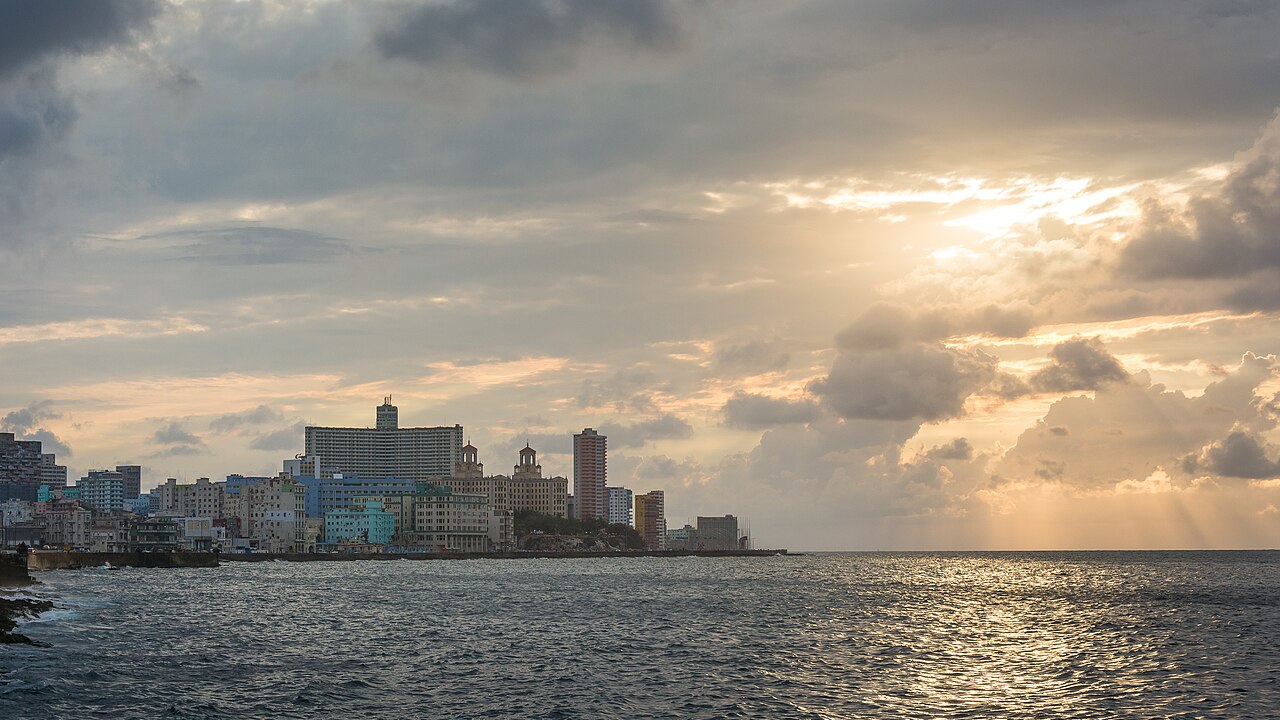
Facts about Cuba
Explore Cuba from the limestone valleys of the west to central towns and the mountains of the east. Learn its provinces, cities and waters, discover the histories, food and music behind the places, then practise Spanish.
- Capital
- Havana
- Currency
- Cuban peso (CUP)
- Official language
- Spanish
- Administrative units
- 15 provinces + special municipality
- Highest point
- Pico Turquino, 1,974 m
- Longest river
- Cauto
Cuba · 0 of 20 rounds passed
Two timed rounds per topic, 20 seconds a question
Havana faces the Straits of Florida in the northwest. Pinar del Río and Viñales connect with tobacco-growing country farther west, while Matanzas and Varadero lie to the east of the capital. Santa Clara anchors the centre; Cienfuegos faces a southern bay and Trinidad sits below the Guamuhaya mountains. Camagüey’s winding historic streets belong to the broad central-eastern plains.
Bayamo lies near the Cauto basin north of the Sierra Maestra, Santiago de Cuba faces a sheltered southeastern harbour and Baracoa sits on the wetter northeastern coast. Offshore, Nueva Gerona is the main town of Isla de la Juventud. Three maps cover all 15 provinces and the special municipality, 24 selected cities and towns, and six waters. The Spanish course introduces general everyday Spanish; the reading explains local speech and other linguistic heritage.
Geography of Cuba
The largest island in the Caribbean, with western limestone valleys, central plains and the Sierra Maestra in the southeast.
- Is Cuba one island?
- The main island of Cuba is the Caribbean’s largest, but the country is an archipelago. It also includes Isla de la Juventud and many smaller islands and cays.
- What is Cuba’s highest mountain?
- Pico Turquino, at 1,974 metres, in the Sierra Maestra of southeastern Cuba.
- How many provinces does Cuba have?
- Cuba has 15 provinces plus the special municipality of Isla de la Juventud. Artemisa and Mayabeque were created in 2011 from the former surrounding Havana province and part of Pinar del Río.
More about Cuba: geography
Cuba is both a country and the name of its largest island. The archipelago also includes Isla de la Juventud and many smaller islands and cays. Florida lies to the north, Mexico’s Yucatán Peninsula to the west, Jamaica to the south and Hispaniola to the east. The Straits of Florida and Yucatán Channel connect the waters around its western end with the Gulf of Mexico, while the Caribbean Sea borders its southern coast.
Plains cover much of the main island. The limestone mogotes around Viñales rise above western farming valleys; the Guamuhaya mountains, also called the Escambray, occupy the centre. In the southeast, the Sierra Maestra contains Pico Turquino, Cuba’s highest mountain at 1,974 metres. The Cauto flows through eastern lowlands to the Gulf of Guacanayabo. Cuba has 15 provinces and the special municipality of Isla de la Juventud, which is a separate answer on the province map.
History of Cuba
Indigenous communities, plantation slavery, the independence struggles and the revolution of 1959 shaped different eras.
- When did Cuba become a republic?
- The Cuban republic was established in 1902, after Spanish rule ended in 1898 and a period of United States military occupation.
- Who was José Martí?
- José Martí was a Cuban writer and independence organiser. He helped organise the renewed independence struggle of 1895 and died that year.
- What happened in Cuba in 1959?
- Batista fled on 1 January 1959 as the revolution triumphed. The new government later developed a socialist system and a close alliance with the Soviet Union.
More about Cuba: history
Indigenous communities, including Taíno peoples, lived in Cuba before Columbus arrived in 1492. Spanish colonisation brought dispossession, forced labour and devastating disease. Sugar and tobacco tied the colony to Atlantic trade, with enslaved Africans forced to work on plantations and in other occupations. Enslavement, resistance and emancipation are central to understanding Cuba’s history. Spain abolished slavery in Cuba in 1886.
Wars for independence began in 1868 and resumed in 1895, with José Martí among the leading figures. Spanish rule ended after the war of 1898, followed by United States military occupation. The republic was established in 1902. In January 1959, the revolution overthrew Fulgencio Batista’s dictatorship; Fidel Castro’s government subsequently established a socialist state aligned with the Soviet Union. The Bay of Pigs invasion in 1961 and the missile crisis in 1962 placed Cuba at the centre of Cold War conflict.
Spanish and other languages in Cuba
Cuban Spanish belongs to the Caribbean Spanish world, with regional variation and vocabulary shaped by several histories.
- What language is spoken in Cuba?
- Spanish is the official and main everyday language. Haitian Creole and African-derived ritual language traditions are also part of Cuba’s linguistic heritage.
- Is Cuban Spanish a separate language?
- Cuban Spanish is a variety of Spanish within the wider Caribbean Spanish world. It has distinctive vocabulary and pronunciation, with variation within Cuba itself.
- Do these lessons teach a Cuban dialect?
- The linked course introduces general Spanish for everyday situations. The country reading explains some features of Cuban speech, which you can explore further through local conversations and recordings.
More about Cuba: language
Spanish is Cuba’s official language. Cuban Spanish shares features with other Caribbean varieties, including the weakening of syllable-final s in much informal speech. Pronunciation varies across regions, generations and social settings. A conversation in Santiago de Cuba need not sound exactly like one in Havana, and everyday conversation differs from formal writing or public speaking.
Indigenous words such as bohío remain in Spanish vocabulary, while African languages contributed to religious and musical traditions. Lucumí, associated with Yoruba heritage, survives especially in ritual use; it is not the everyday language of every Afro-Cuban family. Haitian Creole is also part of the heritage of communities shaped by migration from Haiti. The linked Spanish lessons teach general everyday Spanish and provide a starting point for listening to local speech.
Music, dance and culture of Cuba
Son, rumba and punto connect regional traditions with literature, ballet and an enduring enthusiasm for baseball.
- What is Cuban son?
- Son is a Cuban music and dance tradition combining singing, instruments and rhythmic patterns. It has strong eastern roots and helped shape later popular music across the Caribbean and beyond.
- What is rumba in Cuba?
- Rumba combines percussion, singing and dance, with a particularly strong Afro-Cuban history. UNESCO inscribed the Cuban tradition in 2016.
- What is the Cuban tres?
- The tres is a guitar-like instrument with three pairs of strings. It is closely associated with son and supplies characteristic melodic and rhythmic figures.
More about Cuba: culture
Son brings singing, instrumental music and dance together, with strong roots in eastern Cuba. The tres, a guitar-like instrument with three pairs of strings, is associated with son ensembles. Rumba developed especially in Afro-Cuban communities, joining percussion, song and dance. UNESCO recognised Cuban rumba in 2016 and punto, a poetry and music tradition associated with rural communities, in 2017. These traditions have distinct histories and should not be treated as interchangeable names for salsa.
Religious practices including Regla de Ocha, often called Santería, connect African heritage with Cuban history and community life. Catholic and other religious traditions also have a place in the country. Writers including José Martí and Dulce María Loynaz belong to a rich literary history; Cuban cinema and ballet have international audiences. Baseball connects neighbourhood play with national competition and communities abroad. Carnival traditions differ between cities, with Santiago de Cuba especially well known for its celebrations.
Economy and livelihoods in Cuba
Tourism, tobacco, mining and services operate within an economy where state institutions remain central.
- What is Cuba’s currency?
- The Cuban peso, with the code CUP. The former convertible peso, CUC, was withdrawn after the monetary reform that began in 2021.
- What does Cuba produce?
- Production includes tobacco products, nickel, agricultural goods and manufactured products. Tourism and services also connect Cuba with overseas income; sugar has a much smaller role than it once did.
- What are paladares?
- Paladares are privately operated restaurants. They are one example of private enterprise within an economy where the state retains a major role.
More about Cuba: economy
State enterprises and public services have a large role in Cuba’s economy, alongside cooperatives, self-employed workers and private businesses. Tourism connects Havana, Varadero, the cays and other destinations with hospitality and transport. Tobacco from the west supplies cigar production, while nickel mining and processing are associated with the northeast around Moa. Sugar once dominated exports and remains central to the history of many towns, even as its economic role has declined.
The Cuban peso, abbreviated CUP, is the national currency. The former convertible peso, CUC, was withdrawn following the monetary reform that began in 2021. Import dependence, domestic production constraints, shortages, inflation and the United States embargo all affect economic life. WFP’s 2026–2030 country plan describes how declining purchasing power and repeated natural hazards have made access to food harder.
Government and institutions of Cuba
A socialist republic with a constitutionally leading Communist Party, a National Assembly, a president and a prime minister.
- What type of government does Cuba have?
- Cuba is a socialist republic with a one-party political system. Its constitution gives the Communist Party the leading role in society and the state.
- Does Cuba have both a president and a prime minister?
- Yes. The president is head of state and the prime minister is head of government. Under the 2019 constitution, the National Assembly appoints the prime minister on the president’s proposal.
- Is Isla de la Juventud a province?
- No. It is a special municipality and is shown separately from Cuba’s 15 provinces on this guide’s map.
More about Cuba: politics
Cuba’s 2019 constitution defines a socialist republic and assigns the Communist Party the leading role in society and the state. The National Assembly of People’s Power is the national legislature. The president is head of state, while the prime minister is head of government. The National Assembly elects the president and appoints the prime minister on the president’s proposal. This constitutional framework operates within a one-party political system with restrictions on organised opposition and public dissent.
Provincial and municipal institutions organise government below the national level. The province of La Habana contains the capital and is distinct from Artemisa and Mayabeque around it. Those two provinces were created in 2011, replacing the former surrounding Havana province and incorporating three municipalities from Pinar del Río into Artemisa. Isla de la Juventud has the status of a special municipality rather than a province. Understanding these distinctions helps explain why older maps can show different province names and boundaries.
Nature and wildlife of Cuba
Endemic birds, Zapata’s wetlands, eastern rainforests and coastal habitats connect very different landscapes.
- What is the world’s smallest bird?
- The bee hummingbird, a species native to Cuba. Its tiny size makes it one of the archipelago’s best-known endemic animals.
- What is Cuba’s national bird?
- The Cuban trogon, known locally as the tocororo. Its red, white and blue plumage is often associated with the colours of the Cuban flag.
- Why is Alejandro de Humboldt National Park important?
- The park protects exceptional biodiversity in northeastern Cuba. Its varied geology supports many endemic species, and UNESCO lists it as a natural World Heritage property.
More about Cuba: nature & wildlife
Cuba’s long isolation as an island archipelago helped species evolve that occur naturally nowhere else. The bee hummingbird, the world’s smallest living bird species, is native to Cuba. The Cuban trogon, or tocororo, is the national bird. Wetlands on the Zapata Peninsula support birds and the Cuban crocodile, while forests and limestone landscapes provide other specialised habitats. An endemic species belongs naturally to a particular region; that does not mean it is common or secure there.
Alejandro de Humboldt National Park protects a complex landscape in northeastern Cuba, spanning parts of Holguín and Guantánamo. Its varied geology and high proportion of endemic plants and animals explain its UNESCO World Heritage status. Mangroves, seagrass and coral reefs extend Cuba’s habitats offshore. Hurricanes, drought, habitat loss and pressure on coastal ecosystems affect both wildlife and local livelihoods, making conservation relevant far beyond the boundaries of national parks.
Cuban food and cooking
Rice and beans, ropa vieja, roast pork and yuca reflect households and regions with several culinary inheritances.
- What is ropa vieja?
- Ropa vieja is a dish of shredded beef cooked in a seasoned sauce, often with tomato, pepper and onion. It is widely associated with Cuban cooking.
- What is yuca con mojo?
- It is cassava served with mojo, a dressing commonly made with garlic, citrus and oil. Yuca is the Spanish name for the edible cassava root.
- What is casabe?
- Casabe is a flatbread made from cassava. It has Indigenous Caribbean roots and remains part of food traditions in eastern Cuba and elsewhere in the region.
More about Cuba: food & cuisine
Cuban cooking draws on Indigenous, Spanish, African and other influences, including Chinese migration. Rice and beans are staples, served together or separately in different preparations. Congrí is commonly associated with rice cooked with beans, with terminology and bean choices varying by region and household. Ropa vieja is shredded beef cooked in a seasoned sauce. Roast pork, plantains and yuca with mojo, a garlic and citrus dressing, also appear in familiar meals.
Ajiaco brings meat and starchy vegetables into a substantial stew. Casabe is a cassava flatbread with Indigenous roots, still associated with eastern Cuban traditions. Coffee is often served strong and sweet, while sugar-cane juice is called guarapo. Cooking in Cuba also reflects the availability and cost of ingredients: a famous restaurant dish cannot stand for what every family eats. Private restaurants called paladares and Cuban communities abroad add further variety to the food associated with the country.
Landmarks and heritage of Cuba
Old Havana, Trinidad, Camagüey and Viñales preserve different relationships between towns, trade and landscape.
- Why is Old Havana a World Heritage site?
- Its historic urban centre and fortifications preserve the architecture and defences of a major Caribbean port, including plazas, houses and harbour forts.
- What is the Valle de los Ingenios?
- The Valley of the Sugar Mills near Trinidad contains remains of plantations and sugar production. Its heritage includes the labour and lives of enslaved people as well as plantation buildings.
- What are the mogotes of Viñales?
- Mogotes are steep, rounded limestone hills that rise above the valley floor. They are a defining feature of the Viñales cultural landscape in western Cuba.
More about Cuba: landmarks
Old Havana and its fortification system preserve the history of a major Spanish Caribbean port. Plazas, courtyards and arcaded buildings sit behind defences built around the harbour. Trinidad and the nearby Valle de los Ingenios connect a historic town with the sugar economy, including plantation wealth and enslaved labour. Both are UNESCO World Heritage properties. Cienfuegos and Camagüey have separately inscribed historic centres with different urban histories.
Viñales Valley is a cultural landscape where farming takes place beneath steep limestone mogotes. In the east, San Pedro de la Roca Castle guards the approach to Santiago de Cuba’s harbour, while the historic coffee plantations of southeastern Cuba record another agricultural landscape. Baracoa lies farther east near El Yunque and the wet forests of the Toa basin. These places are spread across a long island, so the city map helps connect each landmark with its own region.
People and communities of Cuba
Regional identities, African and European heritage, other migrations and a large diaspora shape Cuban society.
- Is Oriente a province of Cuba?
- Oriente refers to Cuba’s eastern region and was once a province. The present map divides the east into several provinces, including Santiago de Cuba, Guantánamo, Granma, Holguín and Las Tunas.
- Where is Cuba’s largest city?
- Havana, the national capital, lies on the northwestern coast. Its province is called La Habana on the administrative map.
- How does migration shape Cuban society?
- Migration connects families in Cuba with communities abroad through visits, remittances, language and cultural life. It also changes the age structure and size of communities within Cuba.
More about Cuba: people & society
Cuban society has been shaped by Indigenous peoples, European settlement, African enslavement and later migrations, including arrivals from China, Haiti and other Caribbean islands. These histories overlap within families and communities rather than dividing the population into a few uniform cultural groups. Havana is the largest city, but Santiago de Cuba, Camagüey, provincial towns and rural settlements have their own local histories. Oriente is a historical name for the eastern region, not a current province.
Family connections extend far beyond Cuba, especially to communities in the United States and Spain. Migration influences music, language, remittances and debates about identity. Population ageing and the departure of working-age residents affect households and services, while public education and health care have long been central parts of the state’s social model. WFP describes both the historic reach of basic services and growing difficulties in food access. A single population total without a date would hide rapid demographic change.
More countries in North America