Facts about Fiji
Explore Fiji beyond the beach: mountainous islands, Pacific voyaging, village life, Indo-Fijian traditions and the communities that connect them.
- Capital
- Suva
- Currency
- Fijian dollar (FJD)
- Constitutional languages
- English, iTaukei and Hindi
- Administration
- 4 divisions; Rotuma separately administered
- Highest point
- Mount Tomanivi, about 1,324 m
- Independence
- 10 October 1970
Fiji · 0 of 20 rounds passed
Two timed rounds per topic, 20 seconds a question
Start on Viti Levu: Suva and Nausori sit in the wetter southeast, Nadi and Lautoka on the drier western coast, and Sigatoka on the southwest. Cross to Vanua Levu for Labasa and Savusavu, then look southeast to Taveuni. Ovalau, Koro and Gau belong to Lomaiviti, while Kadavu lies south and Lakeba lies farther east in Lau. Rotuma stands far north of the main archipelago.
Three map games cover the four divisions and Rotuma, ten individual islands and sixteen cities and settlements. Geographic islands are different from administrative divisions and provinces. The maps keep islands on either side of the 180° meridian together. Ten illustrated topics explore history, languages, food and everyday life, alongside the existing Fijian lessons.
An archipelago across the 180° meridian
Viti Levu and Vanua Levu anchor a country of high islands, reefs and far-flung communities.
- What is the capital of Fiji?
- Suva, on the southeastern coast of Viti Levu. Nadi is a major international air gateway on the western side of the same island.
- What are Fiji’s two largest islands?
- Viti Levu and Vanua Levu. Taveuni lies southeast of Vanua Levu, while Kadavu lies south of Viti Levu.
- Is Rotuma one of Fiji’s four divisions?
- Rotuma is administered separately. Central, Eastern, Northern and Western are the four divisions, which contain fourteen provinces between them.
More about Fiji: geography
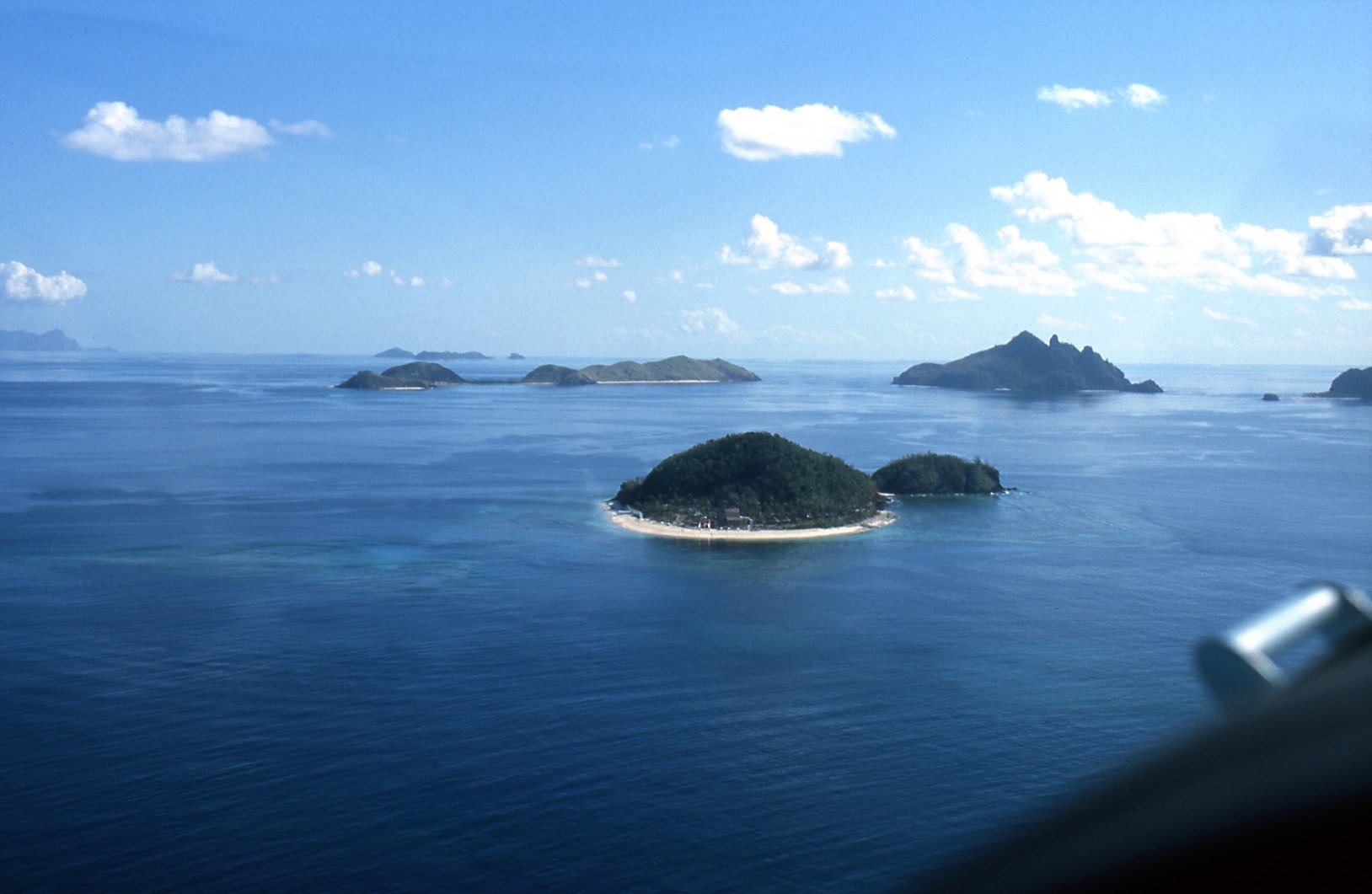
Fiji lies in the South Pacific, east of Vanuatu and west of Tonga. Viti Levu is the largest island: Suva, the capital, stands on its southeastern coast, while Nadi and Lautoka lie in the west. Vanua Levu is the second largest, with Labasa on its northern side and Savusavu on its southern coast. Taveuni lies just to its southeast; Kadavu is south of Viti Levu. Lomaiviti and Lau extend the archipelago eastwards, while Rotuma lies far to the north.
Volcanic mountains intercept moist trade winds, making southeastern slopes generally wetter than the western side of Viti Levu. Mount Tomanivi, about 1,324 metres high, is Fiji’s highest point. Four administrative divisions contain fourteen provinces; Rotuma is administered separately. These divisions are different from geographic island groups. The 180° meridian crosses the islands, but the international date line bends east around Fiji so the country keeps the same calendar date.
Voyagers, colonial rule and independence
Lapita settlement, Pacific connections and the long consequences of plantation labour.
- When did Fiji become independent?
- On 10 October 1970, after nearly a century of British colonial rule. Fiji had been ceded to Britain in 1874.
- Why is Levuka important in Fiji’s history?
- Levuka was a nineteenth-century trading port and Fiji’s first colonial capital. The capital moved to Suva in 1882.
- What was the girmit system?
- Girmit refers to the indenture agreements under which Indian workers were brought to Fiji from 1879 to 1916. Many worked on sugar plantations under harsh conditions.
More about Fiji: history
People settled Fiji about 3,000 years ago, leaving distinctive Lapita pottery. Their descendants developed societies connected by voyaging, trade, marriage and conflict with other Pacific communities. Fiji’s history includes close relationships with Tonga and Samoa as well as distinct island and chiefly traditions. During the nineteenth century, traders, missionaries and settlers became increasingly involved in local politics. Levuka on Ovalau became an important port before colonial rule.
Fiji was ceded to Britain in 1874. Between 1879 and 1916, British authorities brought indentured workers from India, many to work in the sugar industry. Their descendants are a central part of modern Fiji; later Indian migrants also contributed to Indo-Fijian communities. The colonial capital moved from Levuka to Suva in 1882. Fiji became independent on 10 October 1970. Coups in 1987, 2000 and 2006, and the constitutional changes around them, shaped debates over land, political representation and equal citizenship.
Bula, namaste and many island voices
English, iTaukei and Hindi in public life, alongside Rotuman and regional varieties.
- What does bula mean?
- Bula is a Fijian greeting associated with life and good health. People commonly use it to say hello or welcome someone.
- Is Fiji Hindi the same as standard Hindi?
- Fiji Hindi developed in Fiji from the speech of Indian migrants and has its own vocabulary and grammar. Standard Hindi is also used, especially in formal and religious settings.
- Is Rotuman a variety of Fijian?
- Rotuman is a distinct Pacific language with its own history. It is spoken on Rotuma and within Rotuman communities elsewhere.
More about Fiji: language
Fiji’s 2013 Constitution gives English, iTaukei and Hindi equal status. English is widely used in government, education and communication between communities. Standard Fijian, also called iTaukei, draws on the Bau variety, but speech differs between regions. Bula is a familiar greeting associated with life and good health; vinaka means thank you. In Fijian spelling, the letter c represents a sound like th in the English word this, while written b and d commonly include preceding nasal sounds.
Fiji Hindi developed among people brought from different parts of India and differs from standard Hindi. Standard Hindi has roles in education, religion and formal settings, while Fiji Hindi is widely spoken in everyday conversation. Rotuman is a distinct language associated with Rotuma and its communities elsewhere in Fiji and overseas. The linked lessons introduce everyday Fijian; they do not cover all the country’s languages or every regional variety.
Village welcome and a shared rugby stage
Yaqona, meke and masi coexist with many religious and family traditions.
- What is a sevusevu?
- A customary presentation and introduction when visiting a community, often with yaqona root. A local host can explain the appropriate practice for the place and occasion.
- What is a meke?
- A performance combining dance, song and storytelling. Its movements and music can preserve community histories and mark important occasions.
- Which sport brought Fiji its first Olympic gold medal?
- Rugby sevens. The men’s team won gold at Rio 2016, then repeated the achievement at the Tokyo Games.
More about Fiji: culture
A sevusevu is a customary presentation made when entering a community, often involving yaqona, or kava root. Yaqona is also the name of the drink prepared from the plant’s root and shared at ceremonies and social gatherings. Customs vary, so visitors should ask a local host about introductions, dress and permission. Meke brings together movement, singing and storytelling. Masi, decorated barkcloth, carries ceremonial meaning, while weaving, carving and canoe knowledge connect skills with particular places and families.
Fiji’s cultural life also includes Hindu, Muslim, Christian and other religious traditions. Diwali lights, temple gatherings, church services and family celebrations belong to different communities’ calendars. Rugby union, especially the seven-a-side game, has a broad following. Fiji’s men won the country’s first Olympic gold medal in rugby sevens at Rio in 2016 and won again at the Tokyo Games. Support for the teams reaches village grounds, urban neighbourhoods and communities overseas.
Tourism, sugar and a regional service centre
Visitor spending reaches far beyond hotels, while farming, fishing and remittances support households.
- What currency does Fiji use?
- The Fijian dollar, abbreviated FJD. It is issued by the Reserve Bank of Fiji and is a different currency from other countries’ dollars.
- Why is Nadi important to Fiji’s economy?
- Its international airport links Fiji with overseas markets and visitors. Tourism businesses and transport connections spread through western Viti Levu and the nearby islands.
- Does Fiji’s economy depend only on tourism?
- Tourism is important, but Fiji also has agriculture, fishing, manufacturing, public services and finance. Remittances from workers abroad support many families.
More about Fiji: economy
Tourism supports accommodation, aviation, boats, construction, food suppliers and guiding. Nadi is the main international air gateway, while nearby resorts and island connections make western Viti Levu an important visitor hub. Suva is a centre for government, finance, shipping, education and regional organisations. Fiji uses the Fijian dollar, abbreviated FJD; it is separate from the Australian and New Zealand dollars.
Sugar farming and milling helped shape the western and northern towns, and remain part of the economy alongside fishing, forestry, manufacturing and bottled-water exports. Many families also grow crops and fish for their own use or local markets. Money sent home by Fijians working abroad helps households meet expenses. Imported fuel, long transport links and exposure to cyclones create economic challenges. A shock to visitor arrivals can affect many businesses at once, as the pandemic demonstrated.
A parliamentary republic with a complex past
Elected government, a presidential head of state and the legacy of military intervention.
- Is Fiji a monarchy?
- Fiji is a republic. The president is head of state, and the prime minister heads the government. Fiji became a republic after the coups of 1987.
- Does Fiji have two houses of Parliament?
- The Parliament established by the 2013 Constitution has one chamber. Earlier constitutional arrangements included a Senate.
- Are Fiji’s divisions the same as its provinces?
- The four divisions are larger administrative groupings containing fourteen provinces. Rotuma is separately administered and has its own council.
More about Fiji: politics
Fiji is a republic with a president as head of state and a prime minister who leads the government. Parliament has one chamber. Under the 2013 Constitution, voters choose members through an open-list proportional system in a single national constituency. The president is elected by Parliament. Parliamentary government is different from the chiefly institutions that also matter in iTaukei society.
Coups and periods of military rule disrupted elected government after independence. The 1987 coups led to Fiji becoming a republic; a new constitution was adopted in 1997, and further crises followed in 2000 and 2006. Elections resumed under the 2013 constitutional framework in 2014. The Great Council of Chiefs has a customary and advisory role, separate from the elected Parliament. Understanding Fiji’s politics means considering both national institutions and debates about rights, land and representation.
Rainforest, reefs and species found nowhere else
Island isolation creates distinctive wildlife, while climate and invasive species put habitats under pressure.
- Does Fiji have native iguanas?
- Yes. Fiji has native iguanas, including crested and banded forms. Some species have very restricted habitats and need protection from introduced predators and land clearance.
- What is the tagimoucia?
- A climbing plant with striking red and white flowers, closely associated with Taveuni’s upland forests. It is a well-known symbol of the island.
- Why do mangroves matter in Fiji?
- They shelter young fish, store carbon and help protect shorelines. Healthy mangroves connect marine conservation with food security and coastal livelihoods.
More about Fiji: nature & wildlife
Fiji’s habitats include cloud forest, lowland rainforest, mangroves, seagrass and coral reefs. The crested iguana survives in a limited set of dry-forest island habitats. Taveuni is associated with the tagimoucia flower, a climbing plant with red and white flowers. Endemic birds include the orange fruit dove and the elusive Fiji petrel, whose conservation is closely associated with Gau. Fruit bats play important roles in spreading seeds and pollinating plants.
Reefs support food supplies and coastal livelihoods as well as tourism. Mangroves shelter young fish and help protect shorelines. Community-managed marine areas combine local decision-making with conservation work, although their rules vary by place. Introduced predators, habitat clearance, pollution and warming seas threaten wildlife. Tropical cyclones can damage both settlements and ecosystems; sea-level rise and coastal erosion affect where communities can safely live and grow food.
Lovo, kokoda, curry and roti
Root crops, coconut and seafood meet the traditions of Indo-Fijian kitchens.
- What is a lovo?
- An earth oven using heated stones, leaves and a covering that holds in heat. It can cook root crops, fish and meat for a shared meal.
- What is kokoda?
- A dish of fish prepared with citrus juice and coconut milk, often with chopped vegetables. It is one of Fiji’s best-known seafood dishes.
- What are dalo and rourou?
- Dalo is taro, whose corm is eaten as a starch. Rourou refers to a dish made with taro leaves, which must be cooked thoroughly.
More about Fiji: food & cuisine
A lovo is an earth oven in which heated stones cook food under a covering of leaves and soil. Fish, meat and root crops may be prepared together for a gathering. Dalo, or taro, cassava and breadfruit are common starches. Rourou uses taro leaves cooked thoroughly, often with coconut milk. Kokoda combines pieces of fish with citrus juice, coconut milk and other ingredients; citrus changes the fish’s texture but is not the same as cooking it with heat.
Indo-Fijian cooking adds curries, dhal, roti and chutneys to everyday meals. Recipes developed with locally available fish, vegetables, root crops and spices. Markets connect rural growers with town households, and a meal may draw on several traditions rather than belonging to just one. Yaqona is a social and ceremonial drink made from kava root; it is different from coconut water and is not an alcoholic drink.
A port town, sand dunes and forest trails
Levuka and Suva tell different histories, while island landscapes reveal older stories.
- Where is Fiji’s UNESCO-listed historical port town?
- Levuka is on the eastern coast of Ovalau, in the Lomaiviti group. The historical port town was inscribed on the World Heritage List in 2013.
- Where are the Sigatoka Sand Dunes?
- Near the mouth of the Sigatoka River on southwestern Viti Levu. They combine a coastal landscape with important archaeological evidence.
- Which island has the Tavoro waterfalls?
- Taveuni, southeast of Vanua Levu. The waterfalls are in the Bouma area on the island’s eastern side.
More about Fiji: landmarks
Levuka Historical Port Town on Ovalau became a UNESCO World Heritage site in 2013. Its waterfront and buildings record a nineteenth-century Pacific port where Indigenous communities, traders, missionaries and colonial authorities interacted. In Suva, the Fiji Museum holds archaeological and cultural collections beside Thurston Gardens. The city’s waterfront and public buildings reflect its later role as the national capital.
The Sigatoka Sand Dunes lie near the mouth of the Sigatoka River on Viti Levu, where shifting sands have revealed evidence of earlier settlement. Koroyanitu National Heritage Park offers forest and mountain landscapes near Lautoka, with Abaca village as a local starting point. Taveuni’s Bouma area is known for the Tavoro waterfalls. Near Nadi, the Sri Siva Subramaniya temple expresses another strand of Fiji’s heritage. Village visits, trails and religious sites have their own local arrangements and expectations.
Many communities, connected across the ocean
iTaukei, Indo-Fijian and Rotuman identities form part of a wider shared country.
- Who are iTaukei?
- The Indigenous people of Fiji. The term is also used for the Fijian language in official contexts, but language and personal identity are not interchangeable.
- Who are Indo-Fijians?
- Fijians of Indian ancestry, including descendants of workers brought under British indenture and of later migrants. Indo-Fijian communities have diverse religious and cultural traditions.
- Is Rotuma part of Fiji?
- Yes. Rotuma is part of Fiji and is administered separately from the four divisions. Rotuman communities maintain a distinct language and cultural heritage.
More about Fiji: people & society
iTaukei are Indigenous Fijians, with strong connections to customary land, kinship and particular villages. Indo-Fijians include descendants of indentured workers as well as later Indian migrants. Rotumans have distinct cultural and language traditions; Banaban communities on Rabi and communities with Chinese, European and other Pacific ancestry also belong to Fiji. Nationality, ancestry, language and religion describe different aspects of a person’s identity.
Urban life is concentrated around the Suva–Nausori corridor and western Viti Levu, but relationships with home islands and villages remain important. Churches, temples, mosques, schools and sporting clubs provide different centres of community life. Fijians living abroad maintain family ties through visits, remittances and shared events. Writers such as Satendra Nandan and athletes such as rugby player Waisale Serevi are among the people whose work has carried Fiji’s experiences to wider audiences.